LACMA

ShopMembershipMyLACMATickets
LACMA
Los Angeles County Museum of Art
5905 Wilshire Blvd.
Los Angeles, CA 90036
info@lacma.org
(323) 857-6000
Sign up to receive emails
Subscribe
© Museum Associates 2026
  • About LACMA
  • Jobs
  • Building LACMA
  • Host An Event
  • Unframed
  • Press
  • FAQs
  • Log in to MyLACMA
  • Privacy Policy
© Museum Associates 2026
Collections

Willem van de Velde II
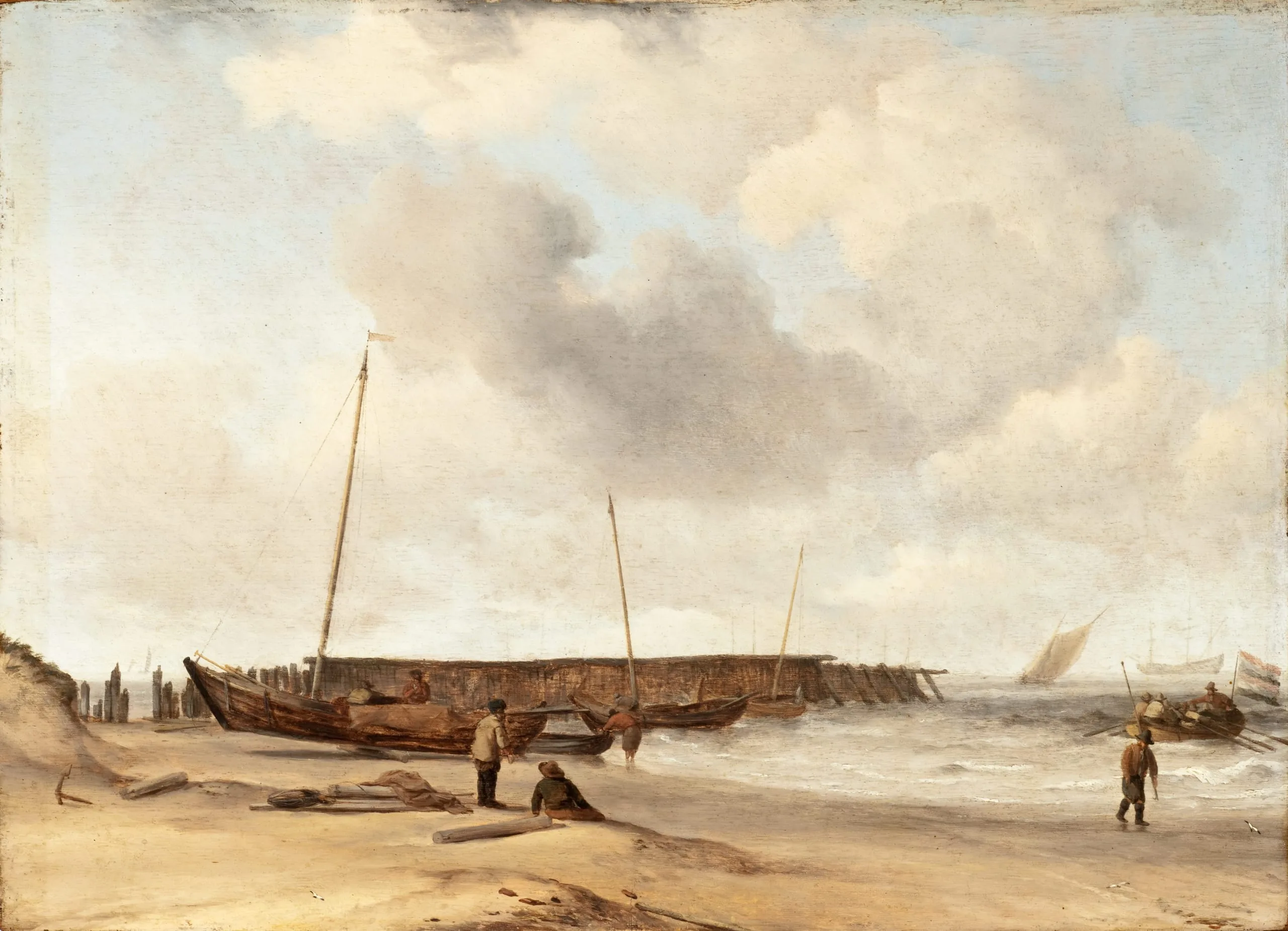
Beach with a Weyschuit Pulled up on Shorecirca 1673

On view:
Geffen Galleries
Oil painting of a beach with beached wooden boats along a low breakwater, several figures on the sand, and large clouds over a calm sea
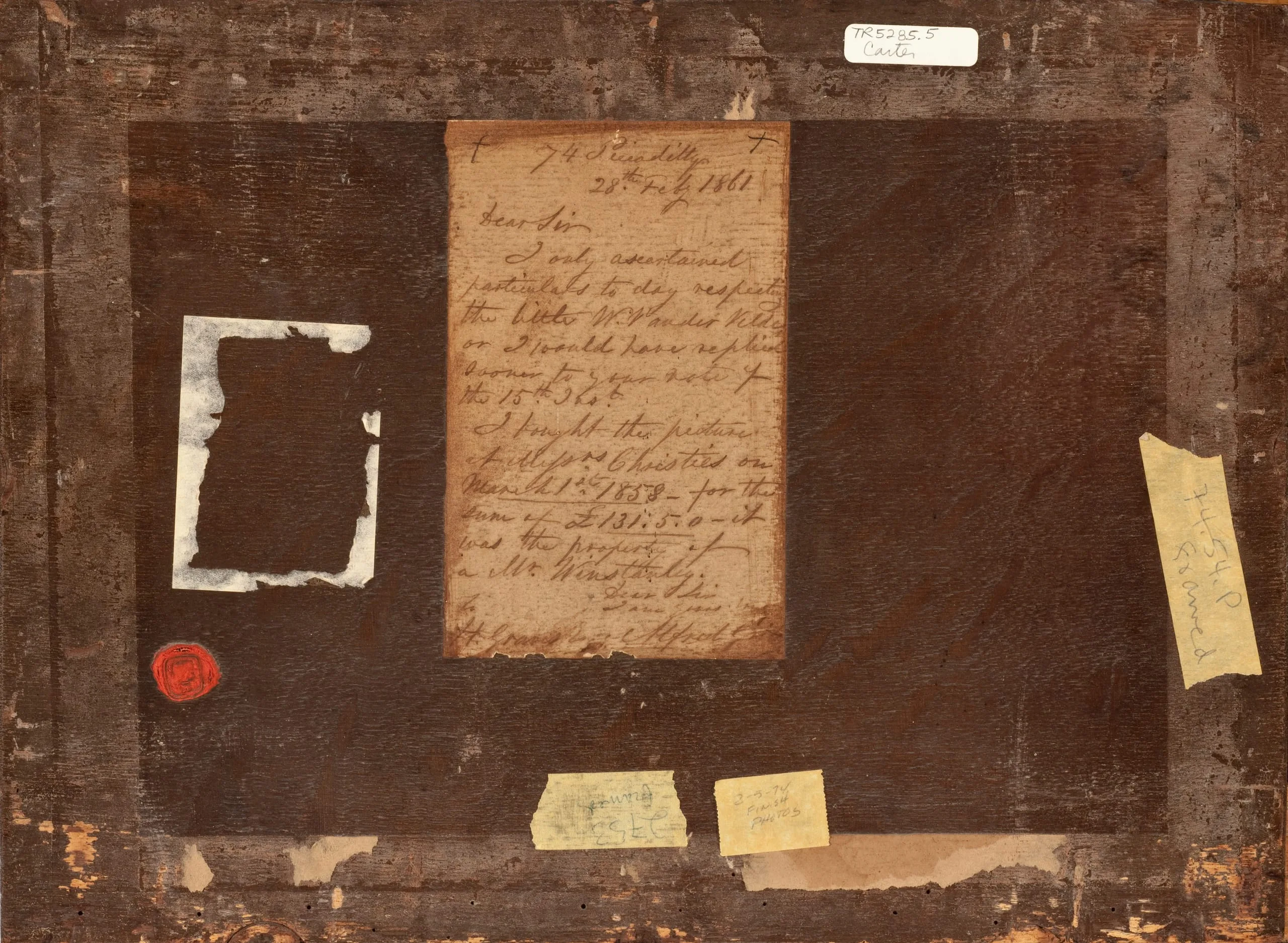
Reverse of a framed panel, showing a handwritten letter dated 1861 in brown ink on aged paper, affixed to a dark wooden backing, alongside a red wax seal, torn paper fragments, and small yellow paper labels.
Artist or Maker
Willem van de Velde II
Northern Netherlands, 1633-1707
Title
Beach with a Weyschuit Pulled up on Shore
Date Made
circa 1673
Medium
Oil on wood panel
Dimensions
Panel: 12 3/8 × 17 in. (31.43 × 43.18 cm) Framed: 19 1/2 × 23 1/2 × 2 1/2 in. (49.53 × 59.69 × 6.35 cm)
Credit Line
Gift of Mr. and Mrs. Edward William Carter
Accession Number
M.2009.106.16
Classification
Paintings
Collecting Area
European Painting and Sculpture
Curatorial Notes

During the seventeenth century, the proliferation of maritime imagery in the Dutch Republic reflected a national pride in the region’s seafaring capabilities. However, unlike many of Willem van de Velde’s pictures, this painting does not highlight monumental vessels designed for ocean navigation but shifts focus to the shoreline and its humble inhabitants. The location is the beach at Den Helder looking toward the island Texel. Small fishing boats, called weyschuit, are moored alongside a wood groin (or groyne), a structure built to trap sediment and disrupt water flow. One of these boats has been moved to the shore via wood rollers. At the right, a sloep, or small rowboat, moves toward the shore, its mast topped with a “double prince” ensign. This six-striped flag helps date the painting to after 1673, when Dutch naval officer Cornelis Tromp flew it on his flagship the Gouden Leeuw (Golden Lion), as depicted in a commemorative portrait at the National Maritime Museum, Greenwich.

Van de Velde based his composition on a drawing he made about eight years earlier, which he inscribed “voor de helder, woonsdach den 20 Mej 1665” (before Den Helder, Wednesday, May 20, 1665). The northernmost point of the Dutch mainland, Den Helder faced the Marsdiep, a marine channel deep enough for large Dutch shipping or wartime vessels to anchor and avoid rough weather conditions in the North Sea. In the painting, the lilting sails of the distant boats indicate heavy winds. It was likely personal reasons that brought the artist to Den Helder: his initial drawing was made around the time that his father, serving as a draftsman-reporter for the Dutch fleet, awaited departure for a military action against the English.

Provenance

Richard Winstanley (d. 1836), London, by 1835(1) (estate sale, London, Christie’s, 16 Mar. 1850, lot 57, sold for 189 guineas to); [Holloway].(2) Richard Winstanley,London (estate sale, London, Christie’s, 6 Mar. 1858, lot 33, sold for £131.5.0 to); [Alfred Gritten, London].(3) Major J. L. Curtis, Langford Hall, Newark, Nottinghamshire (sale, London, Christie’s, 9 July 1937, lot 95, sold for £378 to); [Horace Buttery, London]. [Thos. Agnew & Sons, London, sold 1962 to]; [P. de Boer, Amsterdam, sold 1962 to]; H. Becker, Dortmund, until at least 1967, sold through; [G. Cramer Oude Kunst, The Hague, to]; Mr. and Mrs. Edward William Carter, Los Angeles, given 2009 to; LACMA.

Footnotes

(1) According to Smith 1829–42, vol. 6 (1835), no. 150. M. Robinson 1990, says "probably" Winstanley. The identification of the Carter painting with that in the Winstanley auctions of 1850 and 1858 is confirmed by the annotation in the copy of the 1858 sale at the Getty Research Institute as well as by a label affixed to the back of the panel by Alfred Gritten. In the 1850 sale, Richard Winstanley is identified as "Esq." He may be related to Winstanley auctioneers who were active in Liverpool from at least 1803 to 1841.

(2) The painting was probably bought in. Holloway is listed as the buyer of seven of the ten paintings that reappear in the 1 April 1858 sale of paintings from the collection of Richard Winstanley.

(3) The name was previously identified as Alfred Grilten, undoubtedly a misreading of Michael S. Robinson’s handwritten note to Hannah Carter attached to a letter of 10 July 1976 (Van de Velde object file, Department of European Painting and Sculpture, LACMA). According to Robinson, who cited information from the London Post Office Directories, Alfred Gritten was an art dealer located at 74 Piccadilly, London, from 1859 to 1861. Robinson speculated that he was "one of the sons of Henry Gritten & Sons, picture dealers, who were at 9 King Street (almost next-door to Christie’s) from 1844 to 1858." A letter dated 28 February 1861 (Van de Velde object file, Department of European Painting and Sculpture, LACMA) addressed "Dear Sir" with the address 74 Piccadilly [London], confirms that the buyer was Alfred Gritten. The signature is broken but the letter appears to be signed "H. Graves [for?] Alfred Gritten."
Selected Bibliography
  • Walsh, Jr., John., and Cynthis P. Schneider. A Mirror of Nature: Dutch Paintings from the Collection of Mr. and Mrs. Edward William Carter (Second Edition). Los Angeles: Los Angeles County Museum of Art, 1992.

  • Walsh, Amy L. The Mr. and Mrs. Edward Carter Collection of Dutch Paintings. Los Angeles: Los Angeles County Museum of Art, 2019. https://archive.org/details/Carter_Collection_Dutch_Paintings (accessed May 23, 2022).