- Artist or Maker
- Pieter Claesz
Southern Netherlands, 1597/98-1660/61 - Title
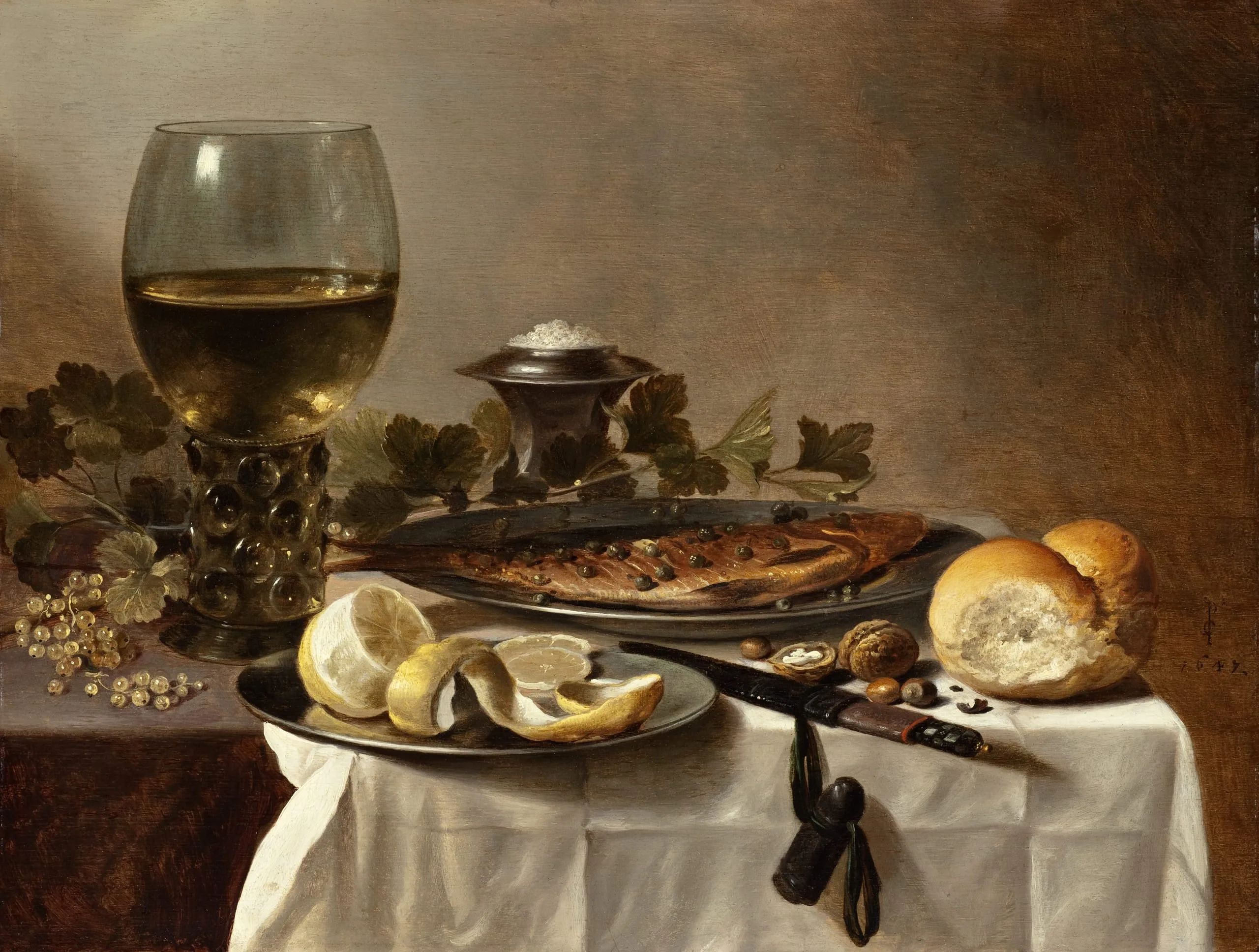
- Still Life with Herring, Wine and Bread
- Date Made
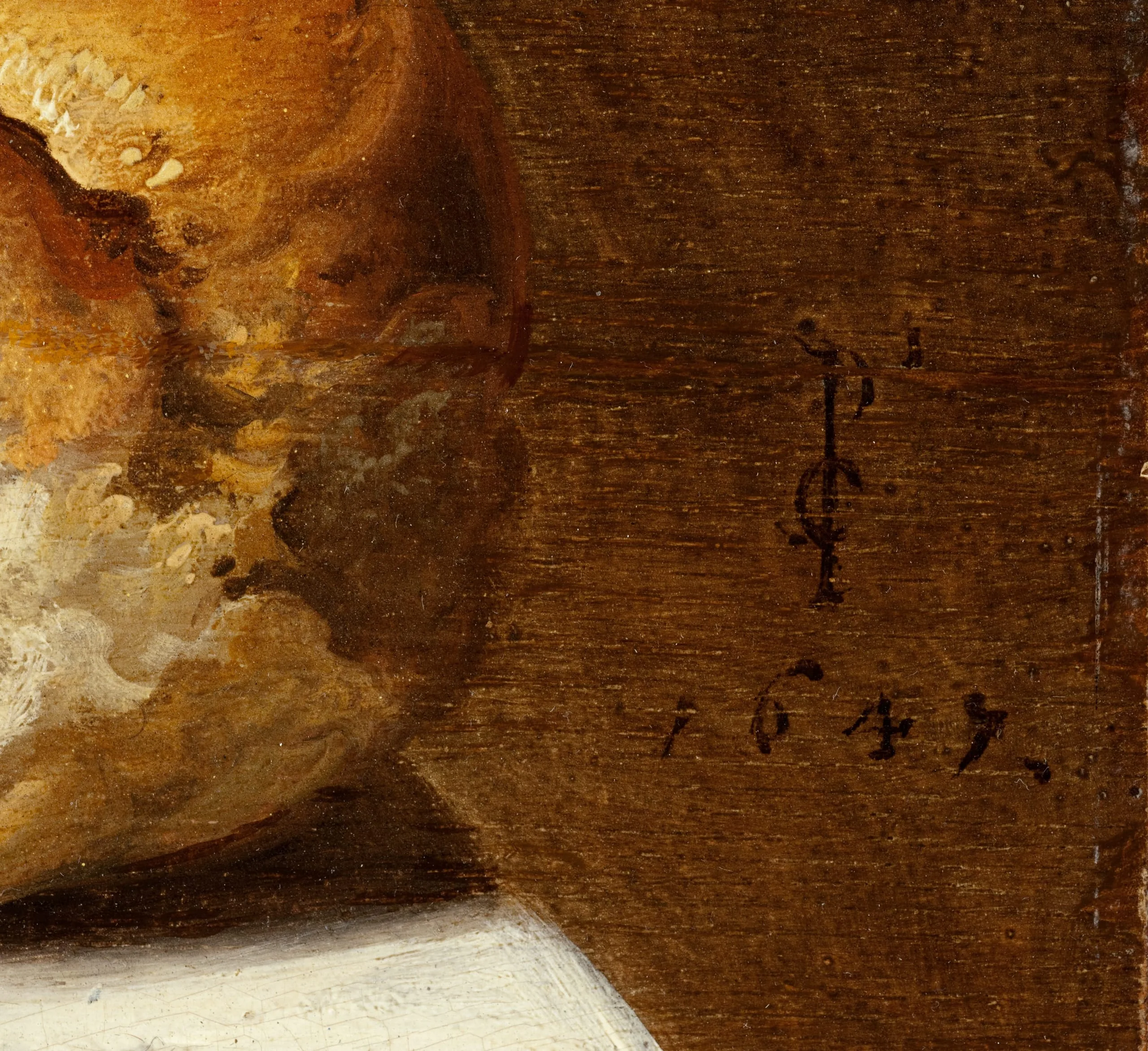
- 1647
- Medium
- Oil on wood panel
- Dimensions
- Panel: 17 1/2 × 23 1/4 in. (44.45 × 59.06 cm)
Framed: 27 1/2 × 33 × 2 in. (69.85 × 83.82 × 5.08 cm)
- Accession Number
- M.2009.106.19
- Curatorial Notes
Claesz’s ontbijt (“little breakfast”) still life assembles the ingredients of a delicious meal. A whole herring with capers rests on a pewter plate next to a fresh loaf of bread, nuts, and a knife. Another plate, precariously balanced at the table’s edge, holds a cut lemon and its curling peel. To the left, a grapevine weaves around a large glass of wine and a vessel filled with sparkling-white salt crystals. While these foodstuffs are complementary, individually they reveal different aspects of Dutch food production, both local and global. Herring, a product of the Netherlands’ lucrative North Sea fisheries, was a staple protein consumed by all classes. While the wealthiest members of Dutch society may have had orangeries or hothouses for cultivating citrus, the fruit was generally imported from southern Europe. The most coveted and impactful foodstuff depicted in Claesz’s tablescape is salt. Not just a delicious mineral used in cooking or cheesemaking, salt was an essential preservative of meats and produce, extending their shelflife to facilitate long-distance transport and commercial distribution. In the fifteenth century, the practice of extracting salt locally from peat ultimately caused dangerous flooding. The Dutch initially turned to other European powers for their supply, but political conflicts and rising prices motivated a search further afield. This insatiable quest for salt led to violent extractive practices utilizing enslaved labor in Africa and the Caribbean. Thus, a disturbing moment in Dutch culinary and economic history belies Claez’s seemingly quiet still life.
- Provenance
Private collection, the Netherlands. Anonymous (sale, Cologne, Lempertz, 1 June 1978, lot 37, ill.). [J. Hoogsteder, The Hague, sold 1980 to]; Mr. and Mrs. Edward William Carter, Los Angeles, given 2009 to; LACMA.
- Selected Bibliography
Walsh, Jr., John., and Cynthis P. Schneider. A Mirror of Nature: Dutch Paintings from the Collection of Mr. and Mrs. Edward William Carter (Second Edition). Los Angeles: Los Angeles County Museum of Art, 1992.
King, Jennifer, ed. Vera Lutter: Museum in the Camera. Los Angeles: Los Angeles County Museum of Art; Munich: DelMonico Books-Prestel, 2020.
- Walsh, Amy L. The Mr. and Mrs. Edward Carter Collection of Dutch Paintings. Los Angeles: Los Angeles County Museum of Art, 2019. https://archive.org/details/Carter_Collection_Dutch_Paintings (accessed May 23, 2022).