LACMA

ShopMembershipMyLACMATickets
LACMA
Los Angeles County Museum of Art
5905 Wilshire Blvd.
Los Angeles, CA 90036
info@lacma.org
(323) 857-6000
Sign up to receive emails
Subscribe
© Museum Associates 2026
  • About LACMA
  • Jobs
  • Building LACMA
  • Host An Event
  • Unframed
  • Press
  • FAQs
  • Log in to MyLACMA
  • Privacy Policy
© Museum Associates 2026
Collections

Salomon Jacobsz van Ruysdael
View of the River Lek and the Town of Vianen1668

On view:
Geffen Galleries
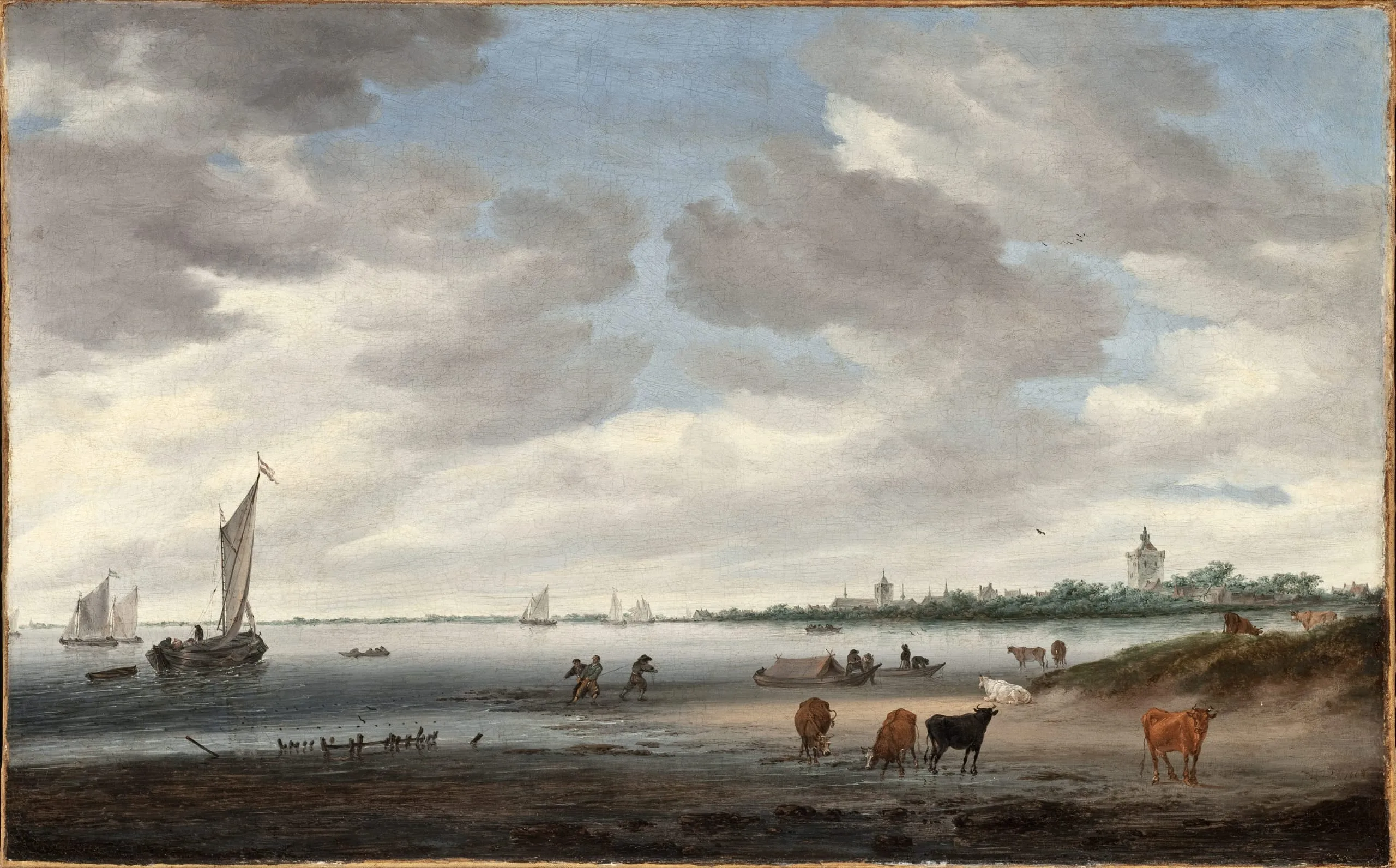
Oil painting of a wide river landscape with cattle on a sandy bank, fishing figures hauling nets, sailing vessels on the water, and a distant town under a cloudy sky
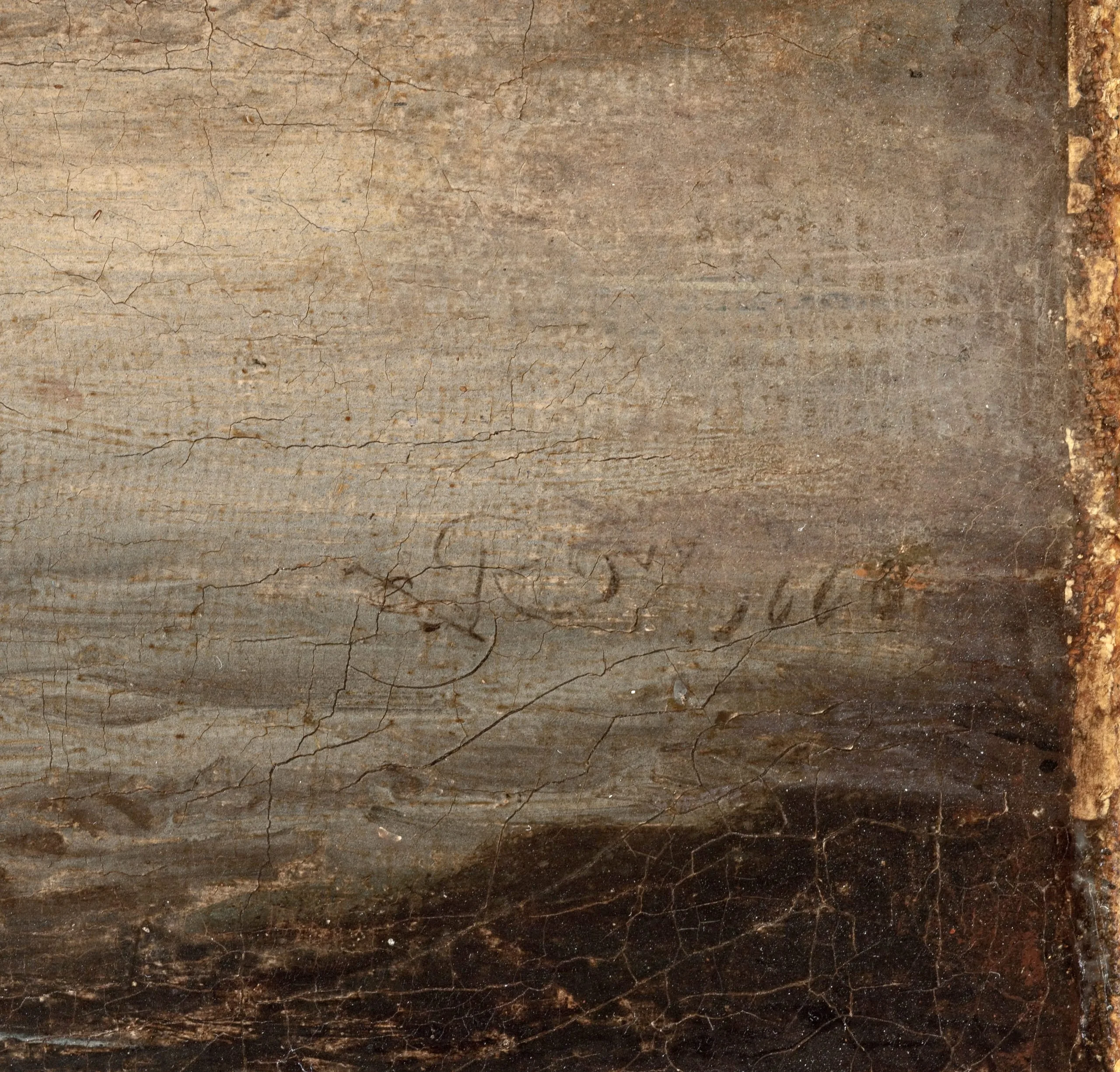
Close-up detail of an oil painting's lower corner, showing a muted grey-brown tonal ground with visible craquelure and a partially legible cursive signature in dark paint.
Artist or Maker
Salomon Jacobsz van Ruysdael
Northern Netherlands, circa 1602-1670
Title
View of the River Lek and the Town of Vianen
Date Made
1668
Medium
Oil on canvas
Dimensions
Canvas: 22 1/2 × 35 7/8 in. (57.15 × 91.12 cm) Framed: 32 × 45 1/2 × 3 in. (81.28 × 115.57 × 7.62 cm)
Credit Line
Gift of Mr. and Mrs. Edward William Carter
Accession Number
M.2009.106.21
Classification
Paintings
Collecting Area
European Painting and Sculpture
Curatorial Notes

Behind the calming blue tones, shoreline populated by livestock, and monumental cloudy sky, Salomon Jacobsz van Ruysdael’s riverscape engages with the economy and cultural life of its time. The town of Vianen lies in the distance, on the south side of the Lek River. The river was part of a system of waterways that linked the Rhine to Rotterdam and the ocean, thus making it a major artery for the transportation of goods across the eastern and northern European landmass. The area was a recreational destination for Utrechters, as Vianen was only about two hours away by canal. It was known for its fish—especially salmon—and historic buildings like Grote Kerk, a Gothic church at the center of town, and the Batestein Castle with its square Sint’Pol tower, which was the home of the landowning aristocratic Brederode family. Van Ruysdael’s scene not only commemorates major pillars of the Dutch economy, such as cattle, fishing, and water transport, but also highlights how modifications to the environment through the built infrastructure of canals, estuaries, and rivers fostered economic growth and encouraged travel by the local population.

Provenance

Sir William Drake (1817–1890), Weybridge, Surrey, by inheritance to his niece and adopted daughter; Ella Katharine (Mrs. Alfred) Hornsby-Drake (1846–1930), London (estate sale, London, Christie’s, 11 Mar. 1932, lot 88, ill., sold for £630 to); [Gooden & Fox, London, still in 1954]. [A. Brod, London, in 1955].(1) J. Lowenstein, London.(2) [Noortman & Brod, Maastricht, sold 1983 to]; Mr. and Mrs. Edward William Carter, Los Angeles, given 2009 to; LACMA.

Footnotes

(1) Possibly owned in shares with Gooden & Fox.

(2) Owner of painting cited by Stechow 1975, no. 473A, p. 142.
Selected Bibliography
  • Walsh, Jr., John., and Cynthis P. Schneider. A Mirror of Nature: Dutch Paintings from the Collection of Mr. and Mrs. Edward William Carter (Second Edition). Los Angeles: Los Angeles County Museum of Art, 1992.

  • King, Jennifer, ed. Vera Lutter: Museum in the Camera. Los Angeles: Los Angeles County Museum of Art; Munich: DelMonico Books-Prestel, 2020.

  • Walsh, Amy L. The Mr. and Mrs. Edward Carter Collection of Dutch Paintings. Los Angeles: Los Angeles County Museum of Art, 2019. https://archive.org/details/Carter_Collection_Dutch_Paintings (accessed May 23, 2022).