LACMA

ShopMembershipMyLACMATickets
LACMA
Los Angeles County Museum of Art
5905 Wilshire Blvd.
Los Angeles, CA 90036
info@lacma.org
(323) 857-6000
Sign up to receive emails
Subscribe
© Museum Associates 2026
  • About LACMA
  • Jobs
  • Building LACMA
  • Host An Event
  • Unframed
  • Press
  • FAQs
  • Log in to MyLACMA
  • Privacy Policy
© Museum Associates 2026
Collections

Salomon Jacobsz van Ruysdael
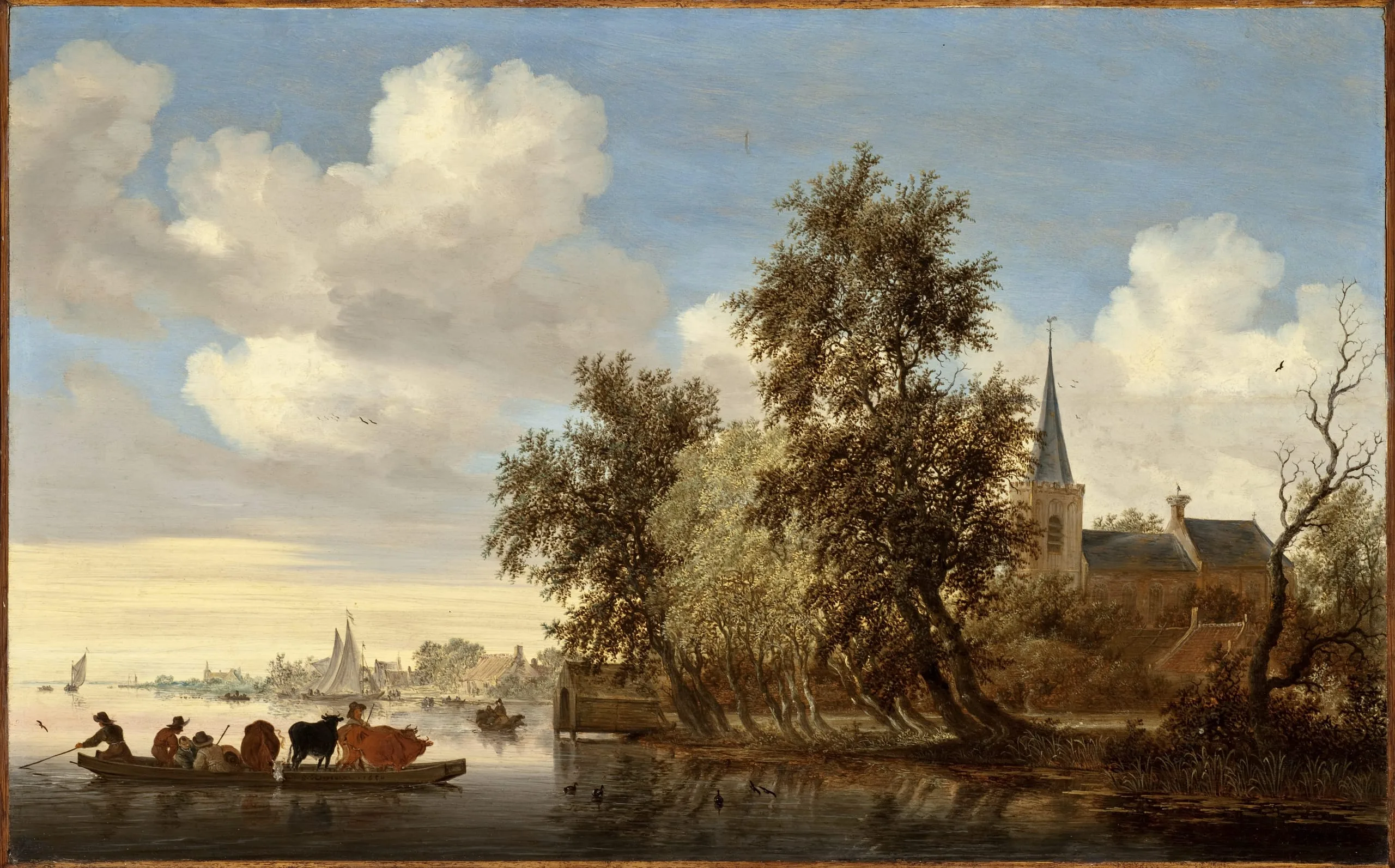
River Landscape with a Ferry1650

On view:
Geffen Galleries
Oil painting landscape of a river ferry carrying passengers and a cow, with tall trees, a brick church with a steeple, and sailboats receding into a hazy distance
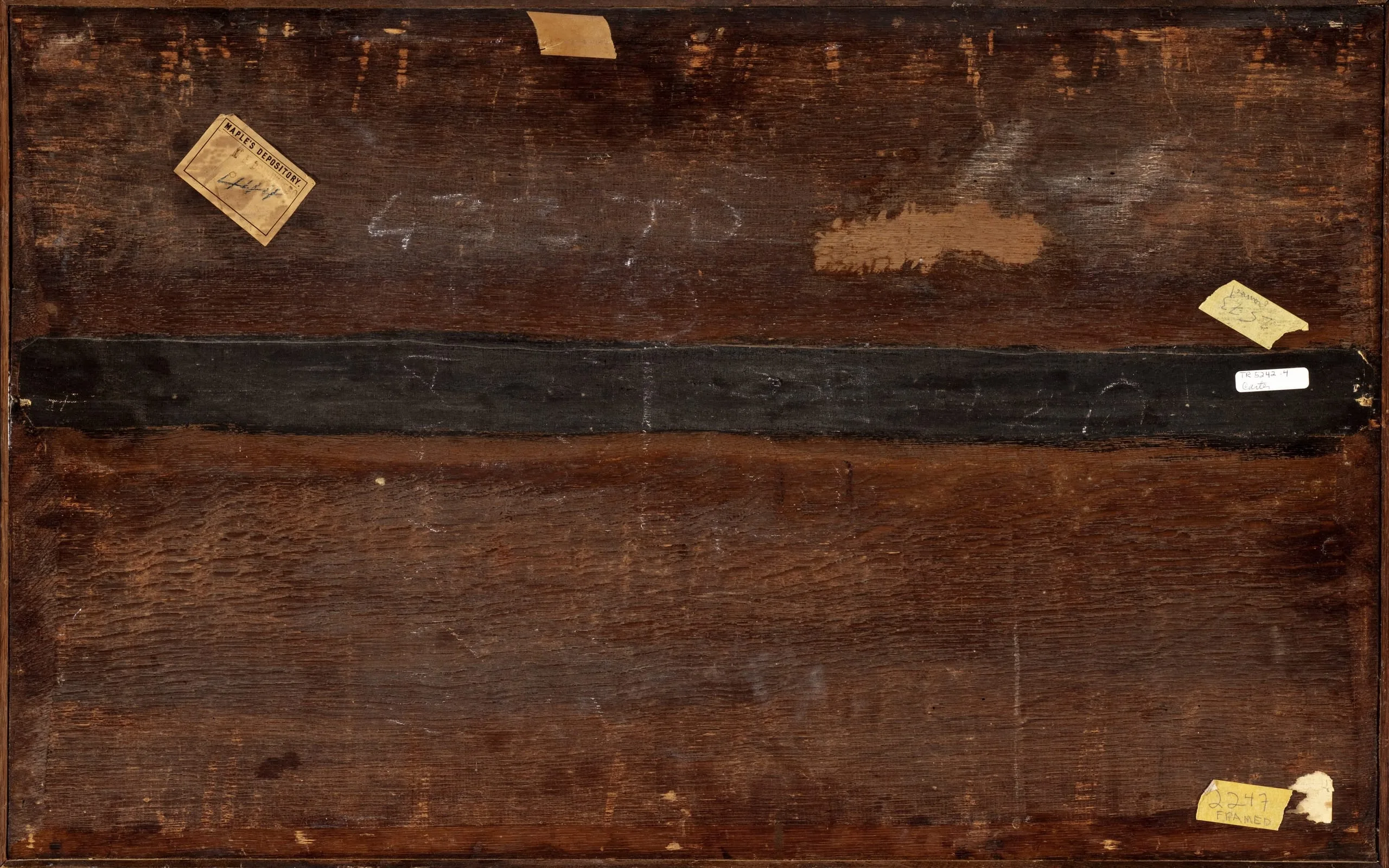
Reverse of a wooden panel with dark brown grain, a horizontal black crossbar, several aged paper labels with printed and handwritten text, chalk markings, and a white museum accession label.
Artist or Maker
Salomon Jacobsz van Ruysdael
Northern Netherlands, circa 1602-1670
Title
River Landscape with a Ferry
Date Made
1650
Medium
Oil on wood panel
Dimensions
Panel: 20 1/2 × 32 3/4 in. (52.07 × 83.26 cm) Framed: 32 × 42 × 3 in. (81.28 × 106.68 × 7.62 cm)
Credit Line
Gift of Mr. and Mrs. Edward William Carter
Accession Number
M.2009.106.13
Classification
Paintings
Collecting Area
European Painting and Sculpture
Curatorial Notes

A ferryboat, positioned below the horizon line, yields to an expansive scene animated by bustling people and animals. Salomon van Ruysdael, the uncle of the renowned Dutch landscapist Jacob van Ruisdael (M.91.164.1), began depicting riverscapes in 1631, and through the next three decades produced numerous paintings that share similar compositional devices. For instance, the ferryboat—loaded with cattle and passengers and gliding across a smooth surface of water—became a central motif in his oeuvre. Here, silhouetted against the sunlit river, the ferry contributes to a balanced composition that evokes a feeling of quiet serenity. These flat-bottomed boats, common in the Netherlands during the seventeenth century, played a crucial role in a sophisticated transportation system linking Dutch cities via roads and inland waterways, both rivers and canals. The waterways provided an economical and efficient means of transport, intimately binding Dutch civilization to the water.

The exact location of this site remains unknown, possibly because the scene is a product of the artist’s imagination. An unidentified church nestles behind sizable trees that cling to the shore of the river. As depicted, churches were often built at the river’s edge, especially in towns near the dikes. Yet the same church—or one that bears its likeness—reappears on a larger scale in a later painting by the artist (1663), situated in an open plain and running parallel to the river. This difference in placement suggests that van Ruysdael was not referencing a specific locale but rather crafting an imaginary riverscape using natural and man-made elements typical to the Netherlands.

2024

Provenance
Mrs. M. F. Brandt (estate sale, London, Sotheby’s, 16 Nov. 1955, lot 41, sold for £10,800 to); [Leonard Koetser Gallery, London, still in 1965]; A. E. Allnatt (sale, London, Sotheby’s, 6 Dec. 1972, lot 32, sold for £89,000 to); [Edward Speelman, Ltd., London, sold 1973 to]; Mr. and Mrs. Edward William Carter, Los Angeles, given 2009 to; LACMA.
Selected Bibliography
  • Walsh, Jr., John., and Cynthis P. Schneider. A Mirror of Nature: Dutch Paintings from the Collection of Mr. and Mrs. Edward William Carter (Second Edition). Los Angeles: Los Angeles County Museum of Art, 1992.

  • Walsh, Amy L. The Mr. and Mrs. Edward Carter Collection of Dutch Paintings. Los Angeles: Los Angeles County Museum of Art, 2019. https://archive.org/details/Carter_Collection_Dutch_Paintings (accessed May 23, 2022).