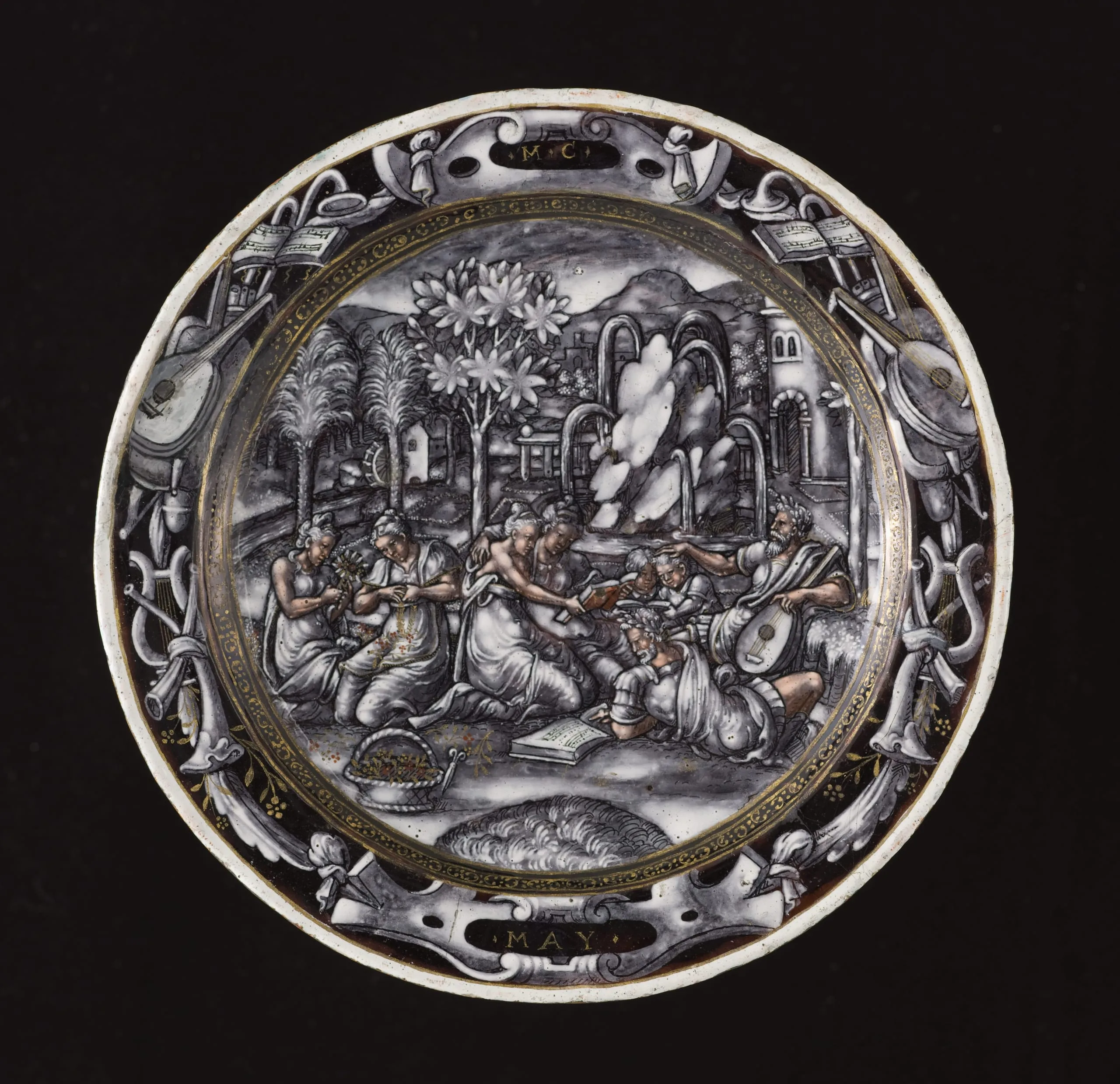
This plate belongs to the only known complete set of calendar plates by Martial Courtesy, a second-generation enameler and son of Pierre Courteys. Calendar plates depict the Labors of the Months, each month featuring an associated rural activity such as warming by the fire in February or harvesting wheat in July. May, here represented by music making, is often seen as a time of leisure. During the medieval and Renaissance periods, the Labors of the Months were often illustrated in church sculpture and religious manuscripts, with specific labors dictated by local customs. The popularity of this motif highlights the importance of seasonality in how premodern societies understood time.
Courteys was best known for grisaille enamels, named for the shades of gray that characterize the style. To produce grisaille enamels, the artist fused black or blue powdered glass to a metallic mount. The artist then added a layer of white glass before using a needlelike tool to remove, or lift (enlevage), sections of the unfired white layer from the dark ground to produce a range of gray tones. Enamelers also sometimes applied pinkish red enamel for flesh tones, as well as other colors and gold sparingly.
Like most other Limoges enamelers, Courteys derived his imagery from circulating prints and book illustrations. He took the figures on his series of calendar plates from engravings by Étienne Delaune. All but the January plate incorporate the artist’s initials, M.C., within a cartouche at the top and the name of the month at the bottom, while the underside of each plate is painted with the appropriate zodiacal sign.
William Randolph Hearst acquired this series of plates along with a number of other Limoges enamels from the J. P. Morgan collection and Italian maiolica from the Morgan and Adolphe de Rothschild collections. The plates still bear Morgan’s red catalogue numbers. Art dealer Joseph Duveen’s client account book records the sale of these plates and other enamels between 1915 and 1919, the same years he was selling the majority of Morgan’s Limoges enamels to Henry Clay Frick.
Cynthia Kok
2025 (adapted from Thomas Michie in Hearst the Collector, 190)