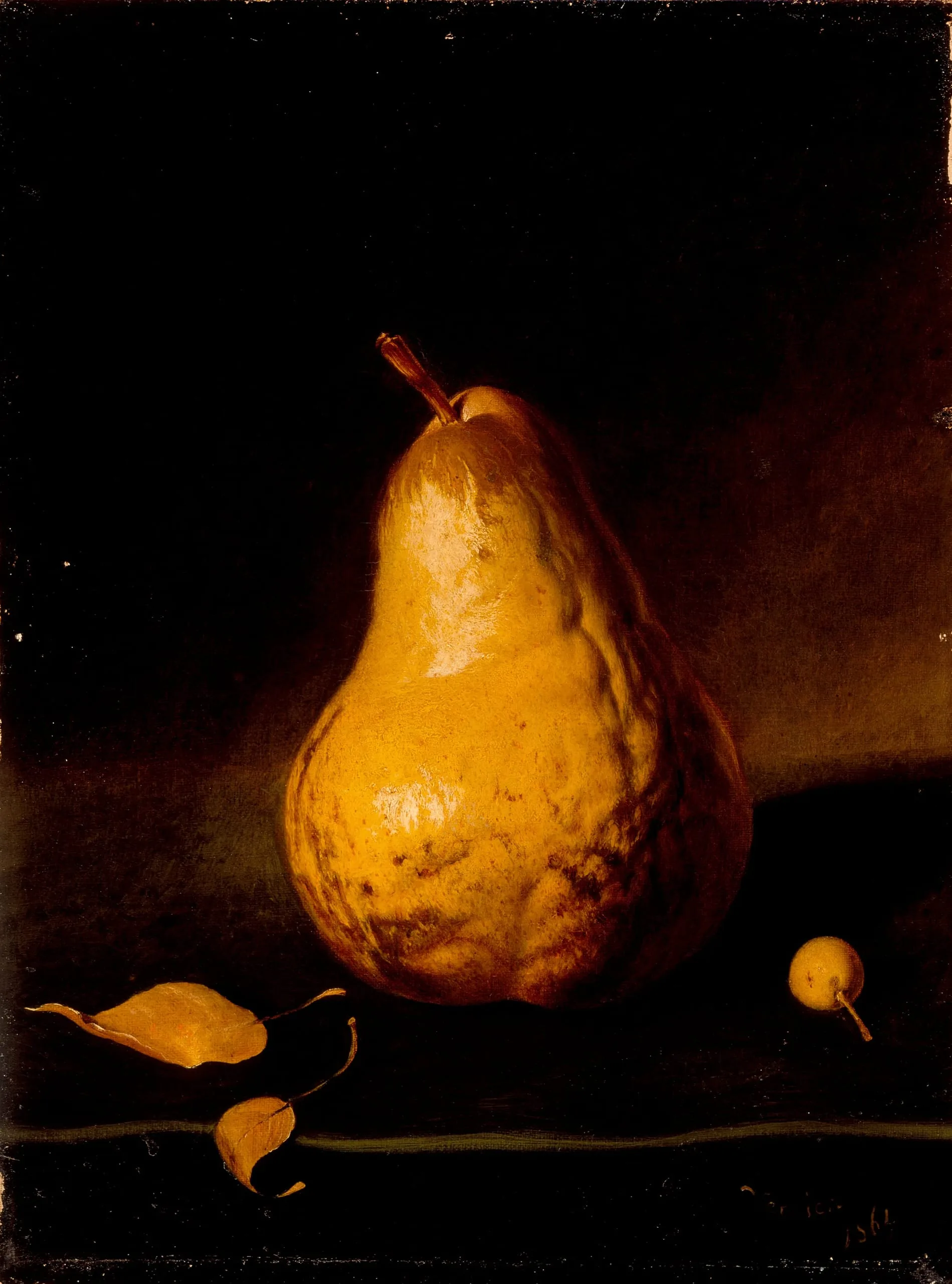
In its March 1863 issue, the American Agriculturist announced with excitement the arrival in New York of a “pomological monster.” “The Great California Pear” as the publication called it in its headline, weighed 3 pounds 7 ounces. A contact in California had carefully packed the specimen, which was grown at the San Jose Mission, and sent it across the continent via Wells, Fargo & Co. The journal exhibited the pear, claiming that thousands of people viewed it. Before it rotted completely, a life-size engraving and wax model painted “so truthfully that many were in doubt which was the original” preserved a sense of the size and appearance of the fruit. The wax version remained on display after the original pear had perished. A couple of years later, other newspapers reported that a “four-pound pear” from the California region was exhibited in 1865 at the new museum in the Department of Agriculture in Washington, D.C. Research has yet to establish whether this was the same model as the wax version mentioned in the American Agriculturist.
Wesley Vernier’s painting, dated 1864, appears in the midst of these agricultural wonders. While Vernier indicated that he was depicting “The Great California Pear” in a notation on the back of the canvas, other parts of his text, such as the name of the grower, “Charles Nova,” and the location, “Los Angelos [sic],” do not on their face correspond to names and locations in the American Agriculturist story. Vernier also identified the pear in the painting as a “Duchesse d’Angouleme” variety that weighed “4 lbs.,” but a Fruit Growers’ committee in New York could not identify the variety of the American Agriculturist’s pear in 1863, and that pear weighed well below a full four pounds. Nevertheless, the work stands as a record of modern horticultural achievement, and still lifes of specific agricultural products were common in the nineteenth century. Vernier’s dramatic lighting and botanically accurate rendering of the pear skin, stem, and leaves, however, are unusual among American still lifes of the period.
Though research has not yet uncovered additional information that would help illuminate the circumstances behind the inscriptions on Vernier’s painting or associate his pear definitively with either the “pomological monster” or the Department of Agriculture’s museum collection, large pears grown in California undoubtedly drew national attention and even traveled around the country. The state’s role in generating wonder and a sense of abundance echoes long-standing settler narratives about the bounty of North America and the motivations for expansion and resource extraction. Moreover, California was perceived as a garden paradise, and the pear’s size demonstrated the richness of the land. In the late 1870s, when the railroad linking the East and Southern California was completed, railroad companies issued posters extolling the fecundity of the land; one lithograph, depicting an array of fruit, referred to California as the “cornucopia of the world.” Vernier’s painting is one example of the reproduction and circulation of the promises of prosperity that drew so many to the West Coast.
Selected Bibliography
Fort, Ilene Susan, and Michael Quick. American Art: A Catalogue of the Los Angeles County Museum of Art Collection. Los Angeles County Museum of Art, 1991.
Gerdts, William H. Painters of the Humble Truth: Masterpieces of American Still Life, 1801−1939. University of Missouri Press and Philbrook Art Center, 1981.
“The Great California Pear.” American Agriculturist, for the Farm, Garden, and Household 12, no. 7 (March 1863).
Selected Exhibition History
California Landscape: Then and Now, La Jolla Museum of Art, June 13−July 13, 1969.
American Cornucopia: 19th Century Still Lifes and Studies, The Hunt Institute for Botanical Documentation, Carnegie-Mellon University, Pittsburgh, April−July 1976.
EATLACMA, LACMA, June−November 2010.