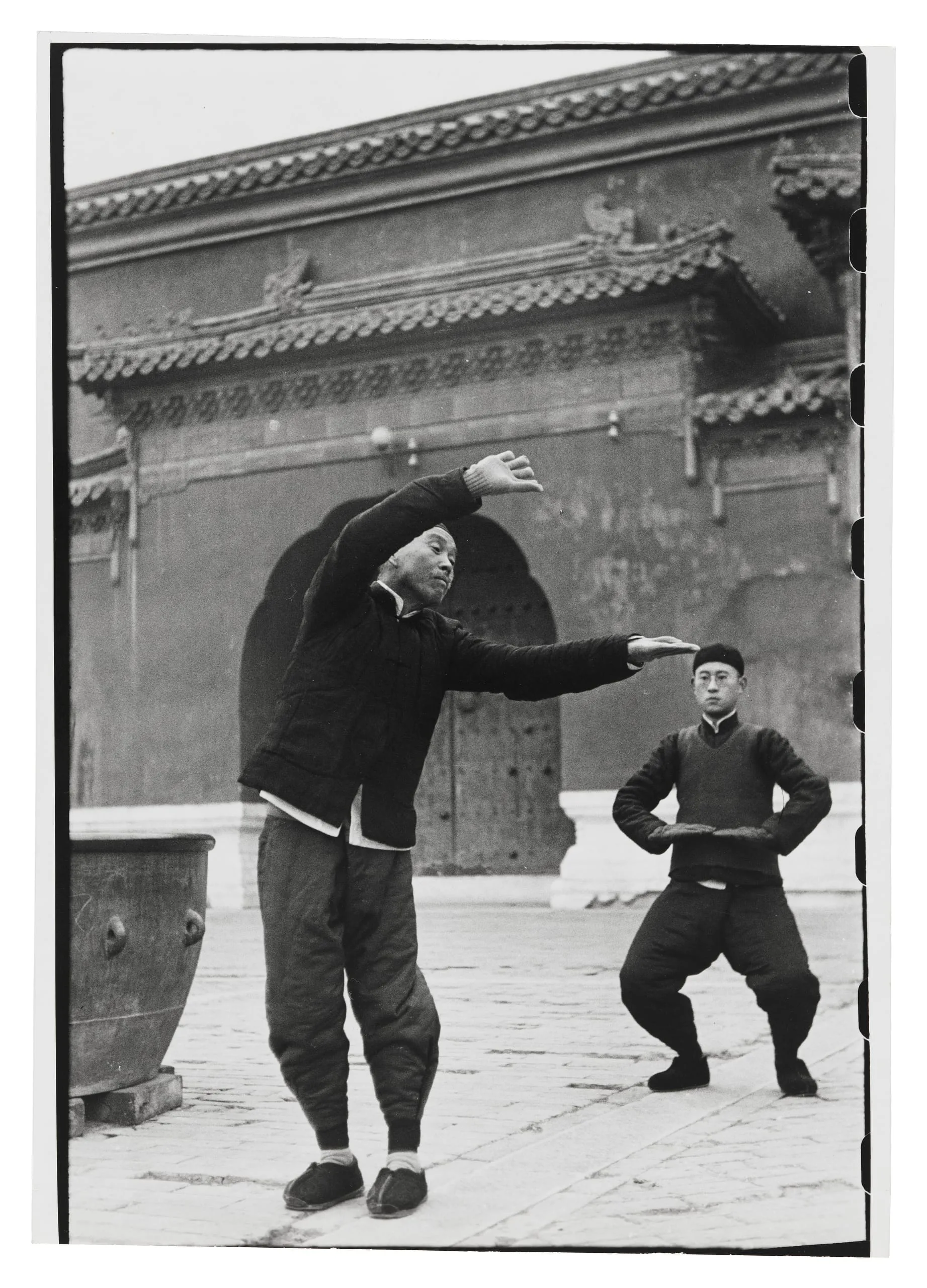
On November 25, 1948, French artist Henri Cartier-Bresson received a telegram from Magnum, the photographic cooperative he cofounded in 1947, asking him to go to China to work on a story for Life magazine titled “The Last Time We Saw Peiping.” He arrived in Beijing just as the Kuomintang was falling and stayed for twelve days until the People’s Liberation Army forced him to move on. For ten months, between December 1, 1948, and September 23, 1949, he documented the retreat of Nationalist forces and the establishment of communism throughout the country, shooting nearly 900 photographs. Dozens of these images were published in Life as well as Illustrated (London) and Regards (Paris), in some forty photo-essays. He returned to China a decade later, in 1958, staying for four months, between June 16 and October 23. This trip was meticulously arranged by his Chinese hosts and yielded 376 rolls of film. The photographs from both trips have been compiled into three books: From One China to Another (1956), China: As Photographed by Henri Cartier-Bresson (1964), and Henri Cartier-Bresson: China 1948−1949, 1958 (2019).
The directive from Life was to concentrate on scenes that revealed “Chinese culture and character, the human angle of the city.” Cartier-Bresson made handwritten notes about each roll of film, which he then turned into captions. This photograph is accompanied by a lengthy text:
Close to the Imperial palace in the gardens of Tai Miao (temple of the Imperial ancestors) every morning from dawn or even before, for some hours men come to do Chinese gymnastics and sword exercises. These movements have a physical as well as moral purpose of controlling the body and the mind. A teacher was teaching his pupils, one was a Major, another one was a curator of a museum, another one an employee at the Shell Co., others were small clerks . . . The movements were developing slowly unwinding each other, implicating the whole body, even more: all the angles of the body as in a sculpture, and this with an enclosed strength hidden and always controlled. [026] A second professor . . . was exposing a fast style while his pupils were doing some modulations. All of them meet every day to do gymnastic [sic] for two hours before going to office. [027]
Cartier-Bresson often used the term “the decisive moment” to describe that fraction of a second when the precise organization of forms and the significance of an event converge in the camera. The images made in China reveal his efforts to capture the interconnected worlds of cultural events, political figures, Maoist propaganda campaigns, ordinary people, and landscapes. His work in China during this turbulent time was critical for his career and established him as a pioneer of photojournalism.
Rebecca Morse, Curator, Wallis Annenberg Photography Department
2025