- Title
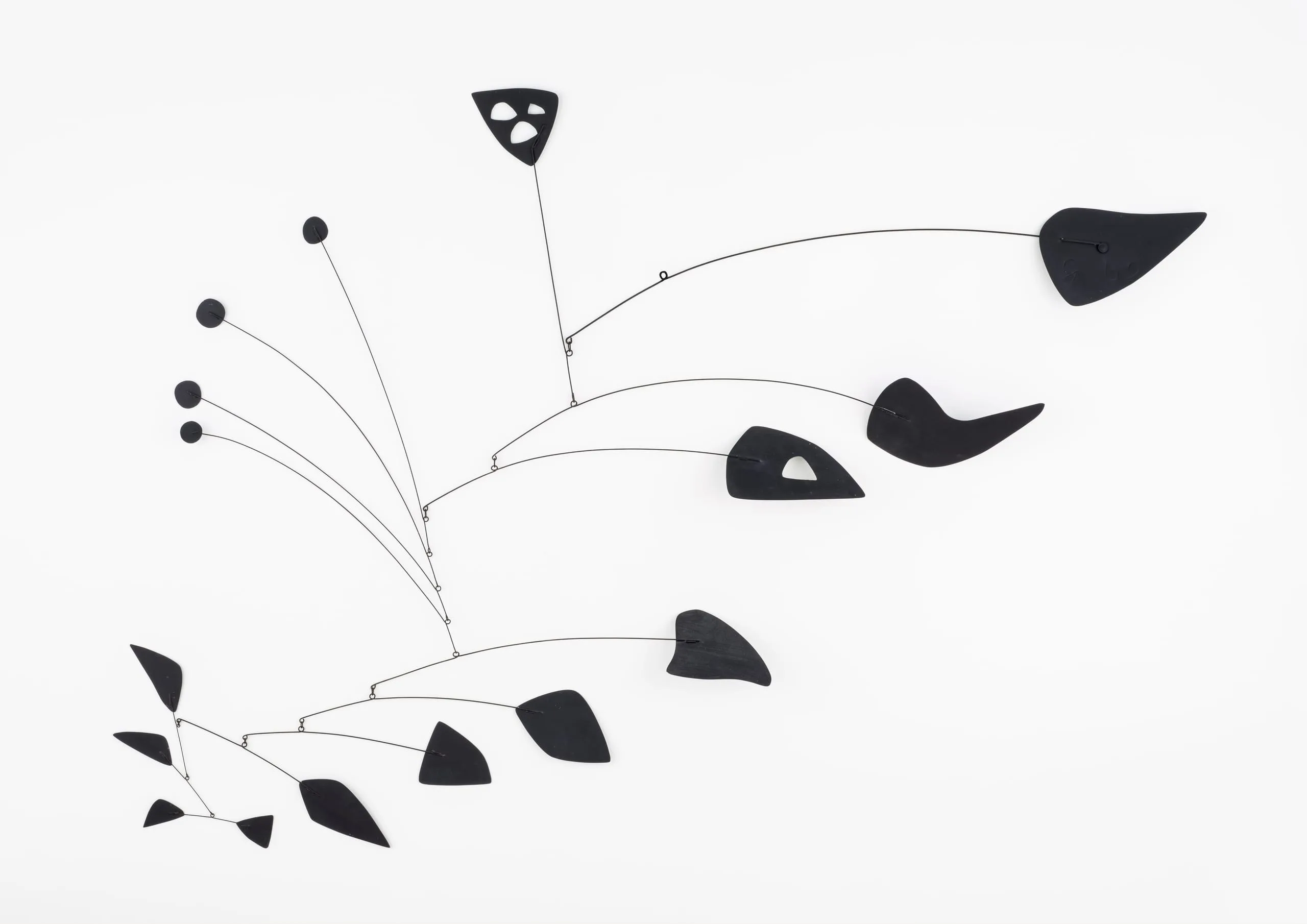
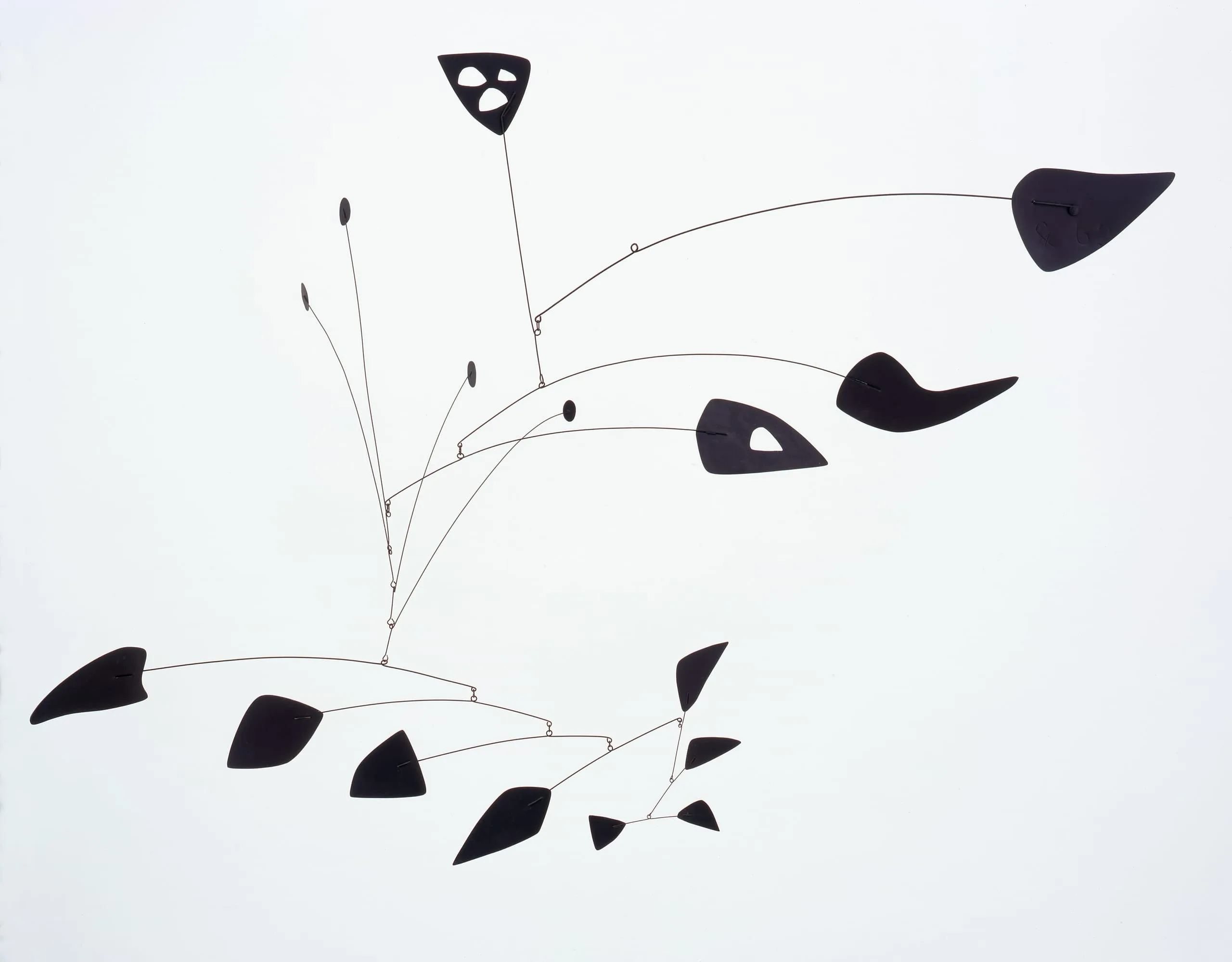
- Little Face
- Date Made
- 1962
- Medium
- Sheet metal, wire, paint
- Dimensions
- 42 x 56 in. (106.68 x 142.24 cm)
- Accession Number
- M.2011.139
- Curatorial Notes
In the early 1930s, Calder began work on a series of innovative sculptures with a kinetic dimension. When they were first showed at the Galerie Vignon in Paris, Marcel Duchamp baptized them “mobiles” because in French the word alludes to both movement and motivation. The very first mobiles were motorized, but by 1933, Calder had abandoned that idea and allowed his counter-weighted construction to move naturally with the changing atmosphere around them. Critics linked these works to the artist’s interest in early astronomical models and mechanical toys. However, the artist himself spoke about these sculptures in relationship to abstract painting, saying that his mobiles were an abstract representation of the ability of living things to react. This concept manifested his critique that the art of his day had become too static in form to reflect the essential place of movement in the modern world. Mobility had always been a central tenet in Calder’s work from the early circus figures he used in performances, to his wire and bronze sculptures and even his later “stabiles” sculpture – which implied movement by default.
Produced in 1962, Little Face is an outstanding example of Calder’s mobiles. It balances whimsy with expert craftsmanship and a dramatic composition. Through its organic, playful forms, it reveals Joan Miró’s close friendship and influence. (Stephanie Barron, Senior Curator, Modern Art)
- Provenance
The artist (1898-1976). [Palais Galerie, Paris]; [Berggruen & Cie., Paris]; [Frank Perls Gallery, Los Angeles]; sold in 1963 to Joseph (1904-2004) and Ann (1925-2019) Koepfli; given in 2011 to LACMA.
- Selected Bibliography
- Barron, Stephanie, and Lisa Mark, eds. Calder and Abstraction: From Avant-Garde to Iconic. Los Angeles: Los Angeles County Museum of Art and DelMonico Books/Prestel, 2013.
- Copyright
- © [year] Calder Foundation, New York / Artists Rights Society (ARS), New York. Calder® is a registered trademark of Calder Foundation, New York.