LACMA

ShopMembershipMyLACMATickets
LACMA
Los Angeles County Museum of Art
5905 Wilshire Blvd.
Los Angeles, CA 90036
info@lacma.org
(323) 857-6000
Sign up to receive emails
Subscribe
© Museum Associates 2025

Museum Hours

Monday

11 am–6 pm

Tuesday

11 am–6 pm

Wednesday

Closed

Thursday

11 am–6 pm

Friday

11 am–8 pm

Saturday

10 am–7 pm

Sunday

10 am–7 pm


  • About LACMA
  • Jobs
  • Building LACMA
  • Host An Event
  • Unframed
  • Press
  • FAQs
  • Log in to MyLACMA
  • Privacy Policy
© Museum Associates 2025
Collections

Jacques Bellange
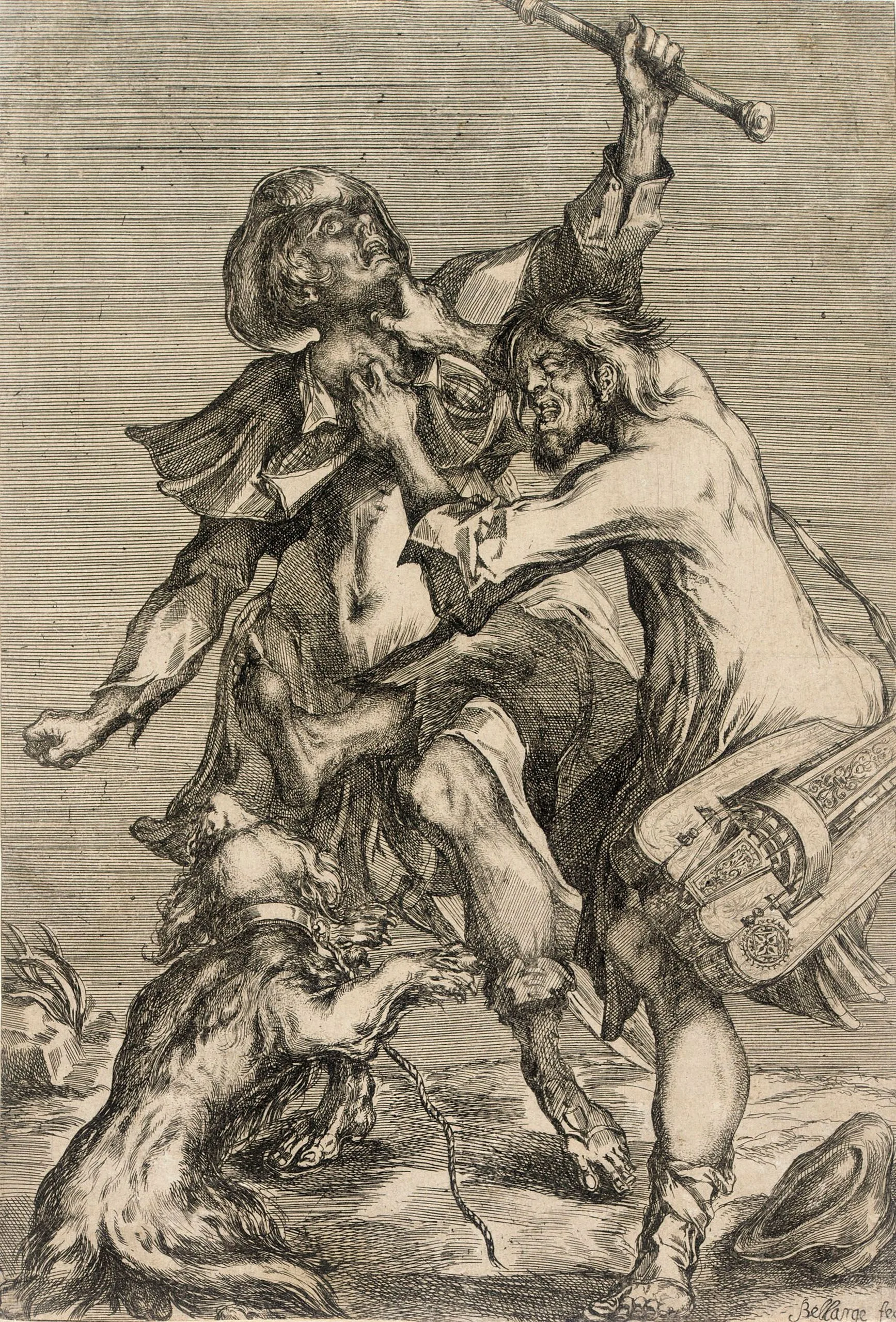
Hurdy-Gurdy Player Attacking a Pilgrimcirca 1614

Not on view
Engraving of two men in violent struggle, one nearly nude wielding a club overhead, the other in a cloak with head thrown back, a chained dog biting at his leg
Artist or Maker
Jacques Bellange
Title
Hurdy-Gurdy Player Attacking a Pilgrim
Date Made
circa 1614
Medium
Etching and engraving with drypoint
Dimensions
Sheet: 12 1/4 × 8 3/8 in. (31.12 × 21.27 cm) Image: 12 1/4 × 8 3/8 in. (31.12 × 21.27 cm)
Credit Line
Purchased with funds provided by the Joseph B. Gould Foundation
Accession Number
M.2009.36
Classification
Prints
Collecting Area
Prints and Drawings
Curatorial Notes
Jacques Bellange is one of the greatest etchers in the history of printmaking. His idiosyncratic style, made up of equal parts mannerism and baroque passed through the distorting lens of a vernacular eccentricity formed outside the mainstream of art making, weds the beautiful to the ugly with a line both sinuous and sculptural, sensual and crisp. Hurdy-Gurdy Player Attacking a Pilgrim is one of Bellange's signature works, perhaps his most famous and recognizable, and an iconic image of the French Baroque. In it, the genre subject of fighting beggars is transformed into a bizarre battle between a pilgrim (recognizable by the cockle shell of Saint James on his hat) and an itinerant hurdy-gurdy player, the latter grabbing feverishly at the pilgrim's hideous goiter. The tawdriness of the subject is contradicted by the artist's elegant and courtly style, in which fluid drapery clings to soft flesh, and expressive line simultaneously defines form and emphasizes surface.
(Kevin Salatino, Curator of Prints and Drawings - February, 2009)