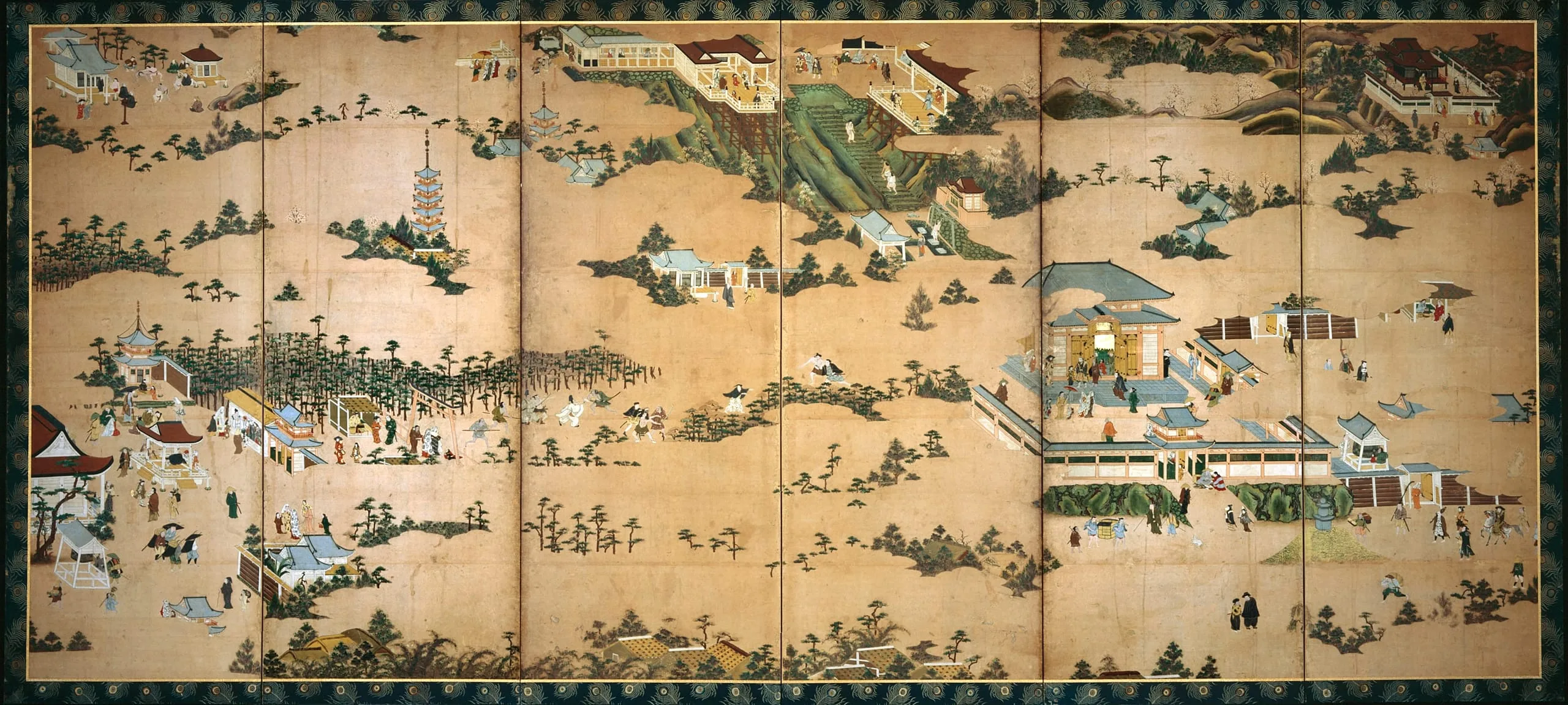
Panoramic views of Kyoto, the capital of Japan from 792 to 1868, were first painted on folding screens in the sixteenth century. Called Rakuchu rakugaizu(literally, "views in and around the capital"), the screens often depict genre scenes such as storytelling, the selling of food, the serving of tea, and occasionally musical performances, mothers comforting their children, or even servants sleeping. Invariably, these scenes include natural features such as mountains and rivers as well as important identifiable structures such as Buddhist temples and Shinto shrines. The buildings depicted can conclusively determine the date of the screens: Rakuchu rakugaizu were meant to be literal representations of the primary sites of the capital, portraying buildings that were extant at the time the screen was created.
This recently discovered screen, Pastimes and Pleasures in the Eastern Hills of Kyoto or Higashiyama yuraku-zu, depicts the Eastern Hills (Higashiyama) district of the capital. Numerous famous places are represented, such as the temples of Kiyomizudera, Hokoji, Chion'in, and Yasaka; the Shinto shrine and district of Gion; and the teahouse known as Nikenjaya. The screen can be dated to the Genna era (1615-1624) on the basis of architecture: The Hokoji bell tower depicted at center right was built in 1615, and the wooden torii gate at center left was replaced in 1624 by a stone torii gate. Thus, to be an accurate and current illustration of this area of Kyoto, the screen must have been created in this time period.
This screen was featured in the epochal exhibition, Views of Kyoto, at Kyoto National Museum (one of only three national museums in Japan) and has been published in two extremely important sources: the catalogue for Views of Kyoto (Kyoto National Museum, 1994), and Gakuso, the scholarly journal of Kyoto National Museum. Rakuchu rakugaizu were often produced in pairs; however, Professor Hiroyuki Kano, Kyoto National Museum's Chief Curator of Japanese Painting, has published this screen as a rare example of a single screen created solely to highlight eastern Kyoto.
The restrained, elegant treatment and sparing use of gold indicate a painter who was a member of the leading Kano School, which produced works for the aristocracy, rather than a more typical machi-eshi (or "town-painter" artisan), whose works were made for the much lower-level merchant class. The high quality of the painting and brushwork strongly suggest an artist of great distinction, and Pastimes and Pleasures in the Eastern Hills of Kyoto is on par with several Rakuchu rakugaizu registered by the Japanese government as an Important Cultural Property (a category of National Treasure).