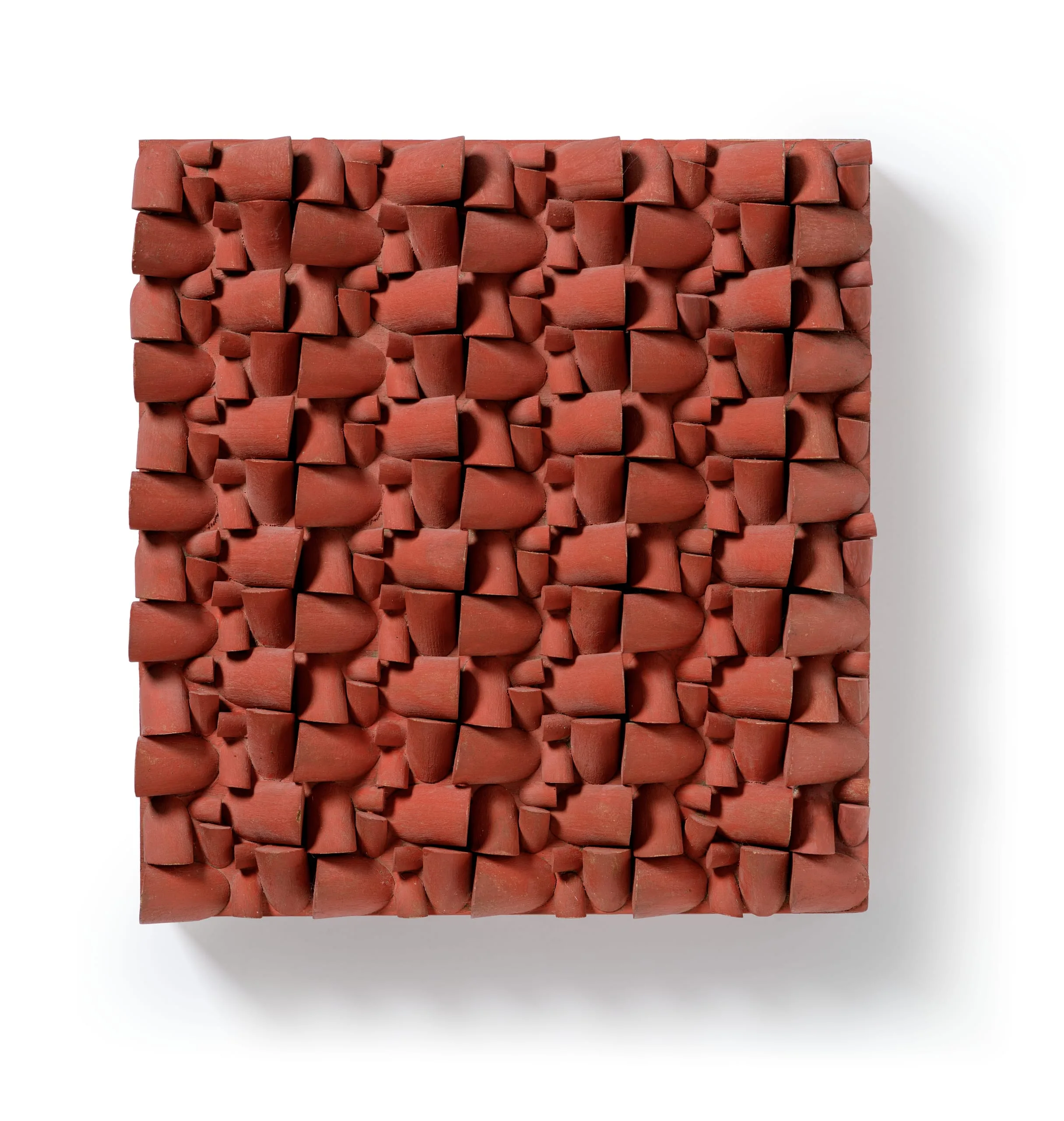
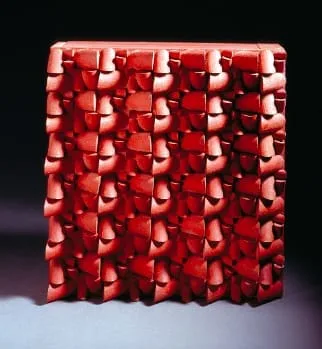
Sérgio Camargo’s concern with the relationship of opposites finds full expression in this delicate wood construction, where plane and volume, stasis and movement, light and shadow are brilliantly articulated. Camargo is one of Brazil’s most important abstractionists, known for exuberant reliefs of cylindrical modules in painted wood that blur the boundary between systematic abstraction and organic form. According to the critic Guy Brett, the development of Camargo’s style was “marked by one of those flashes of illumination which arise in the midst of the everyday. Cutting an apple to eat it, he saw the knife blade had made two planes, one at an angle to the other. He had made the plane by cutting into the volume. The plane was part of the apple; at the same time it was alien to it, a human construct. This paradoxical meeting of nature and culture was central to all of Camargo’s subsequent work.”
Born in Rio de Janeiro, Camargo moved to Buenos Aires at sixteen; there he studied with the influential artist Lucio Fontana (1899–1968) and was exposed to the Argentine Constructivist movements of the 1940s. At eighteen, he moved to Paris, where he frequented the studio of Constantin Brancusi (1876–1957). He returned to Brazil in 1953 during the heyday of geometric art, when artists’ groups were formed, styles invented, and manifestos issued. Although Camargo did not belong to any group, the resurgence of abstraction in Europe and in his homeland had a decisive impact on his formal experimentation of the 1960s. His participation in the 1963 Paris Biennial, where he received the International Prize for Sculpture, and his one-person exhibition at the legendary experimental gallery Signals in London (1964) marked the beginning of his international career. He also participated in group shows at the pioneering Galerie Denise René in Paris, including the seminal Le Mouvement II (1964) and Lumière et mouvement (1967), which brought together the day’s most important practitioners of Op and kinetic art.
Ilona Katzew
2024