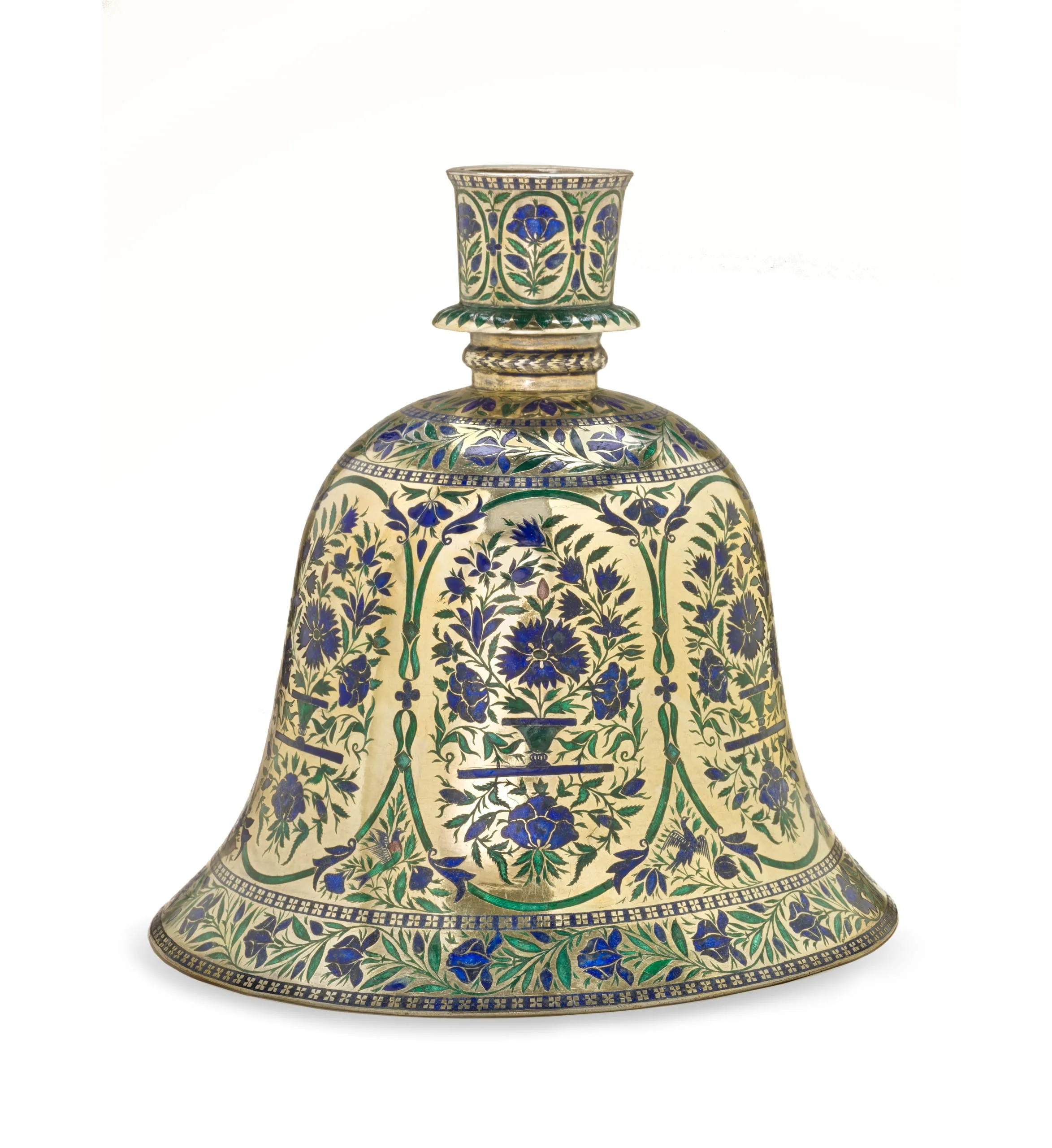
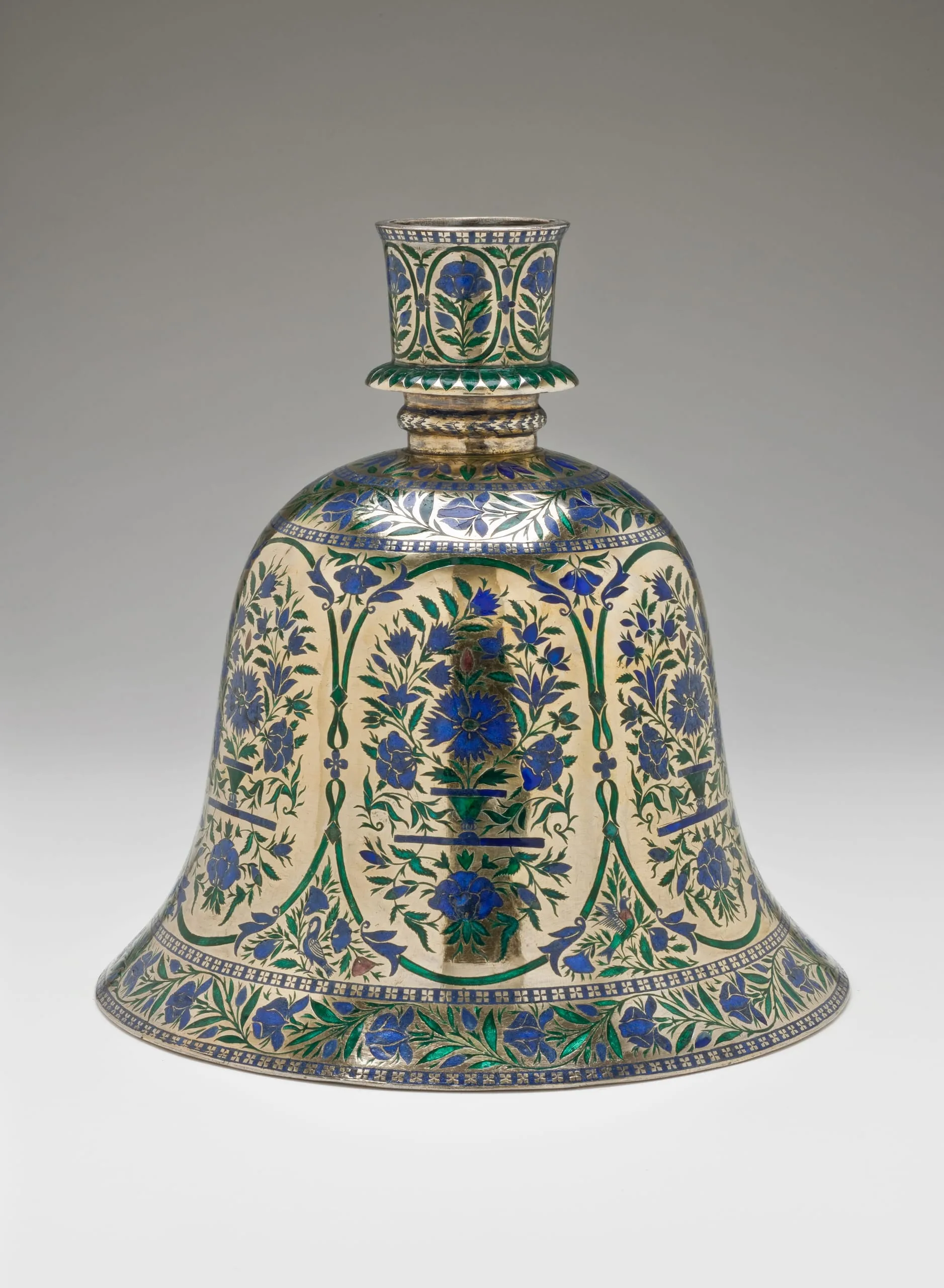
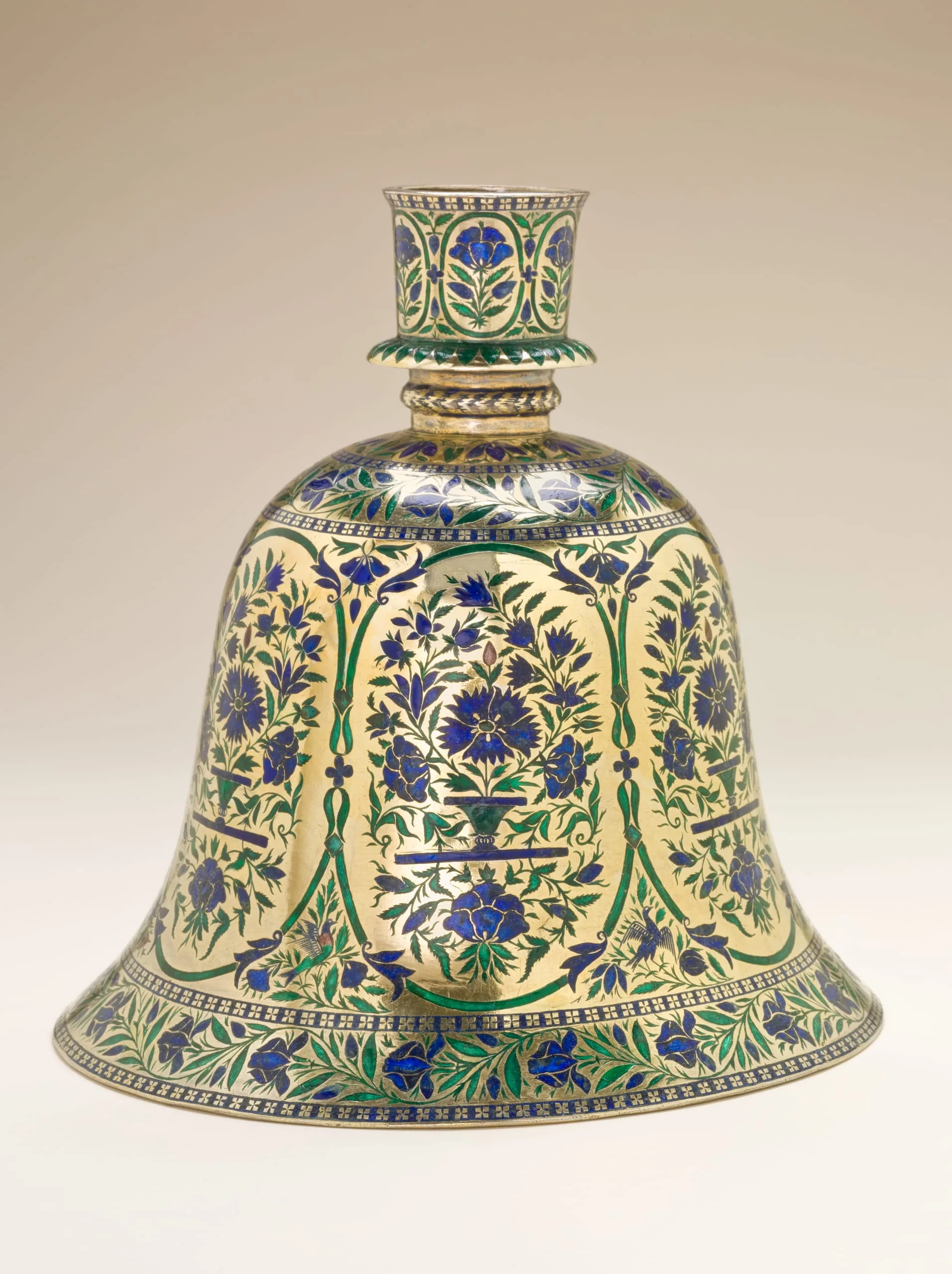
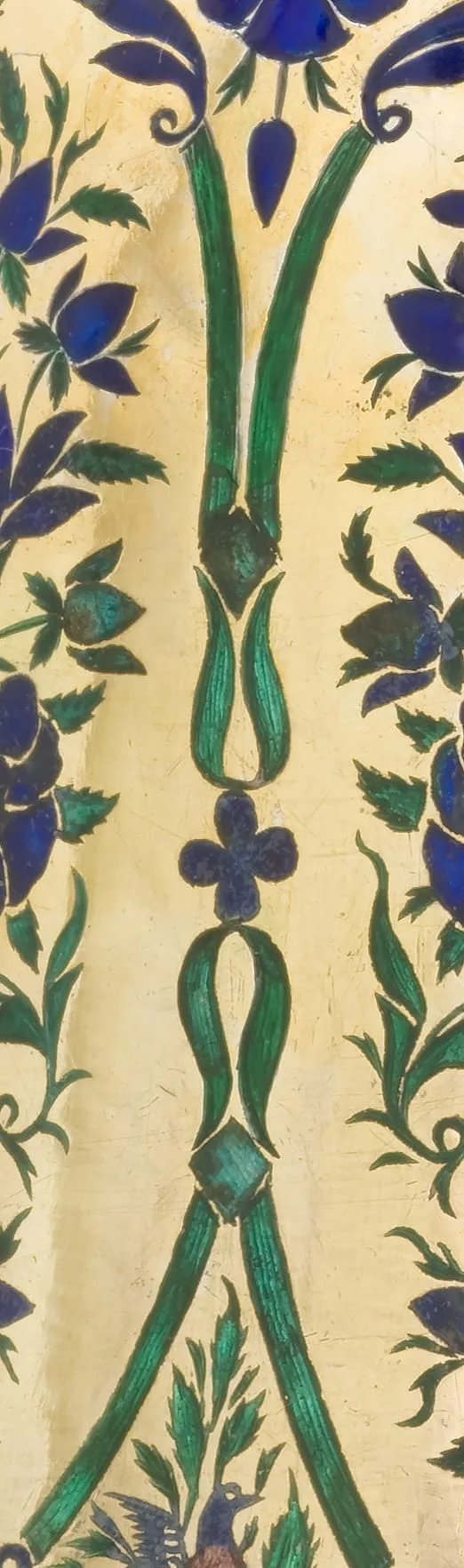
The bell-shaped hookah base is made of gilded silver with elegant floral and avian designs in translucent blue, green, and aubergine enamel. Beneath the slightly flaring mouth is an arcade with six cartouches, each containing an identical poppy (Papaver somniferum). The vessel’s shoulder and splayed foot are each decorated with a meandering iris scroll. The vessel body has six cartouches, each with an identical hybrid flowering plant with a central blossom inspired by a dianthus or carnation. It is flanked by poppies, lilies, and lotuses or tulips growing unrealistically from the same two stalks. A small bud in translucent aubergine accentuates the vertical axis, and this same color is used, occasionally and inconsistently, to highlight small areas of the flora and fauna decoration in the spandrels. The poppy plants emerge from a translucent green footed vase that has a prominent ring molding with vertical ribs.
A maker’s mark of a stork is engraved on the silver base plate. Such pictographic maker’s marks found on some Lucknow metalworks are presumably part of a broader nonliterate artist/craftsperson identification system. Regrettably, however, they cannot yet be correlated to individual artists or workshops, or to the few Lucknow enamelers identified as award recipients in contemporaneous exhibition publications.
Lucknow hookahs were fashioned in a wide range of media, function types, and decoration, including several varieties of metal hookahs made with diverse decorative techniques. One style perpetuated the Mughal leitmotif of formally arranged flowering plants with inlaid gems set on a gold and/or translucent enameled ground. The most acclaimed Lucknow hookahs, however, are the silver and gilded silver water pipes with translucent enameling. Myriad decorative programs of complex compositions, including lush landscapes teeming with wildlife and architectural vignettes; multitudinous motifs of flora and fauna; and a number of intricate geometric patterns adorn these ornate smoking apparatuses.
Comparable Lucknow enameled hookah bases are in the Metropolitan Museum of Art, New York (2015.500.4.15) and Victoria and Albert Museum, London (IS.122-1886).
See Stephen Markel, Mughal and Early Modern Metalware from South Asia at LACMA: An Online Scholarly Catalogue (2020), pp. 96-106, 108-109, no. 5. https://archive.org/details/mughal-metalware