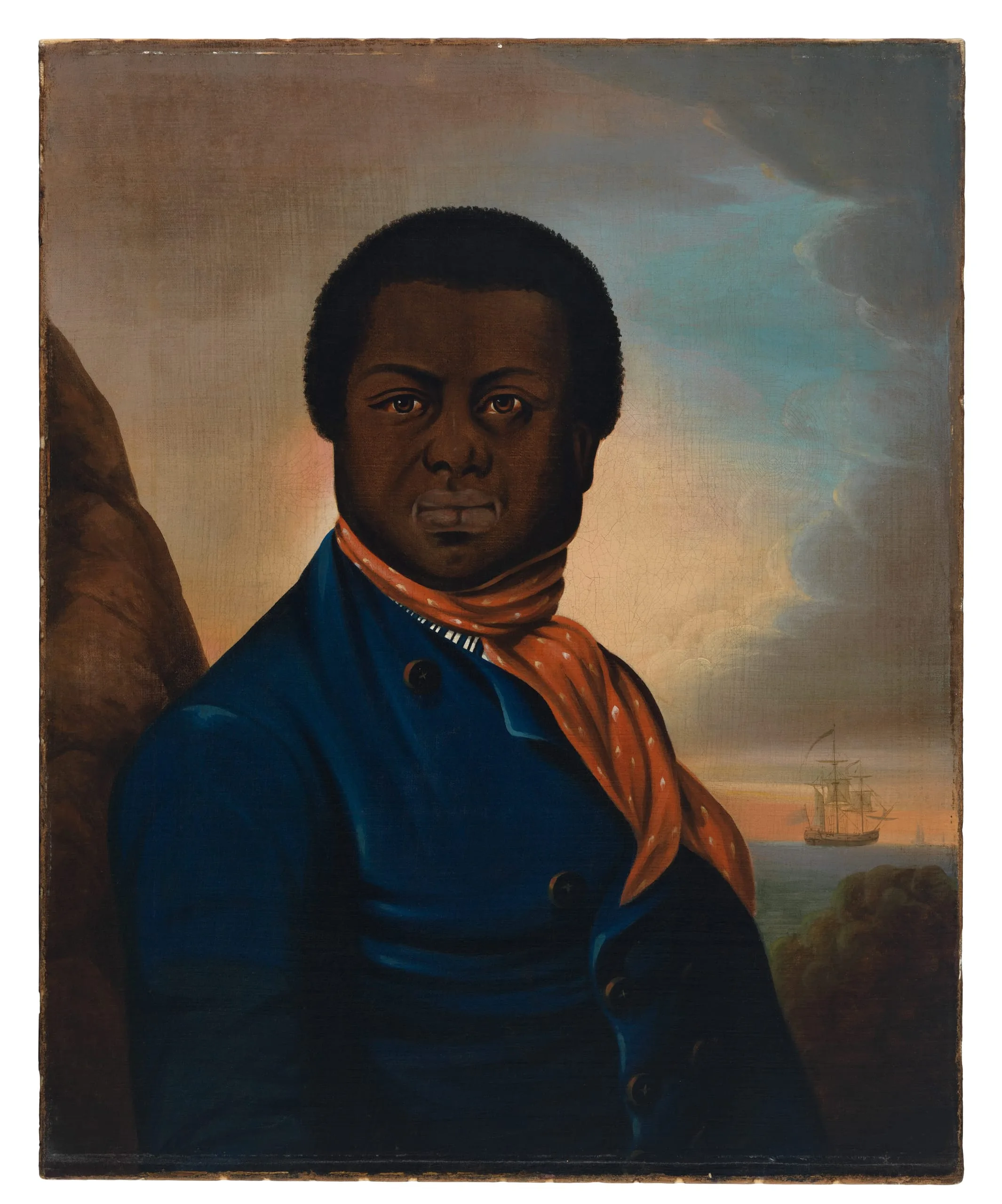
Who is the man in this painting? Who painted this portrait and why? While research has not yet provided definitive answers to these questions, the painting reveals the significant contributions of free and formerly enslaved Black men to maritime activities in the late eighteenth and early nineteenth centuries. A scholar of the work has suggested that the sitter may be Captain Paul Cuffe (1759−1817) based on similarities to a silhouette portrait of Cuffe (1812; Library of Congress). The son of an enslaved African American father and Wôpanâak (Wampanoag) mother, Cuffe worked as a ship captain, merchant, and abolitionist in Massachusetts. His journey to becoming one of the wealthiest Black Americans and an advocate for Black resettlement in Sierra Leone, among other notable accomplishments, was certainly extraordinary enough to make him a highly desirable subject for a portrait.
Sailing was a dangerous but advantageous career for many free African American men of the era. There were other Black sailors on both sides of the Atlantic who would have been eligible candidates for well-executed portraits such as this, and there were many European and American itinerant artists eager for commissions. Whoever the subject of the portrait may be, life on the sea is the key feature of his identity. The sitter wears clothes that are typical of a sailor of the period, including a double-breasted blue jacket, jaunty red scarf, and striped shirt. He stands at an elevated vantage point with a clear view of the sea and a large ship behind him. Several other vessels in the distance suggest a busy waterway. The clash of gray clouds on the right and a bright halo of sun at the center evoke the range of weather conditions that are so consequential to seafarers, while also dramatically framing the sitter’s face. Even without further information about the artist or sitter, the painting is a defiant depiction of a Black man free from bondage and in control of his own image.
Selected Bibliography
Bolster, W. Jeffrey. Black Jacks: African American Seamen in the Age of Sail. Harvard University Press, 1997.
Kaplan, Sidney. The Black Presence in the Era of the American Revolution, 1770−1800. New York Graphic Society in association with the Smithsonian Institution Press, 1973.
Kim, Christine Y., and Myrtle Elizabeth Andrews. Black American Portraits, p. 20. LACMA, 2021.
Selected Exhibition History
Art Across America, National Museum of Korea, February 5−May 19, 2013; Daejeon Museum of Art, June 18−September 1, 2013.
Black American Portraits, LACMA, November 7, 2021−April 17, 2022.
The Fortens of Philadelphia, Museum of the American Revolution, Philadelphia, February 11−November 26, 2023.