LACMA

ShopMembershipMyLACMATickets
LACMA
Los Angeles County Museum of Art
5905 Wilshire Blvd.
Los Angeles, CA 90036
info@lacma.org
(323) 857-6000
Sign up to receive emails
Subscribe
© Museum Associates 2025

Museum Hours

Monday

11 am–6 pm

Tuesday

11 am–6 pm

Wednesday

Closed

Thursday

11 am–6 pm

Friday

11 am–8 pm

Saturday

10 am–7 pm

Sunday

10 am–7 pm


  • About LACMA
  • Jobs
  • Building LACMA
  • Host An Event
  • Unframed
  • Press
  • FAQs
  • Log in to MyLACMA
  • Privacy Policy
© Museum Associates 2025
Collections

Unknown
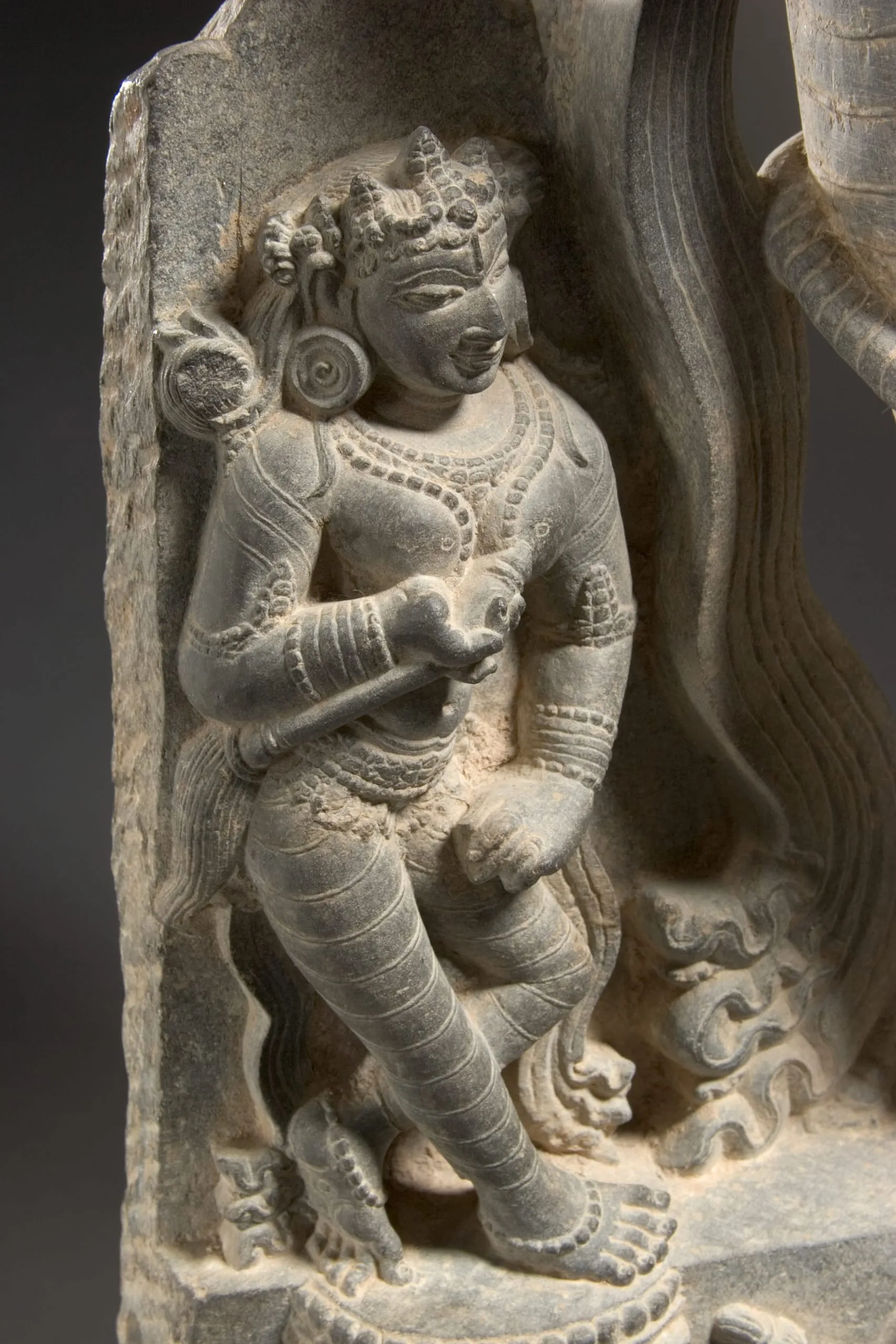
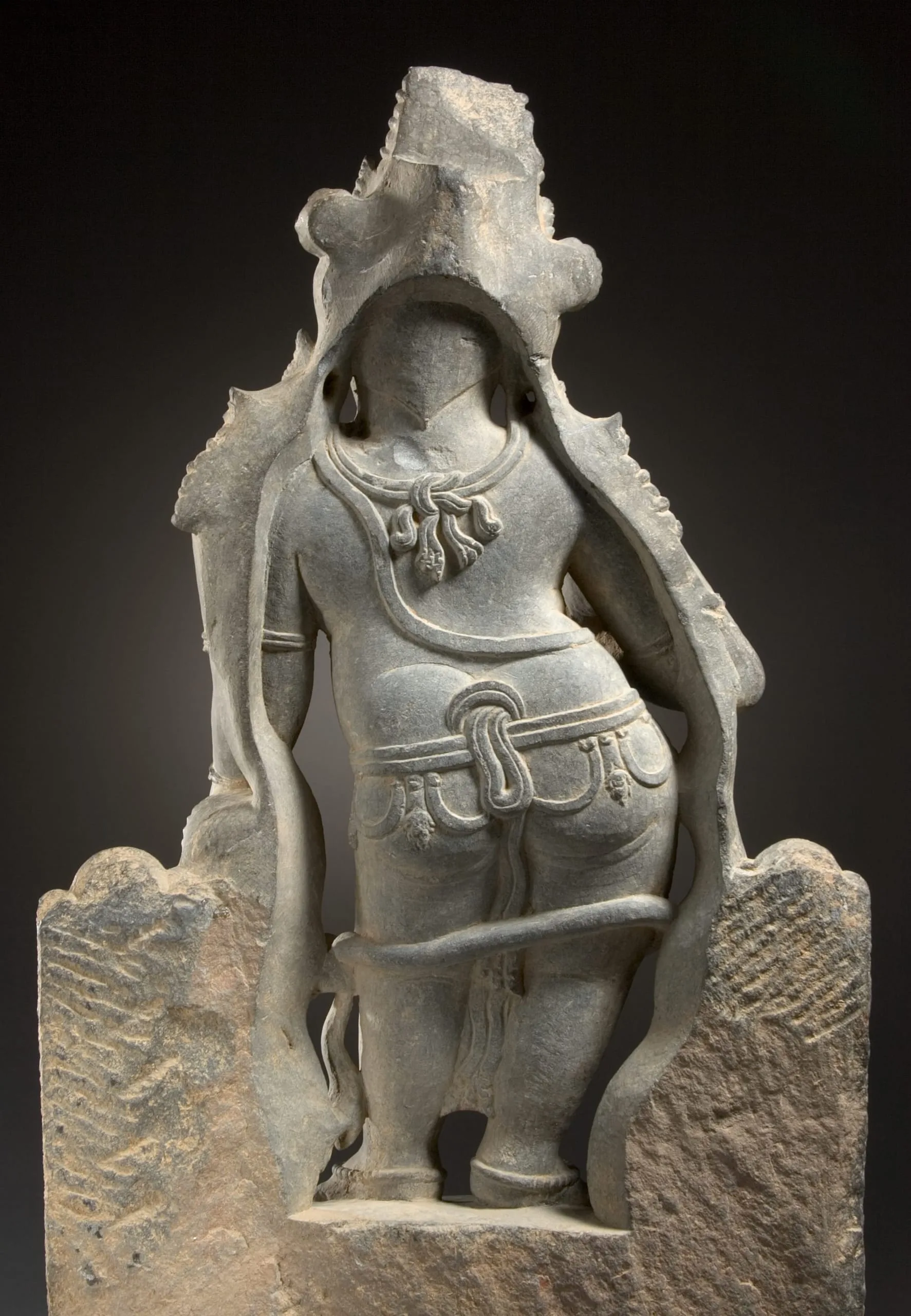
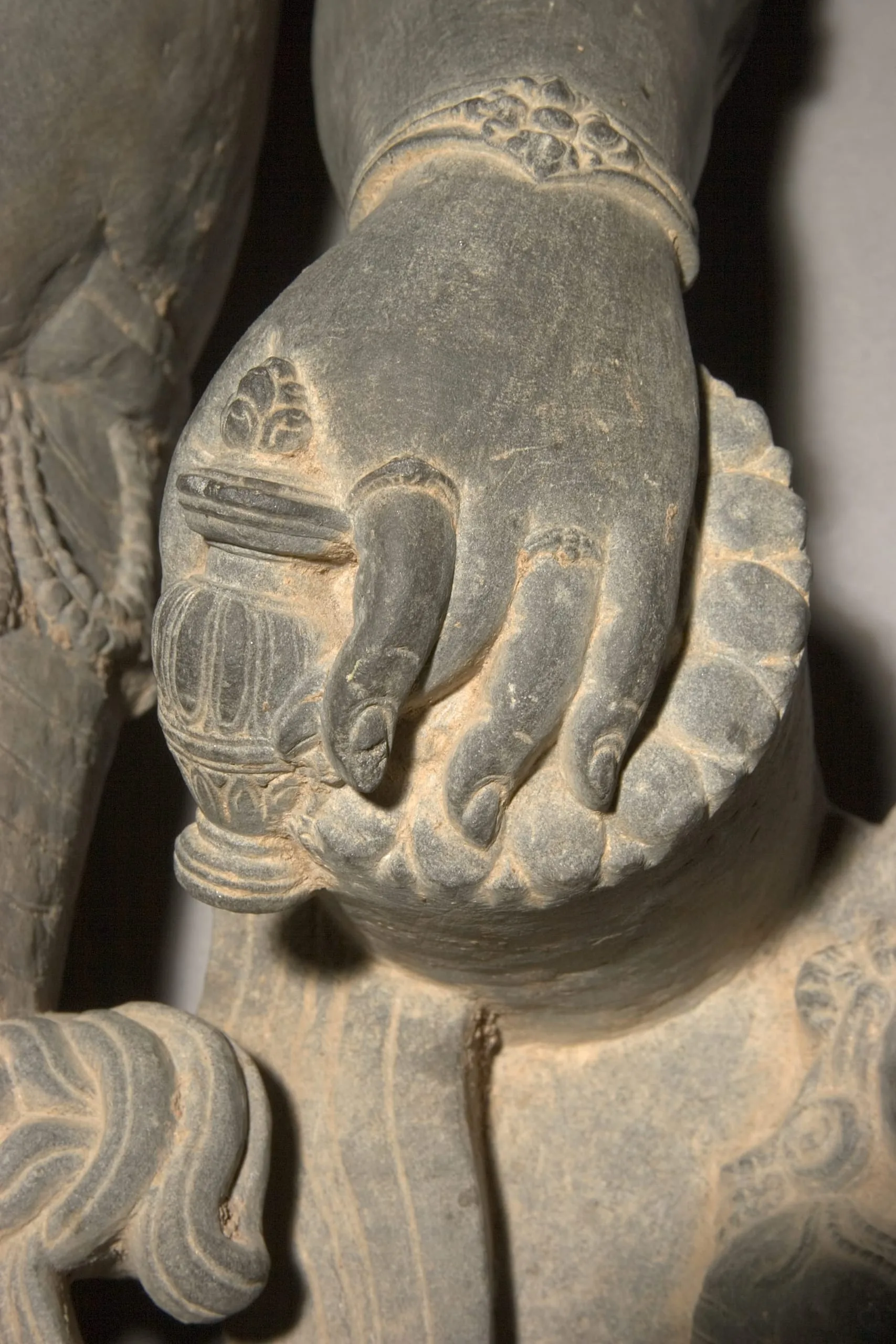
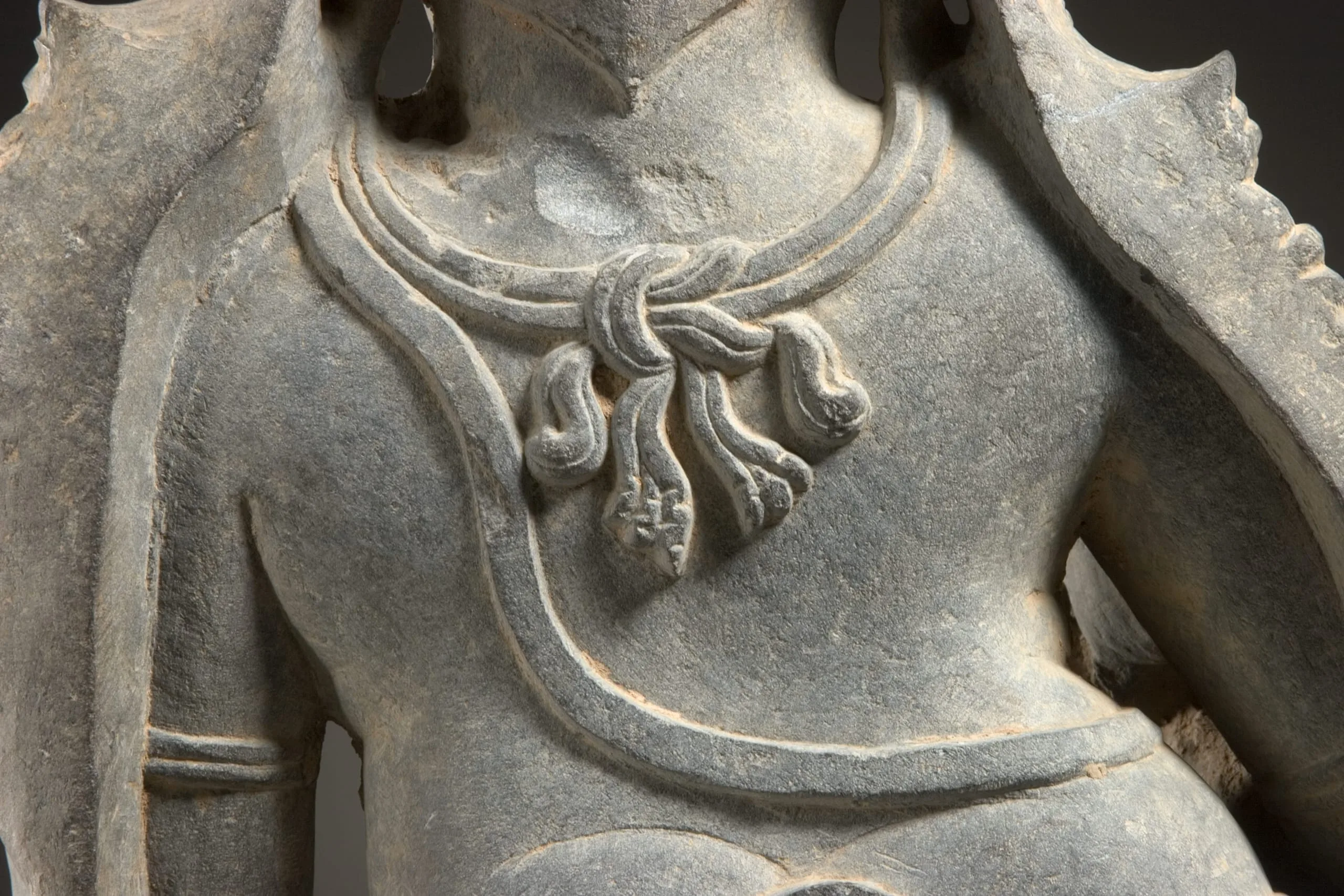
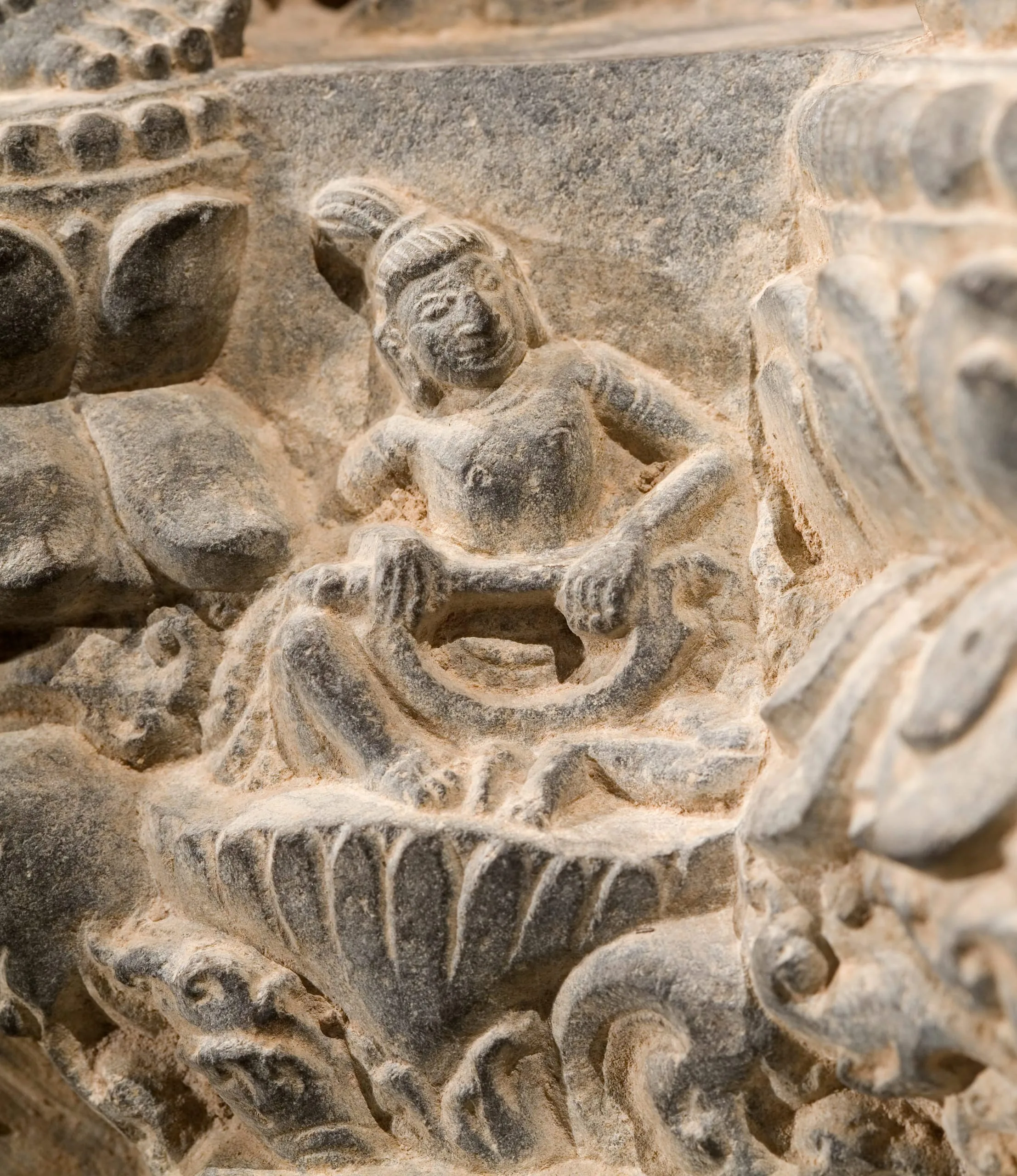
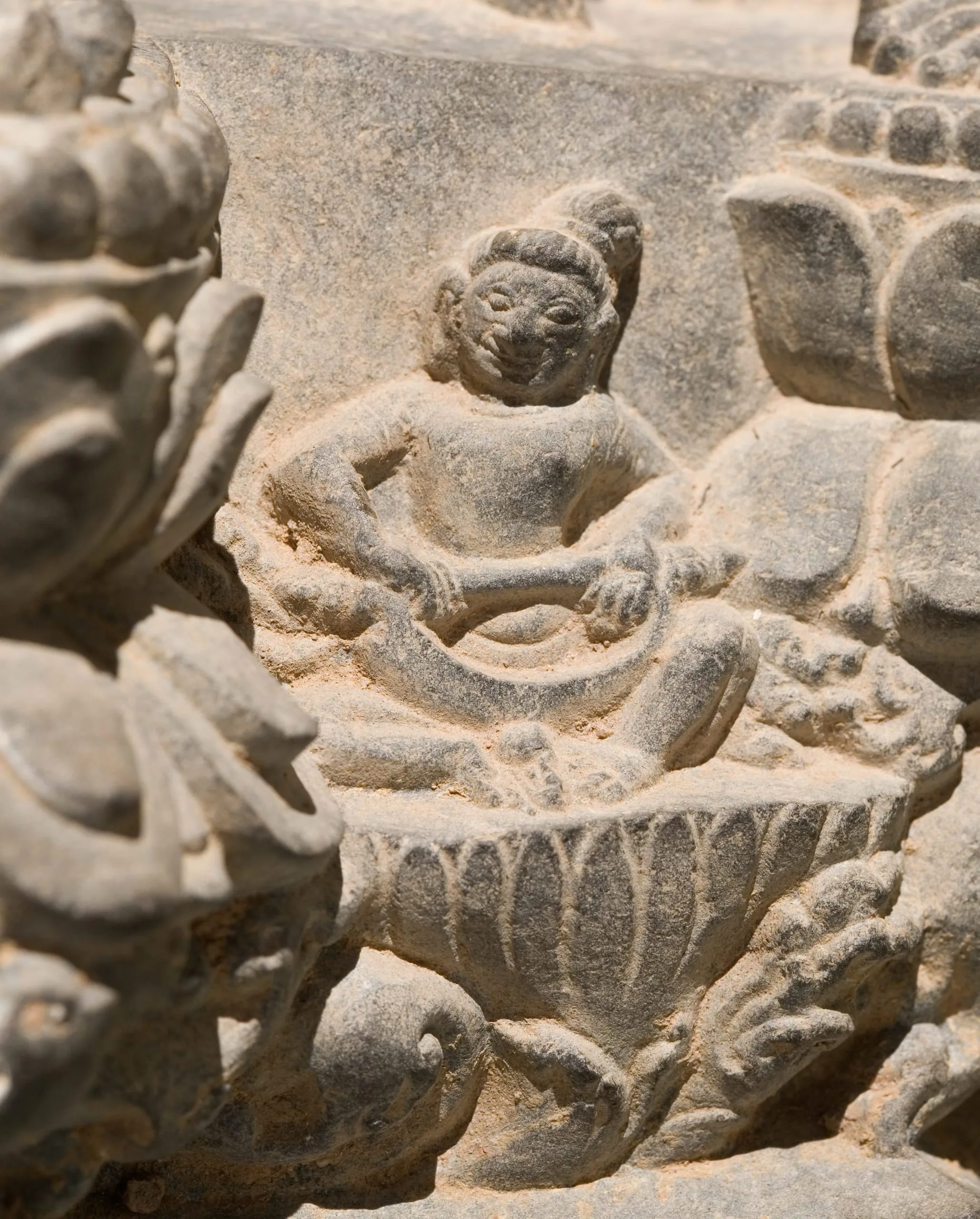
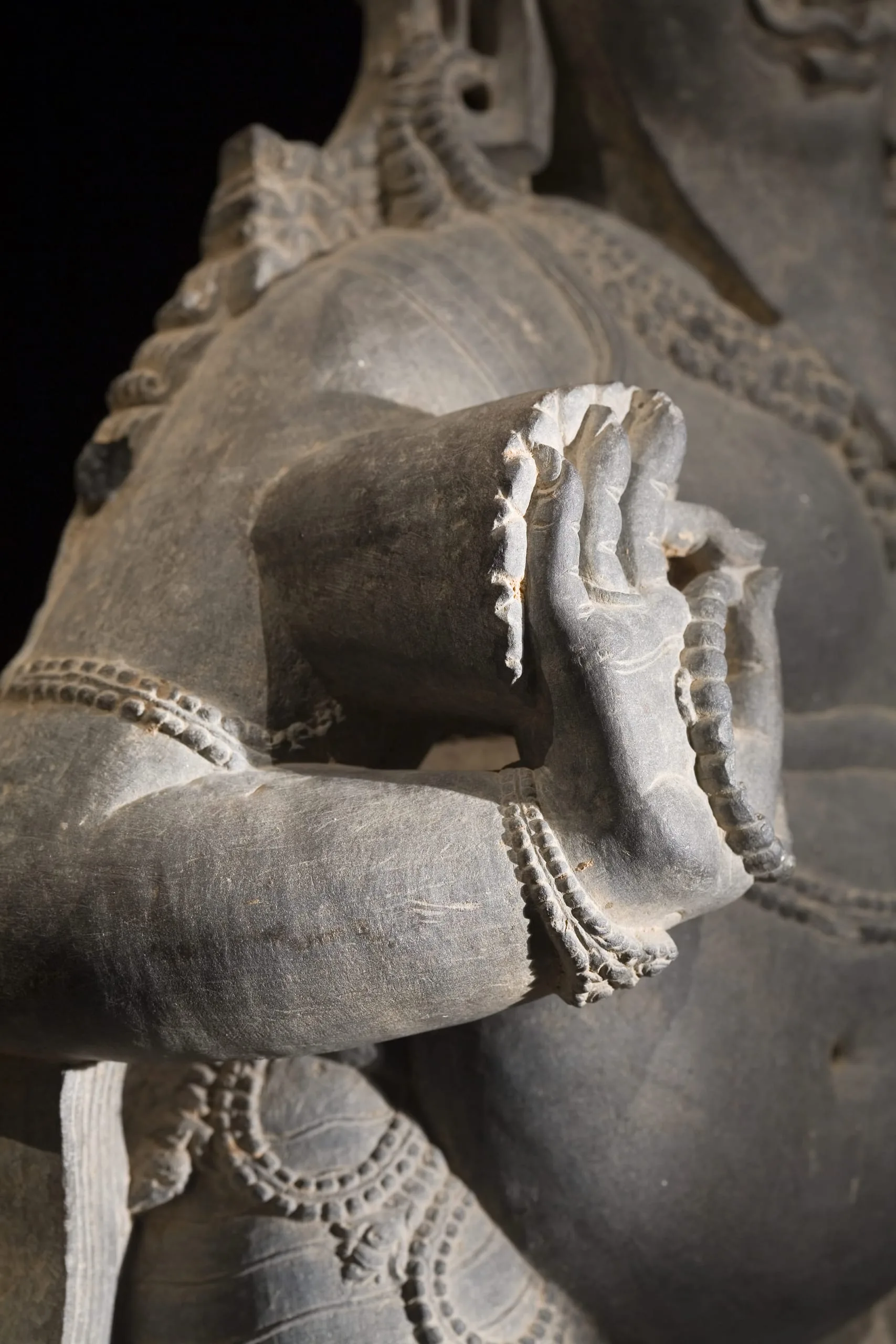
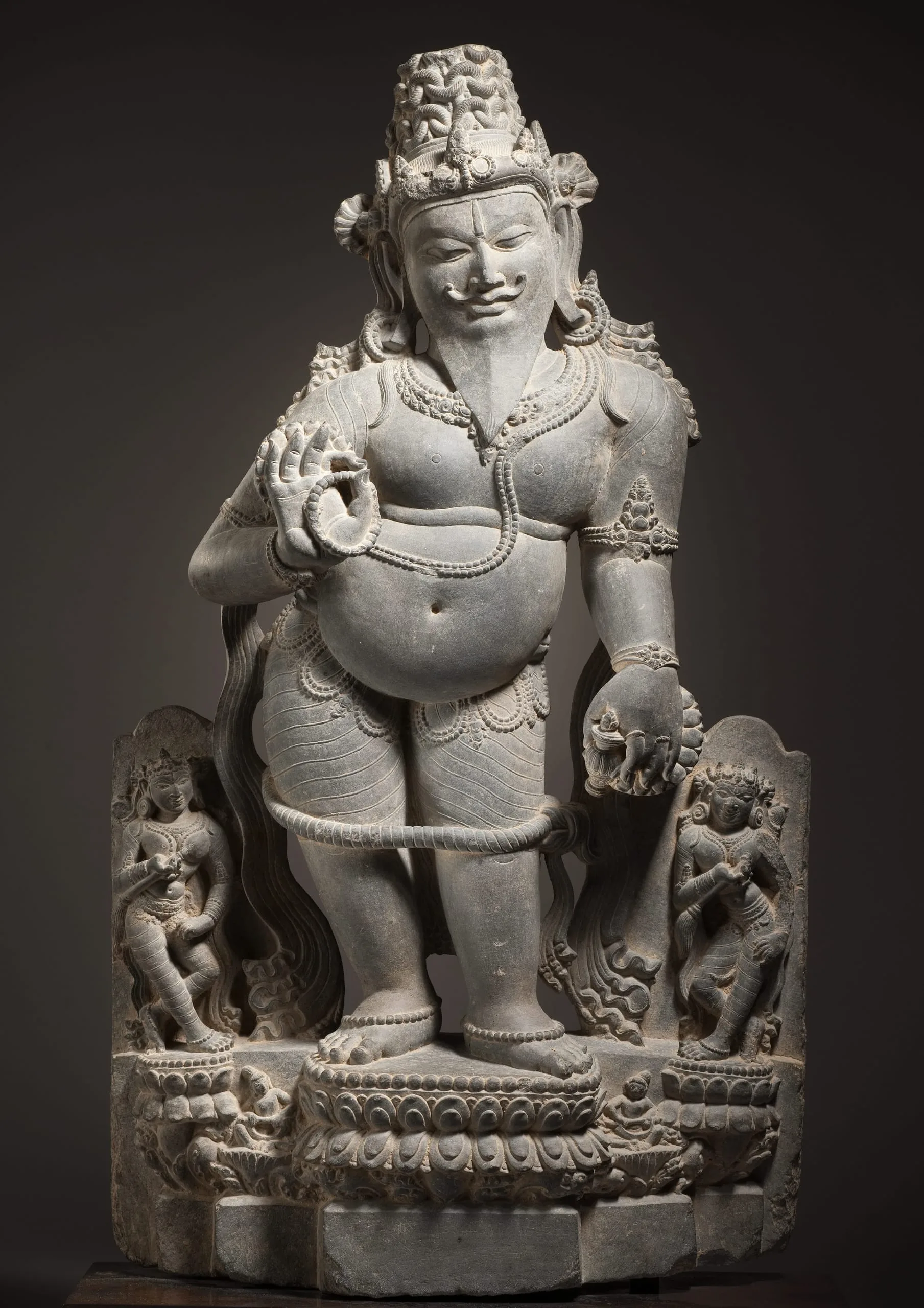
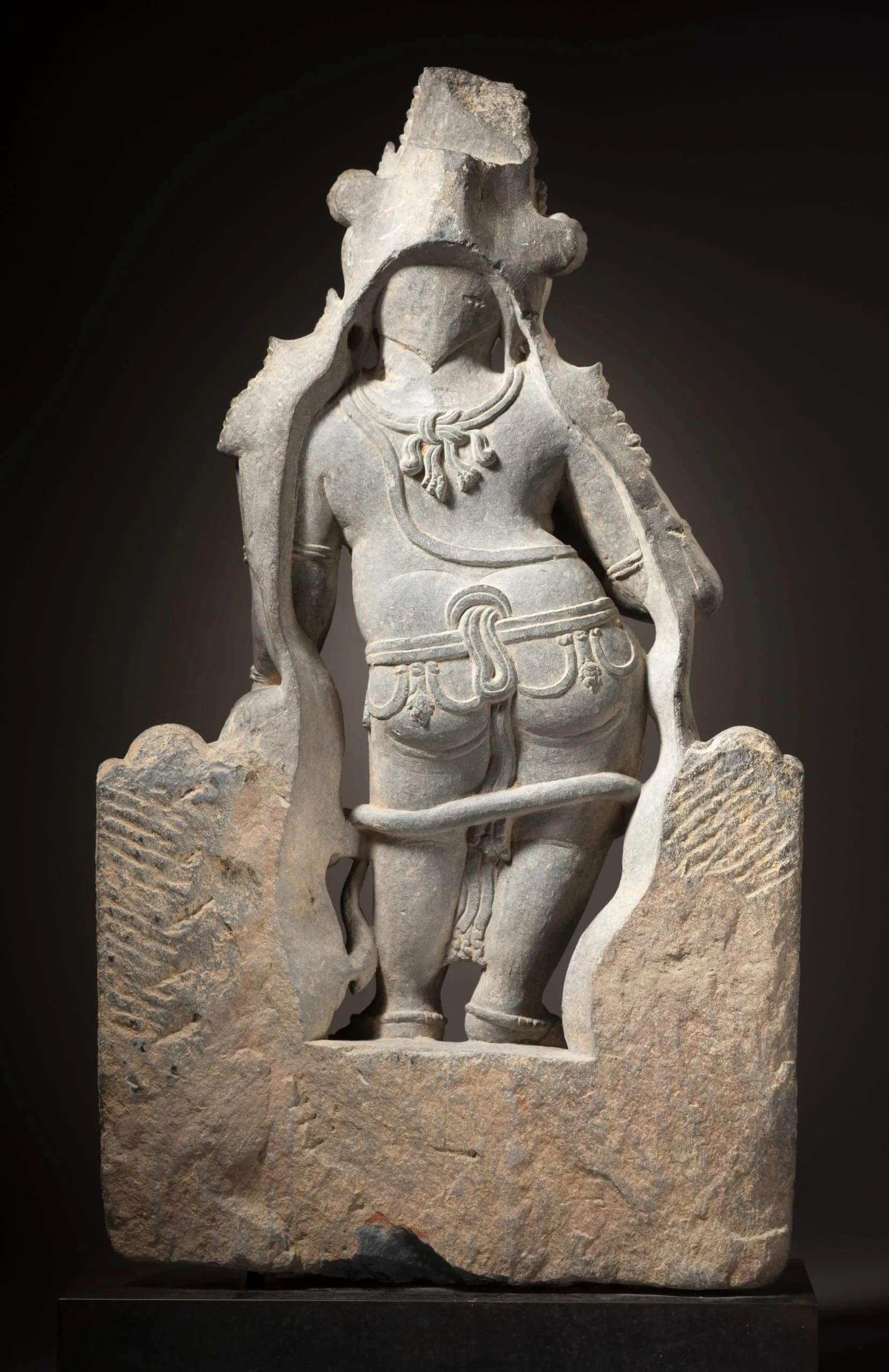
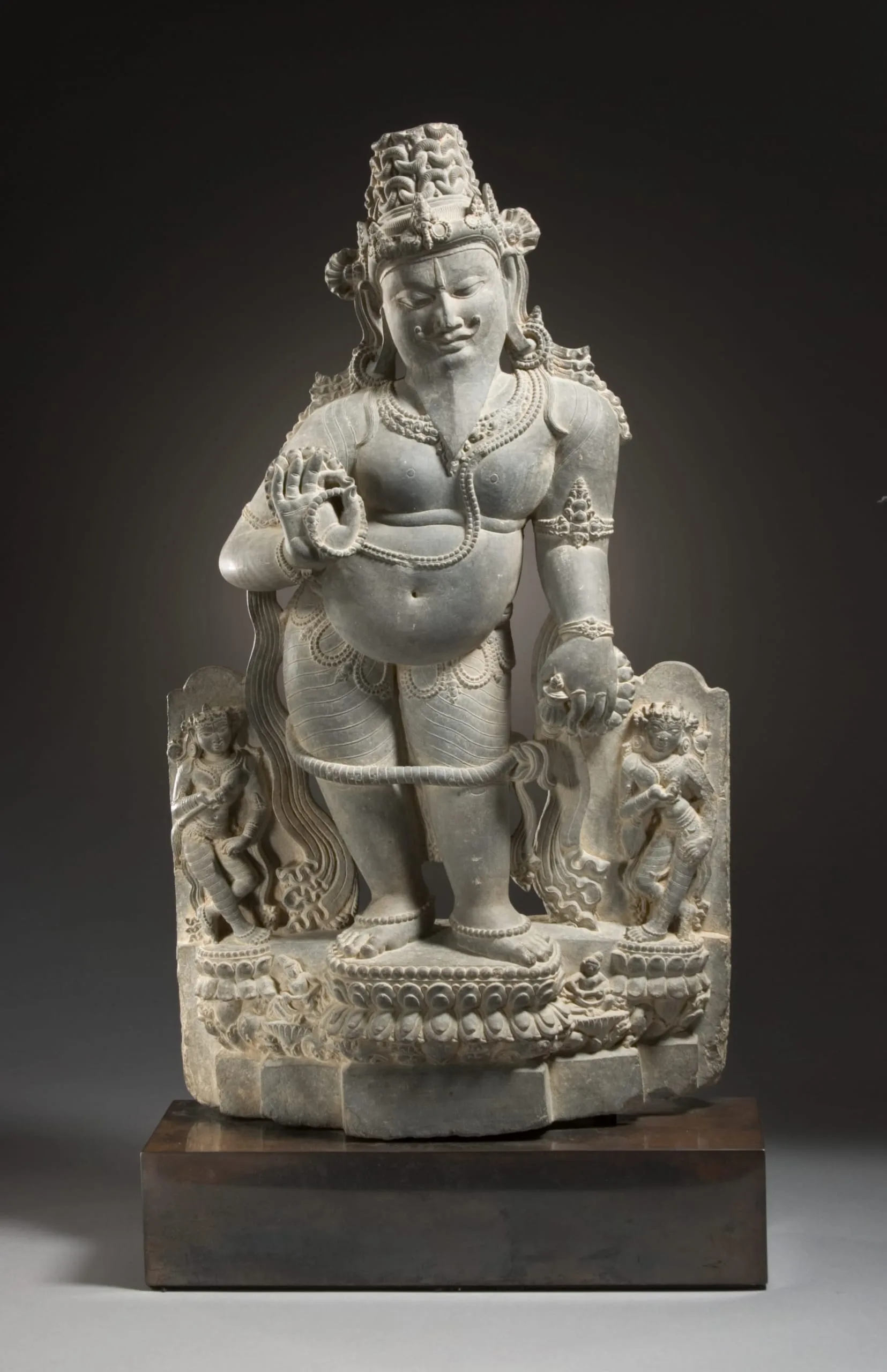
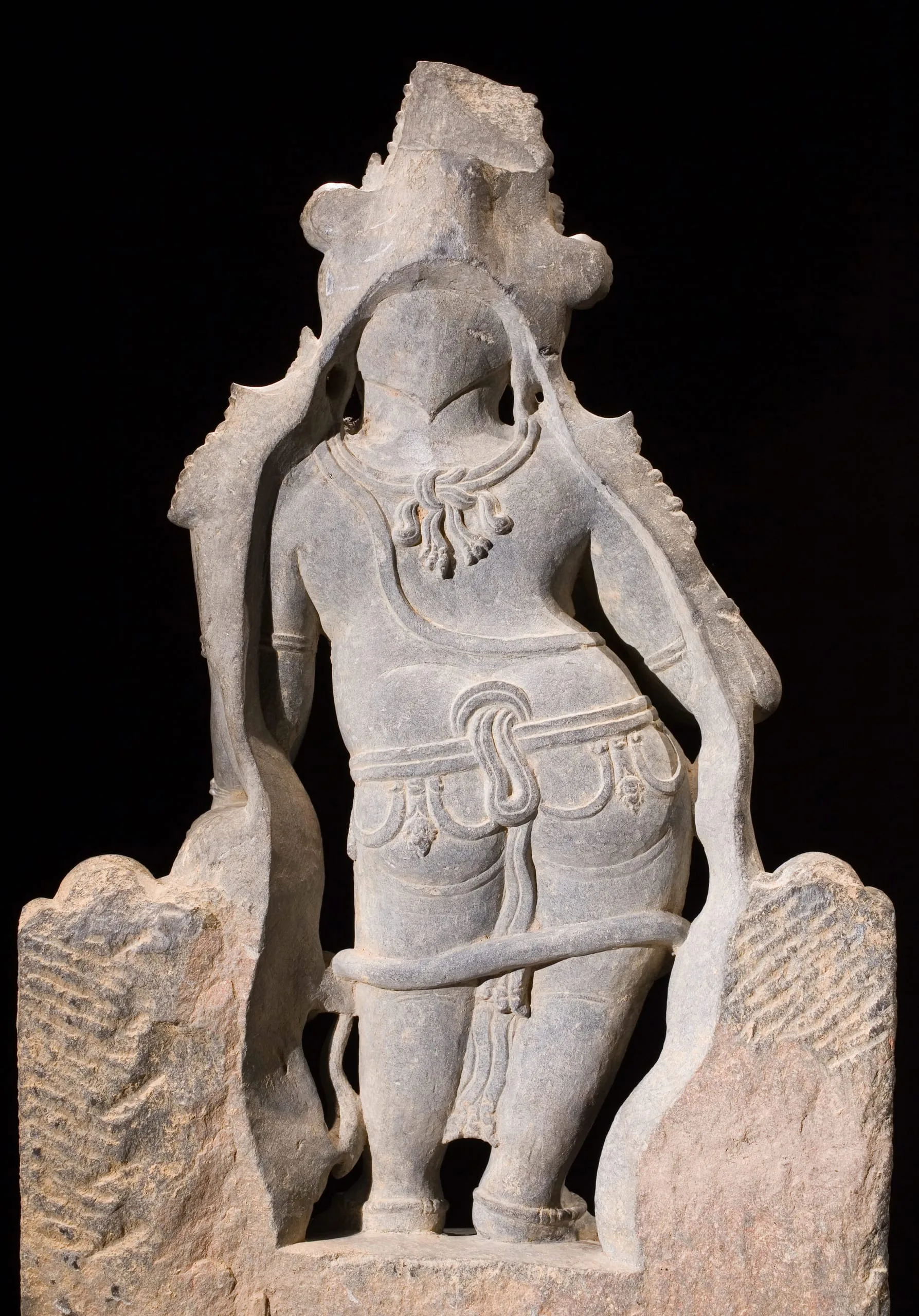
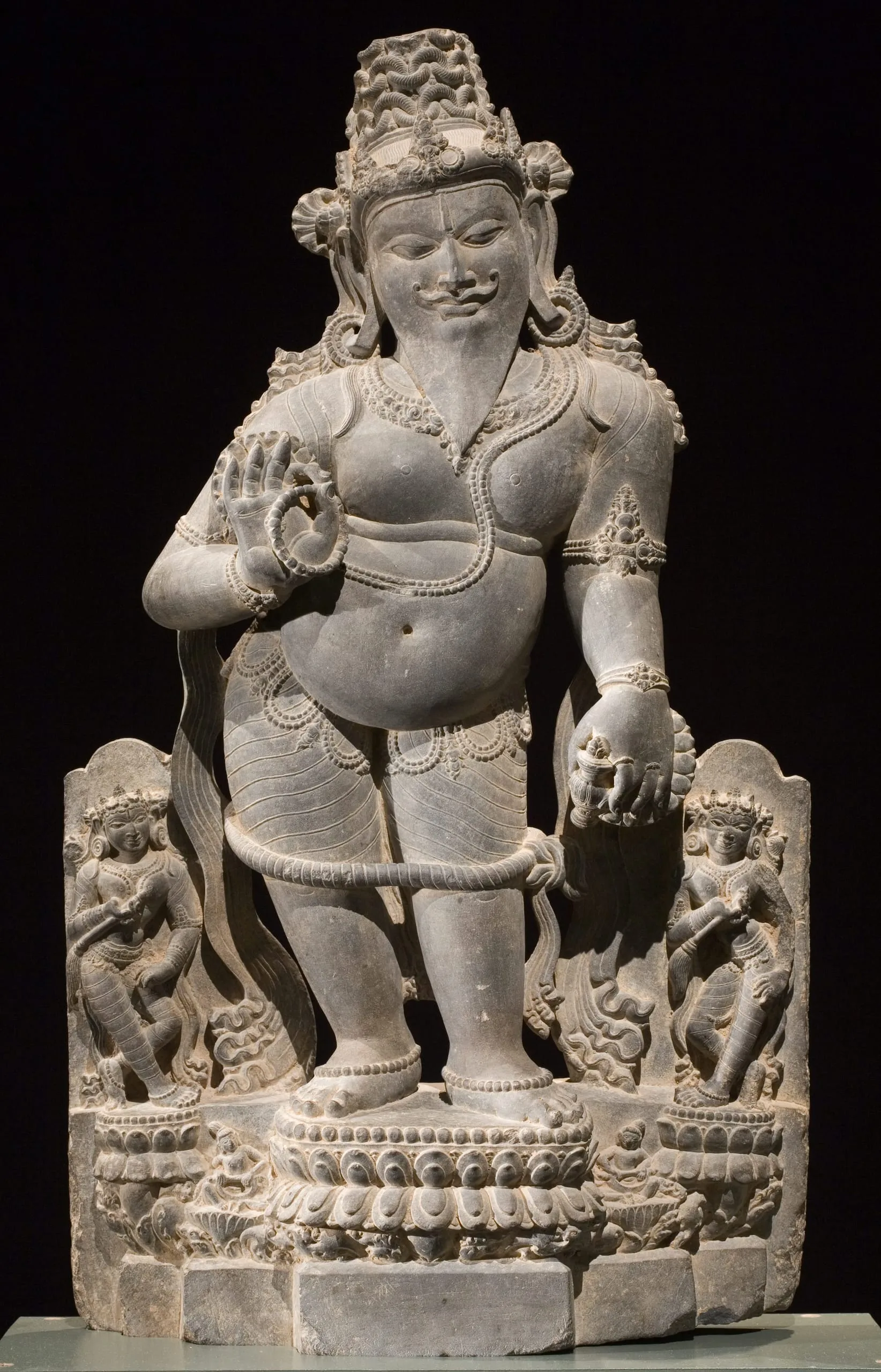
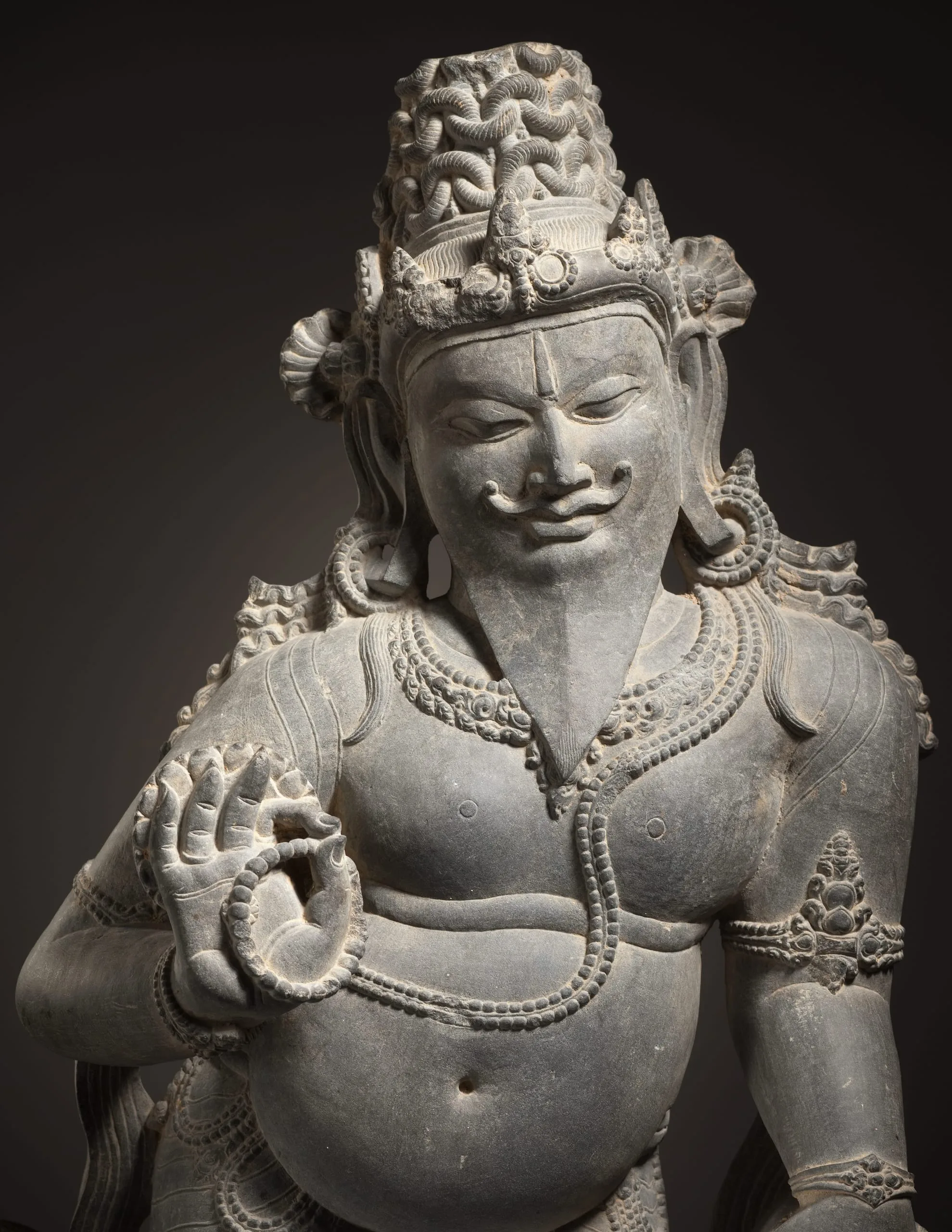
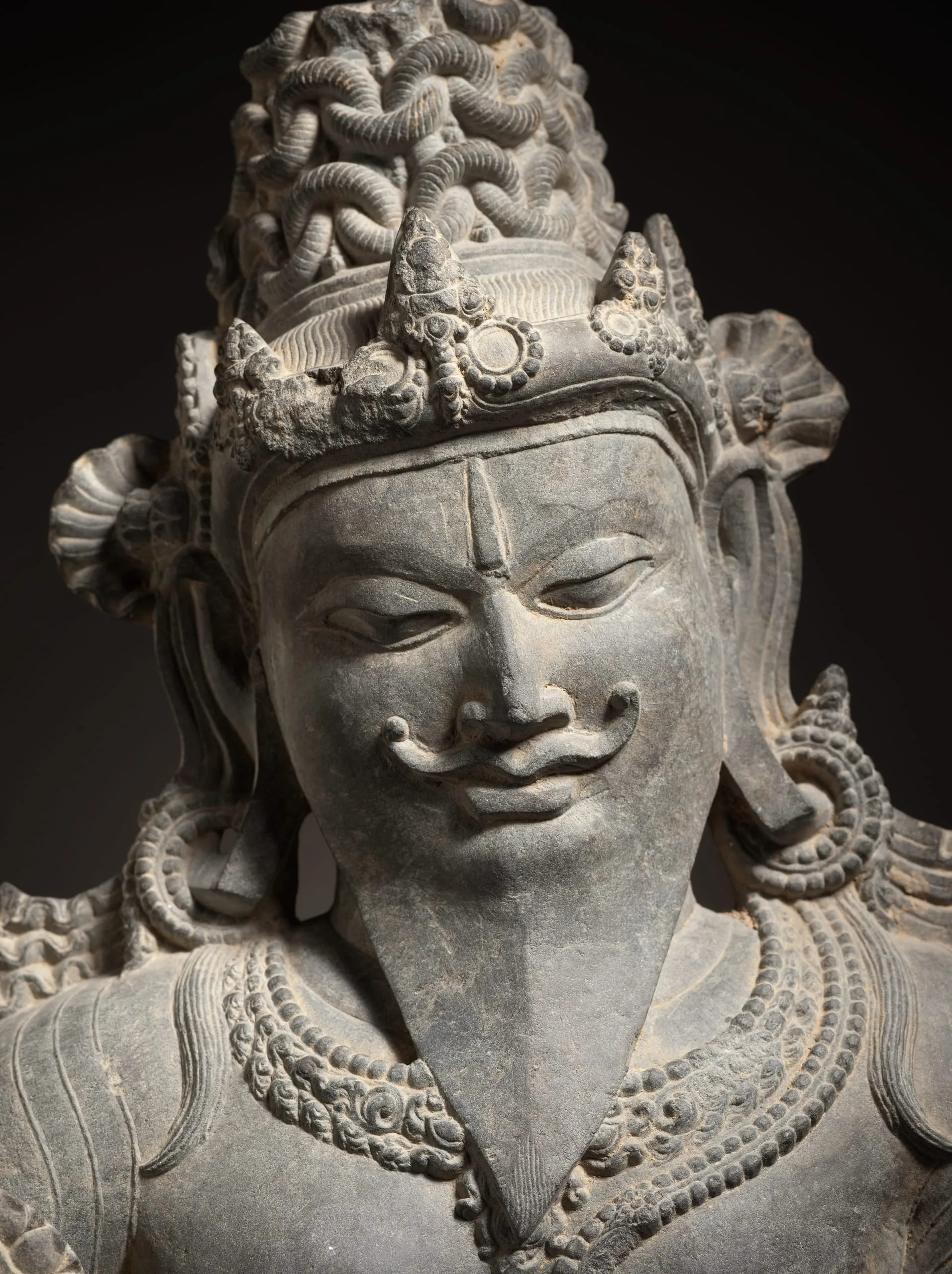
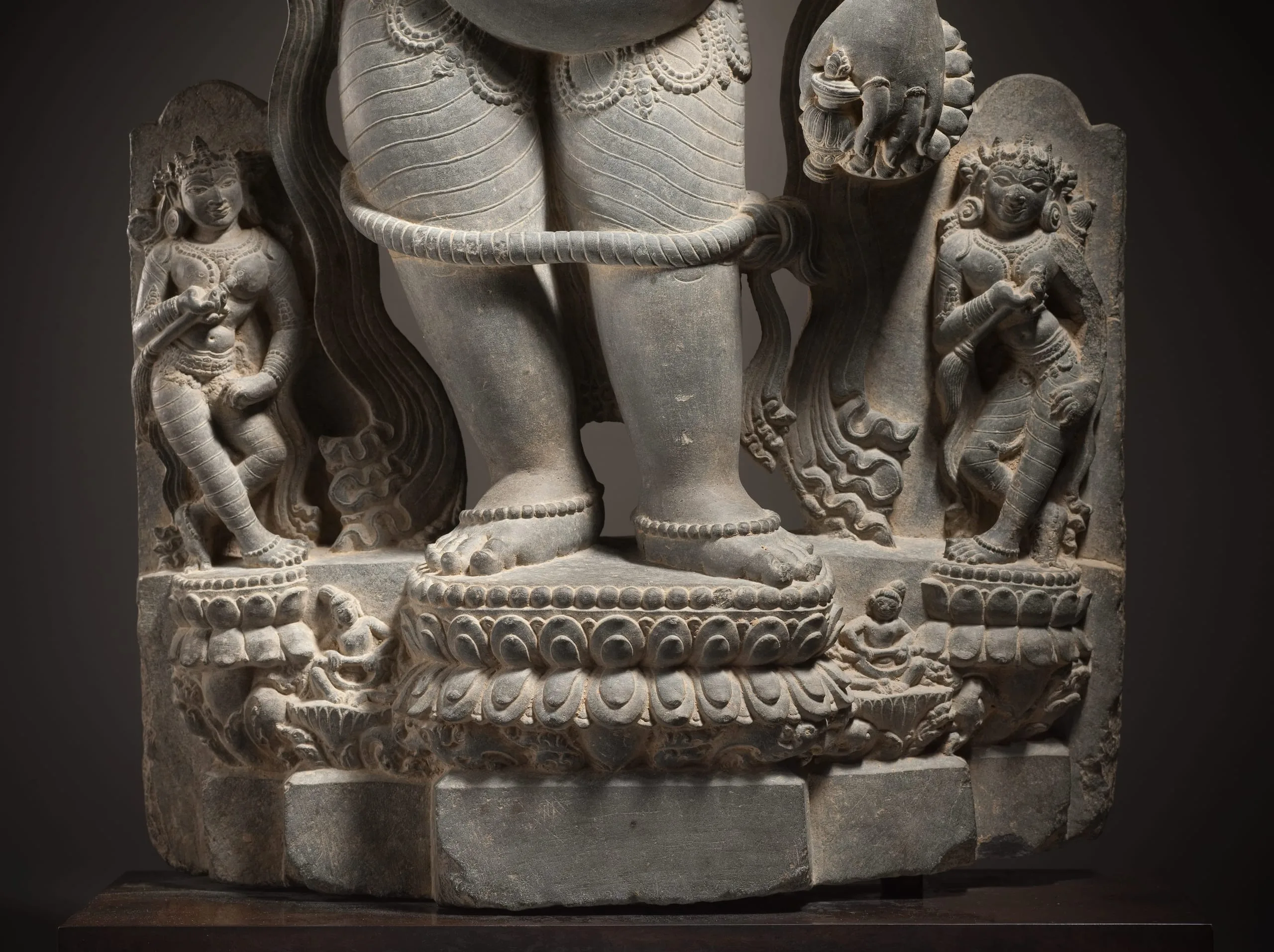
The Maharishi (Great Sage) Agastya12th century

Not on view
Gray stone sculpture of a large standing multi-armed deity with a round belly, elaborate tiered crown, and beaded jewelry, flanked by two smaller carved figures on a tiered lotus base
Stone relief sculpture of a standing male figure in high relief, wearing an ornate belt, necklace, and short dhoti, with an elaborate headdress above; the figure emerges from a roughly hewn gray stone slab with jagged edges and incised hatching on the lower flanking panels.
Stone sculpture of a standing deity adorned with an elaborate crown, jewelry, and beaded garlands, one hand raised holding a circular object. Smaller attendant figures flank the base, which features a lotus pedestal with carved relief figures. Pale gray stone with finely detailed carving throughout.
Stone sculpture of a standing deity figure in three-quarter view, wearing ornate jewelry, a decorated waistband, and dhoti; elaborately carved headdress partially broken; flanked by architectural or vegetal elements at lower sides; gray stone with weathered surface.
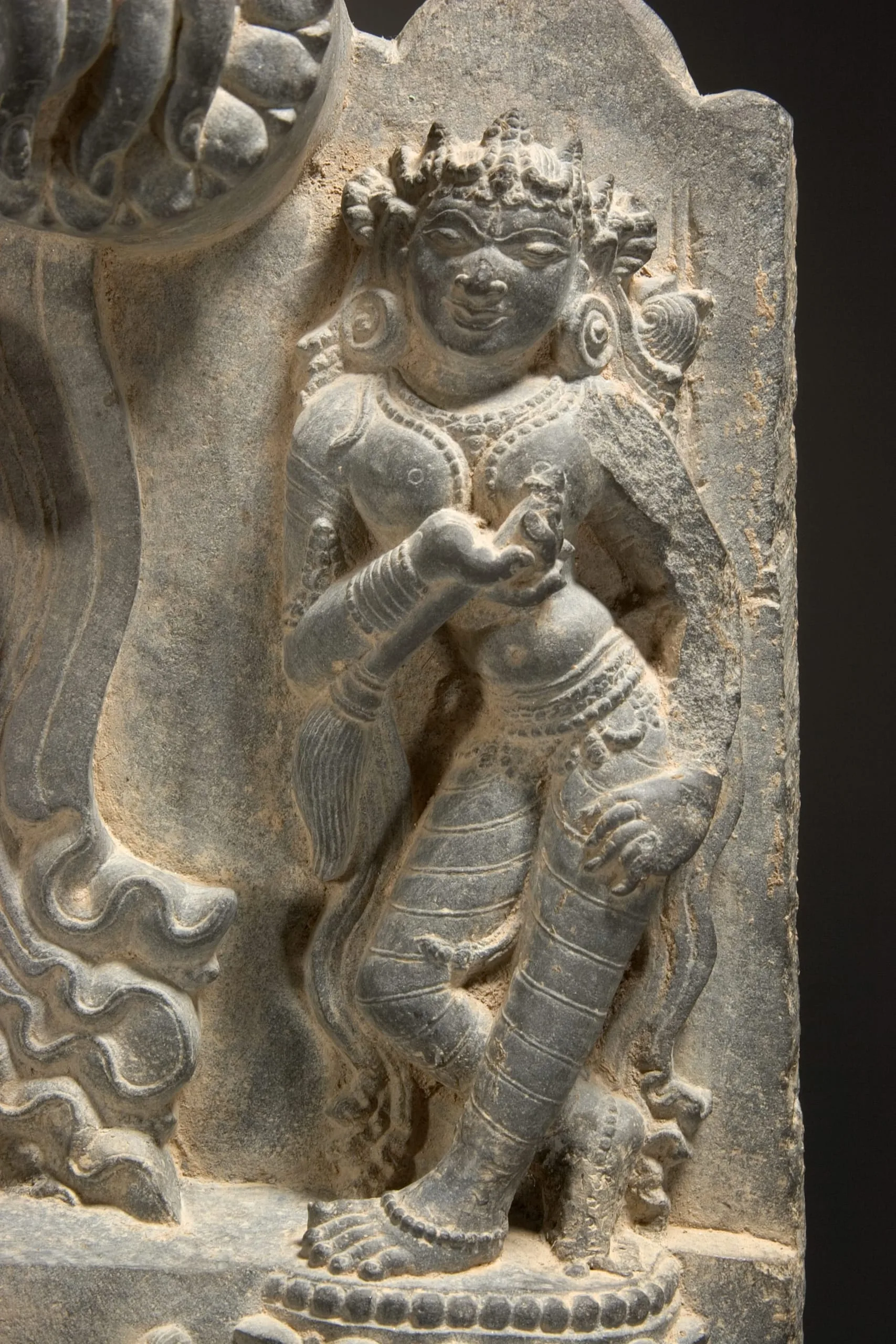
Stone sculpture of a standing deity in tribhanga pose, adorned with elaborate jewelry, beaded garlands, and a tall crown. Right hand raised in abhaya mudra, left hand holding a small figure. Two smaller attendant figures flank the base, carved in shallow relief against a tiered back slab.
Stone sculpture, upper torso of a deity wearing an ornate foliated crown, large circular ear ornaments, and multiple layered necklaces, one hand raised in a mudra gesture, with finely carved surface details against a dark background.
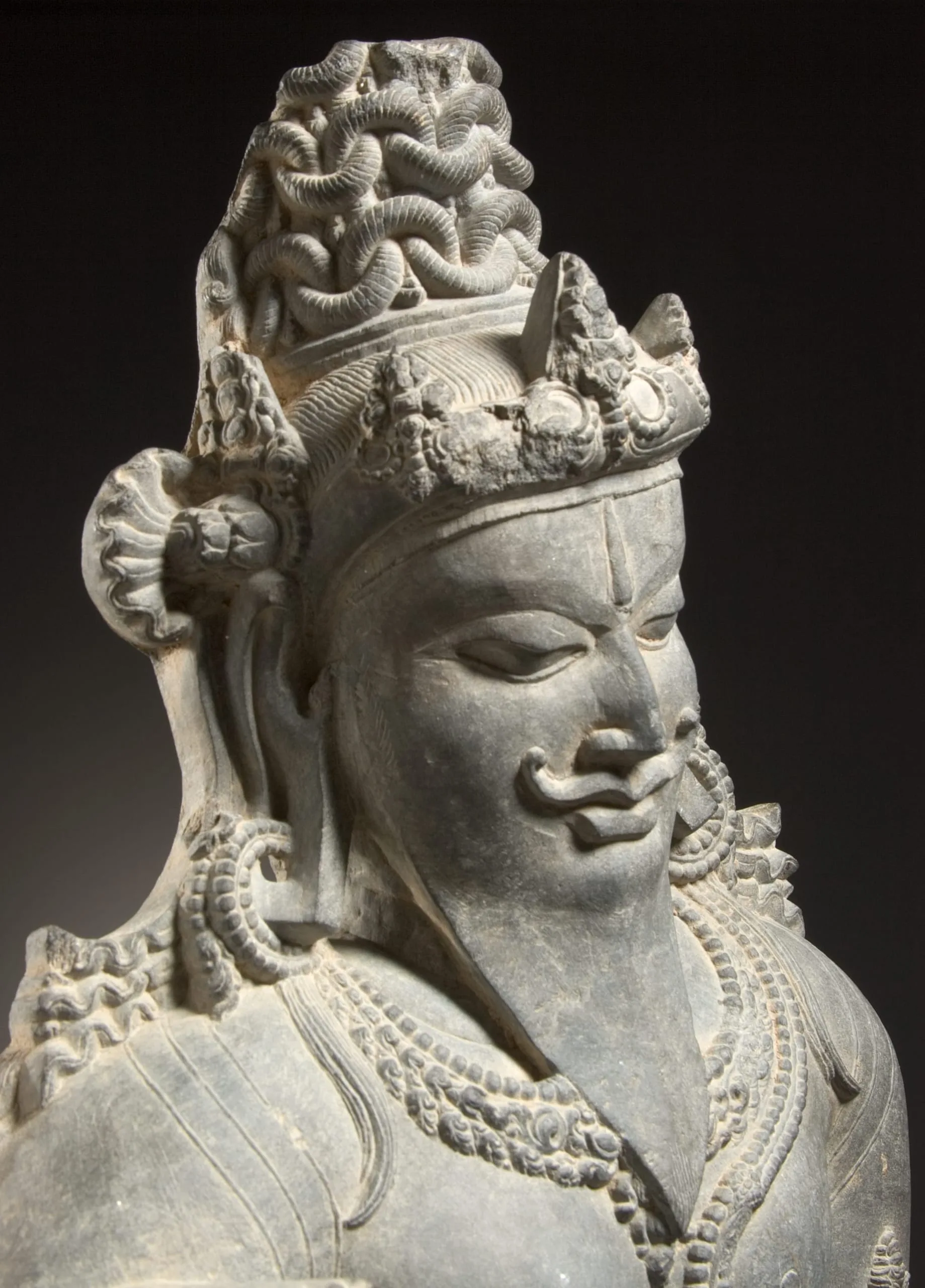
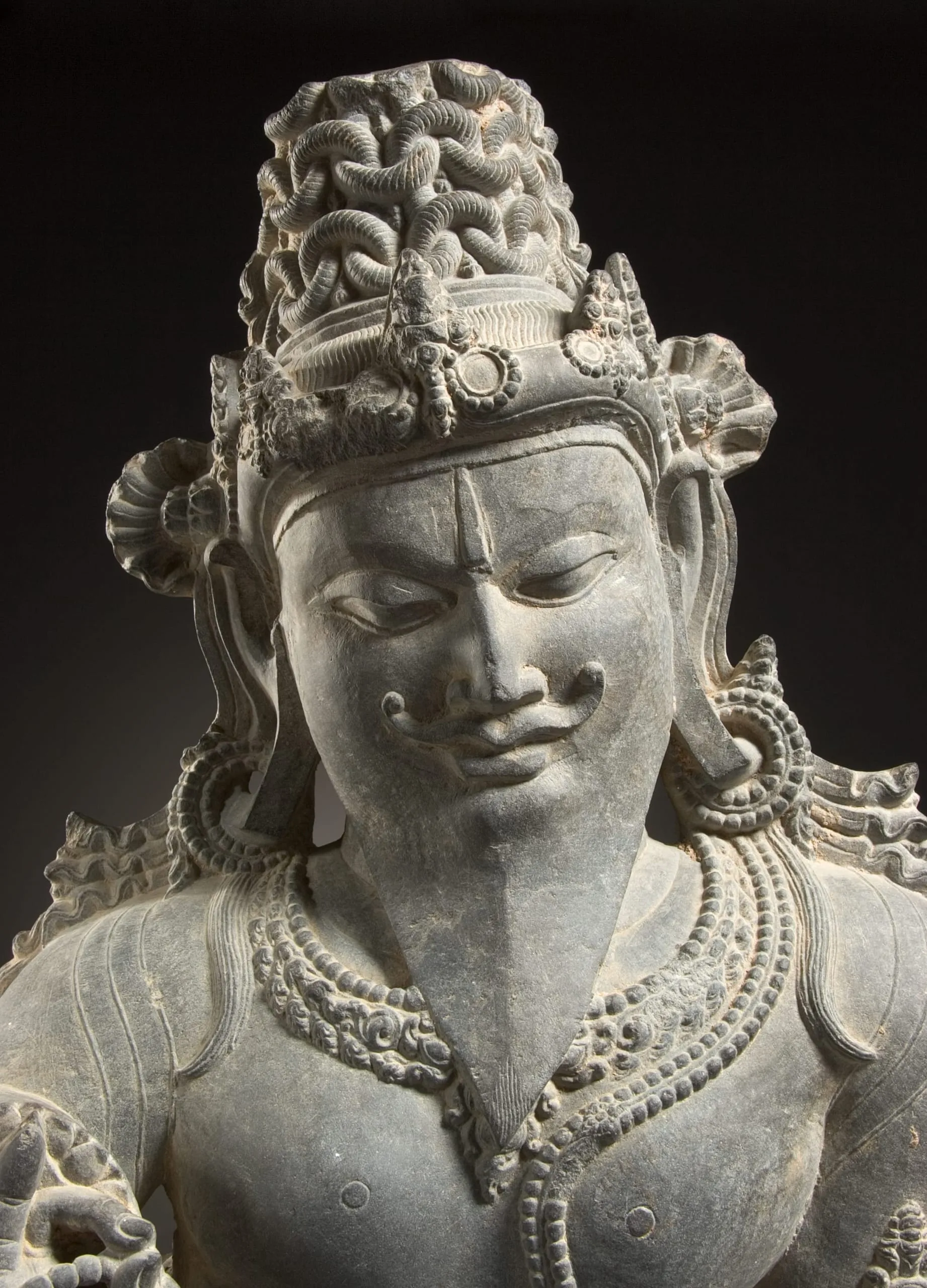
Stone sculpture, close-up of a deity figure with an elaborate crown of coiled hair, a third eye on the forehead, curled mustache, and layered beaded necklaces, with finely carved surface detail against a dark background.
Gray stone sculptural relief, lower portion of a large standing deity on a double-lotus pedestal, flanked by two smaller attendant figures in dynamic poses with jewelry and crowns, additional small figures carved along the base, finely detailed beaded ornaments and layered petals throughout.
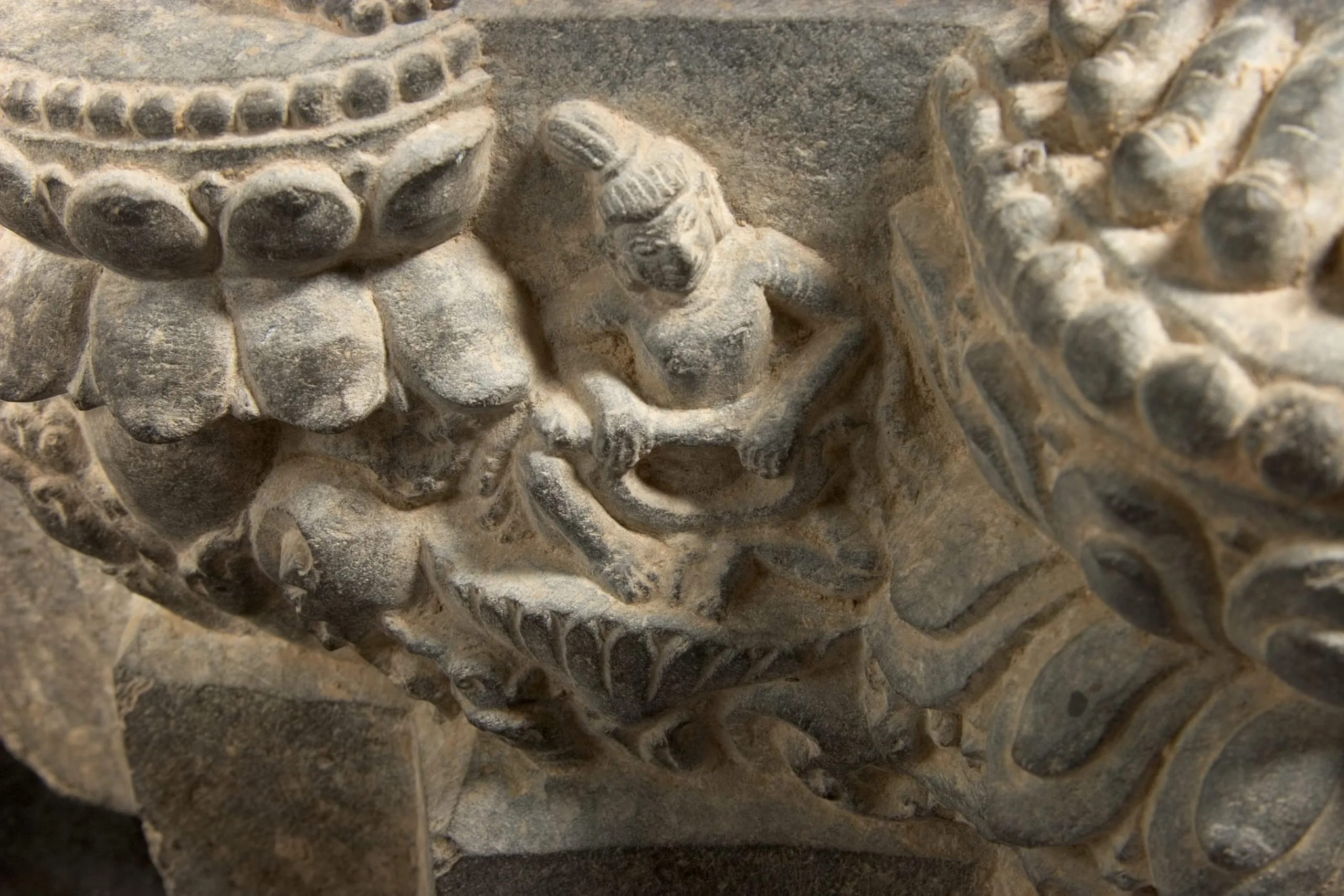
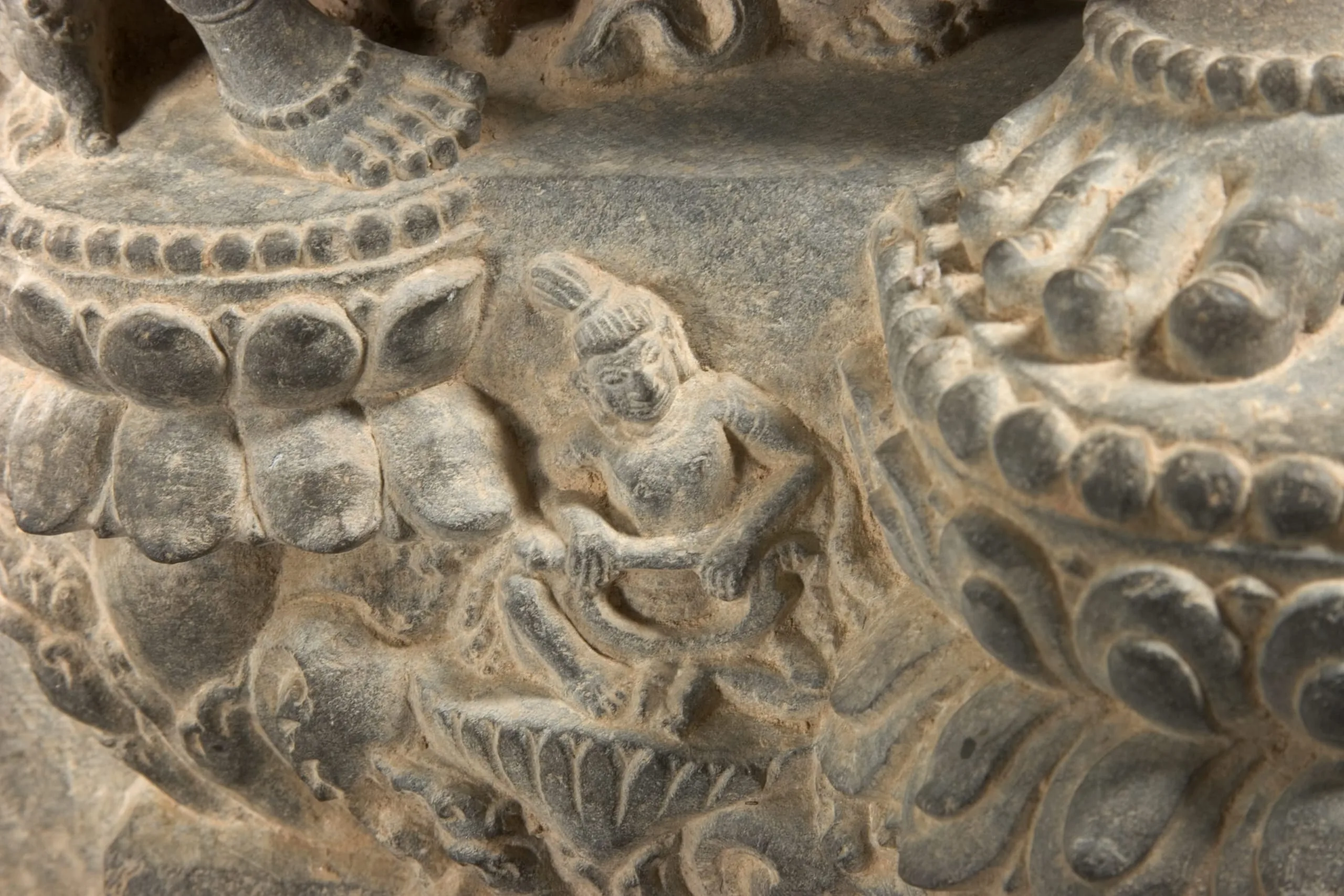
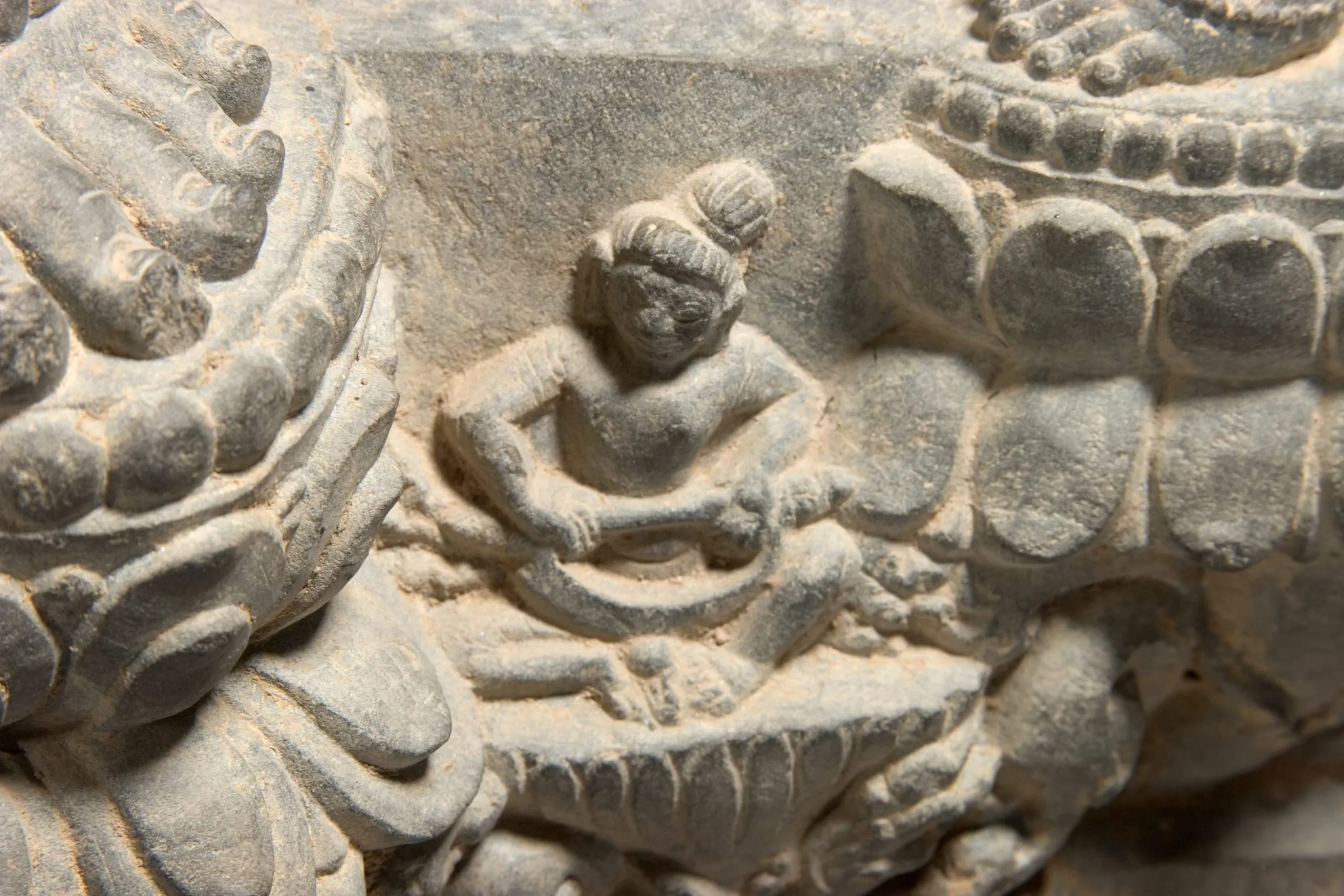
Close-up of gray stone relief carving showing a small seated figure with headdress amid lotus petals and beaded borders, with larger carved forms at the edges.
Stone relief carving of a standing male figure in a dynamic tribhanga pose, wearing elaborate jewelry, armbands, and a pleated dhoti; detailed crown and large circular earrings; gray granite with worn surface texture.
Stone relief carving, close-up detail showing a small seated figure with topknot hairstyle surrounded by large-scale decorative elements including beaded borders and petal or scale forms in gray stone.
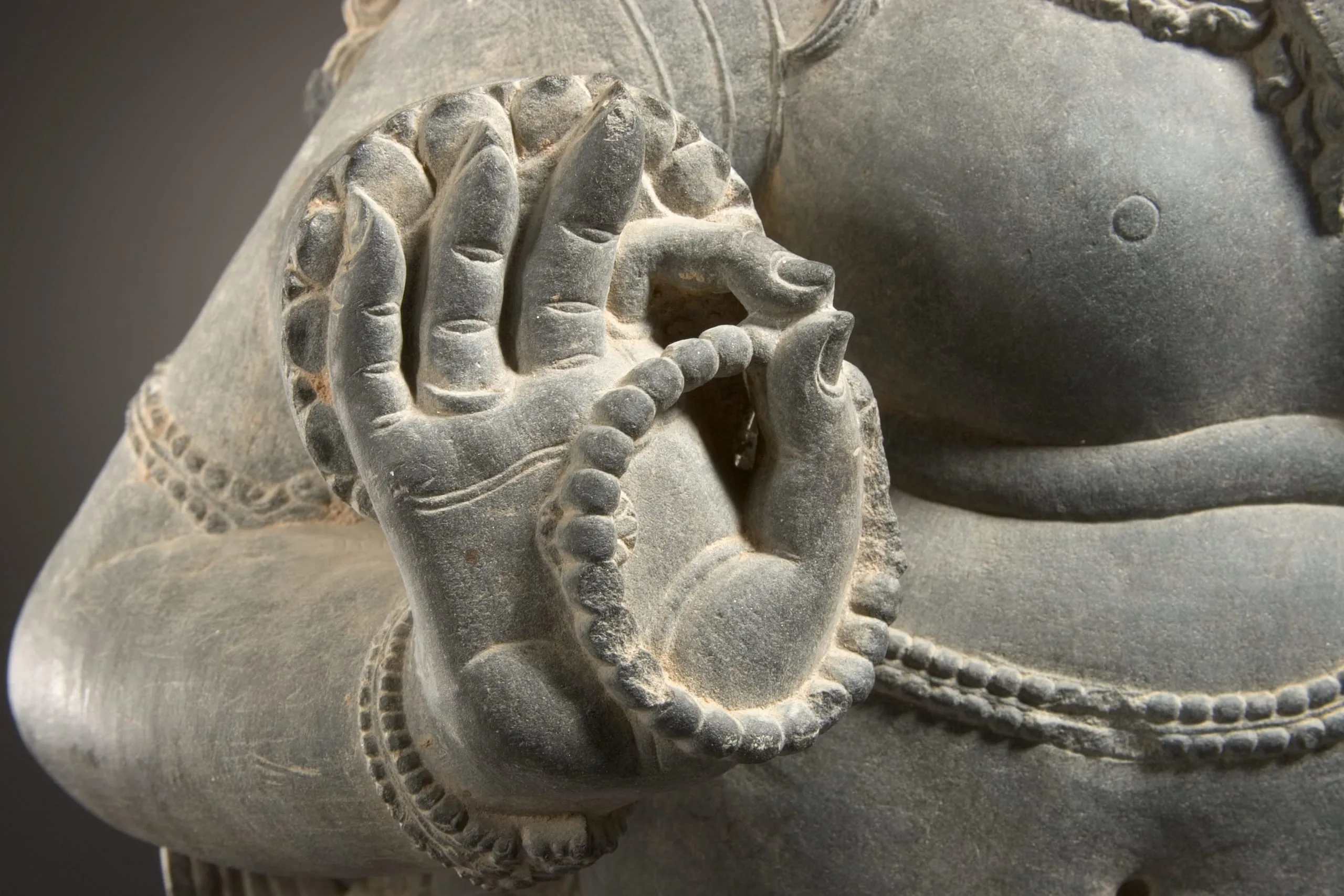
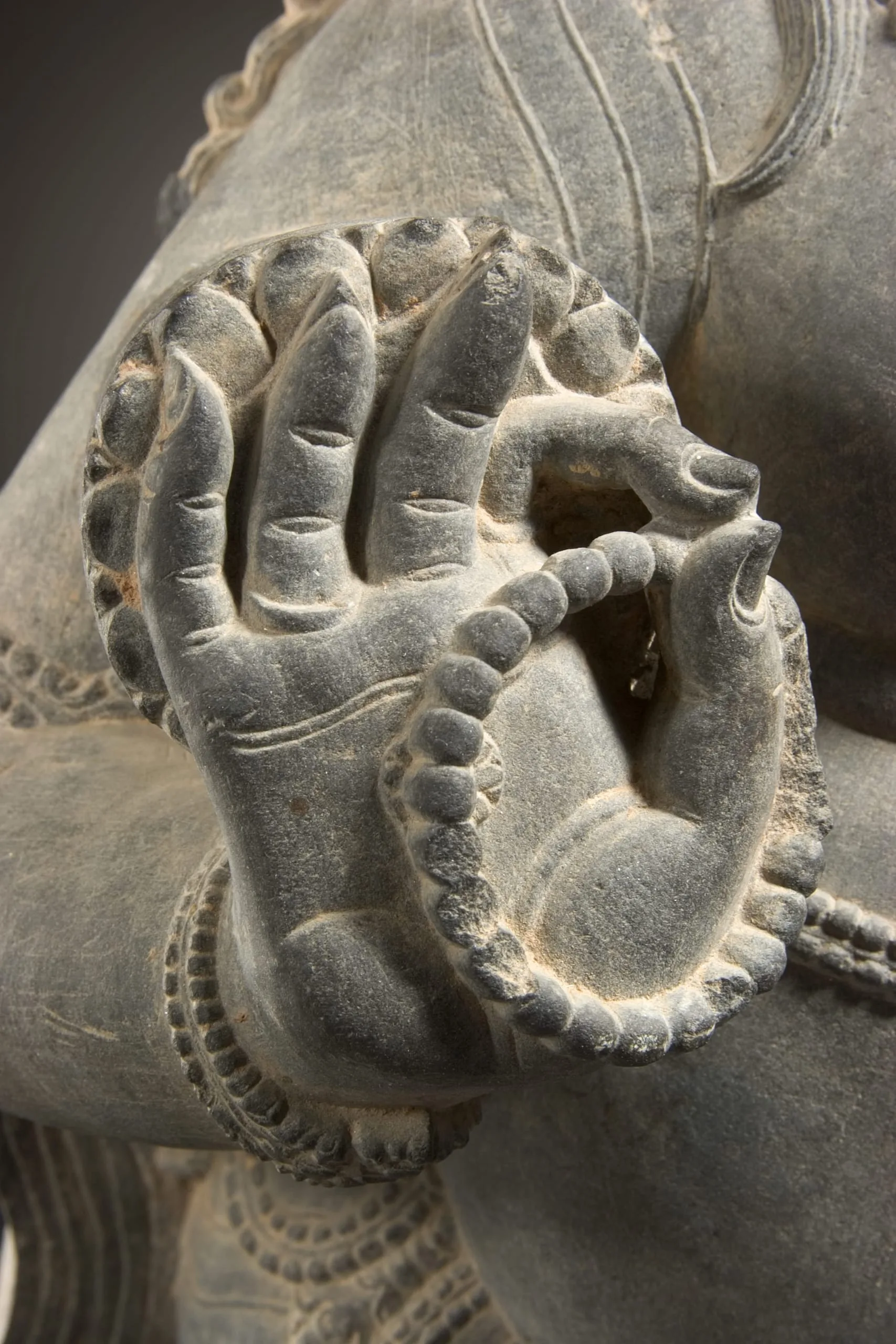
Close-up of a gray stone sculpture showing two hands in a mudra gesture, adorned with beaded bracelets and a strand of beads across the torso, with finely carved finger detail.
Close-up detail of a gray stone sculpture showing two hands, one large with palm facing outward and one smaller forming a gesture, encircled by a beaded garland, with finely carved bracelets visible.
Stone sculpture, close view of a deity figure wearing an elaborate crown of coiled forms, large circular ear ornaments, and layered bead necklaces, with downcast eyes and finely carved facial features against a dark background.
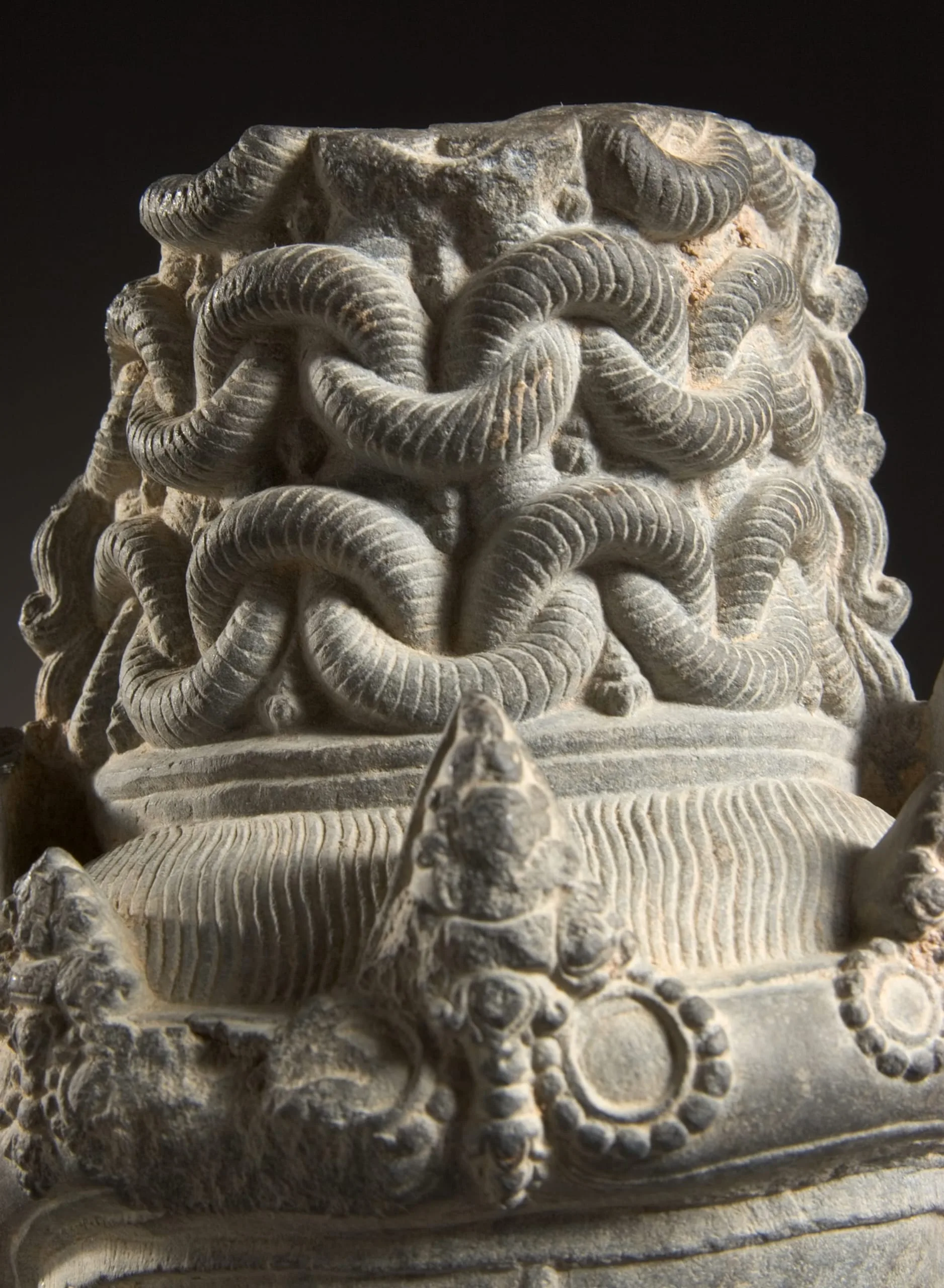
Gray stone sculpture fragment showing an elaborately carved crown or headdress with intertwined coiled serpents above tiered registers of finely incised vertical lines, with beaded circular medallions at the lower edge.
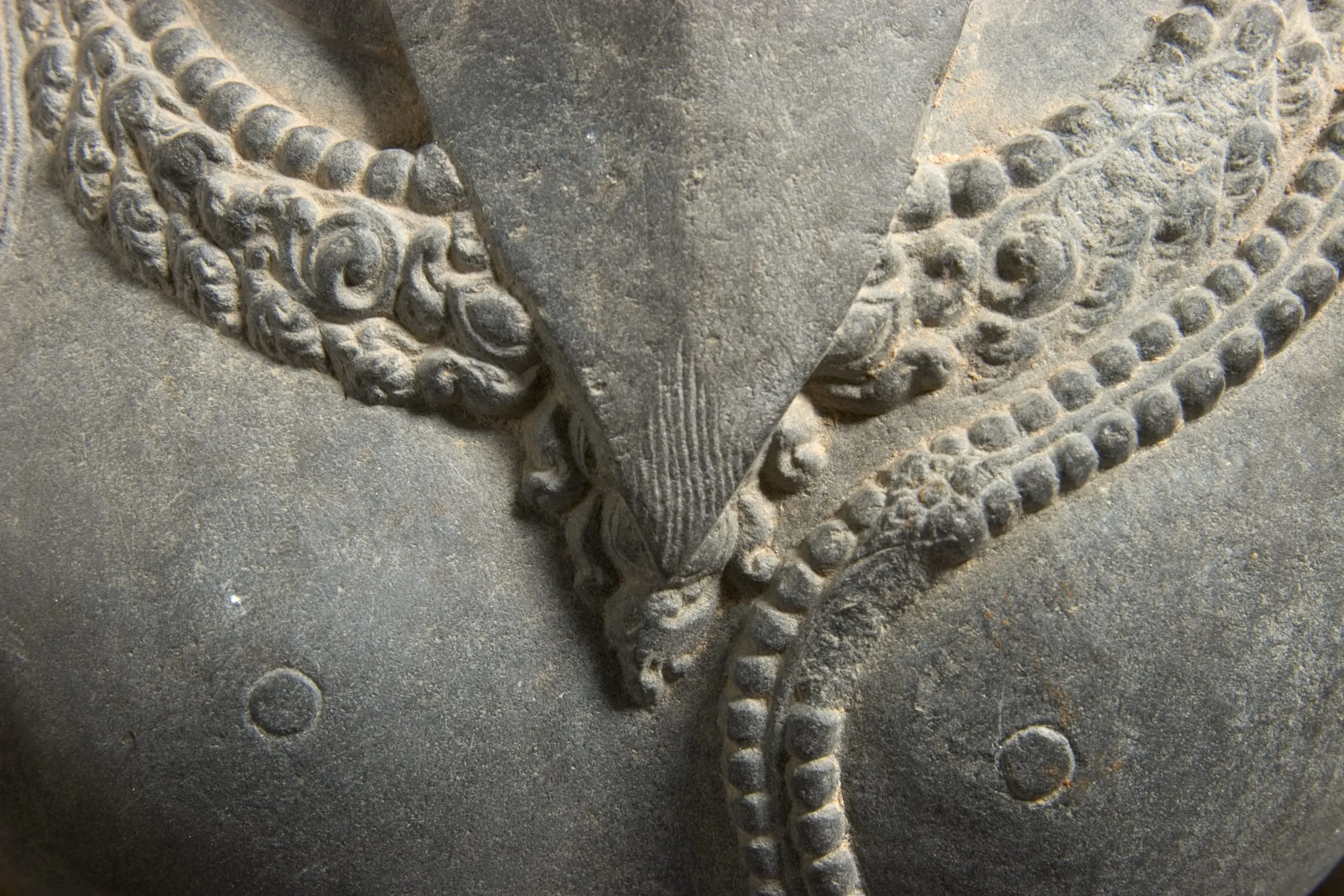
Close-up detail of a gray stone sculpture showing a chest adorned with two carved necklaces of beaded strands, joined at center by a small zoomorphic clasp with scrolling decorative elements.
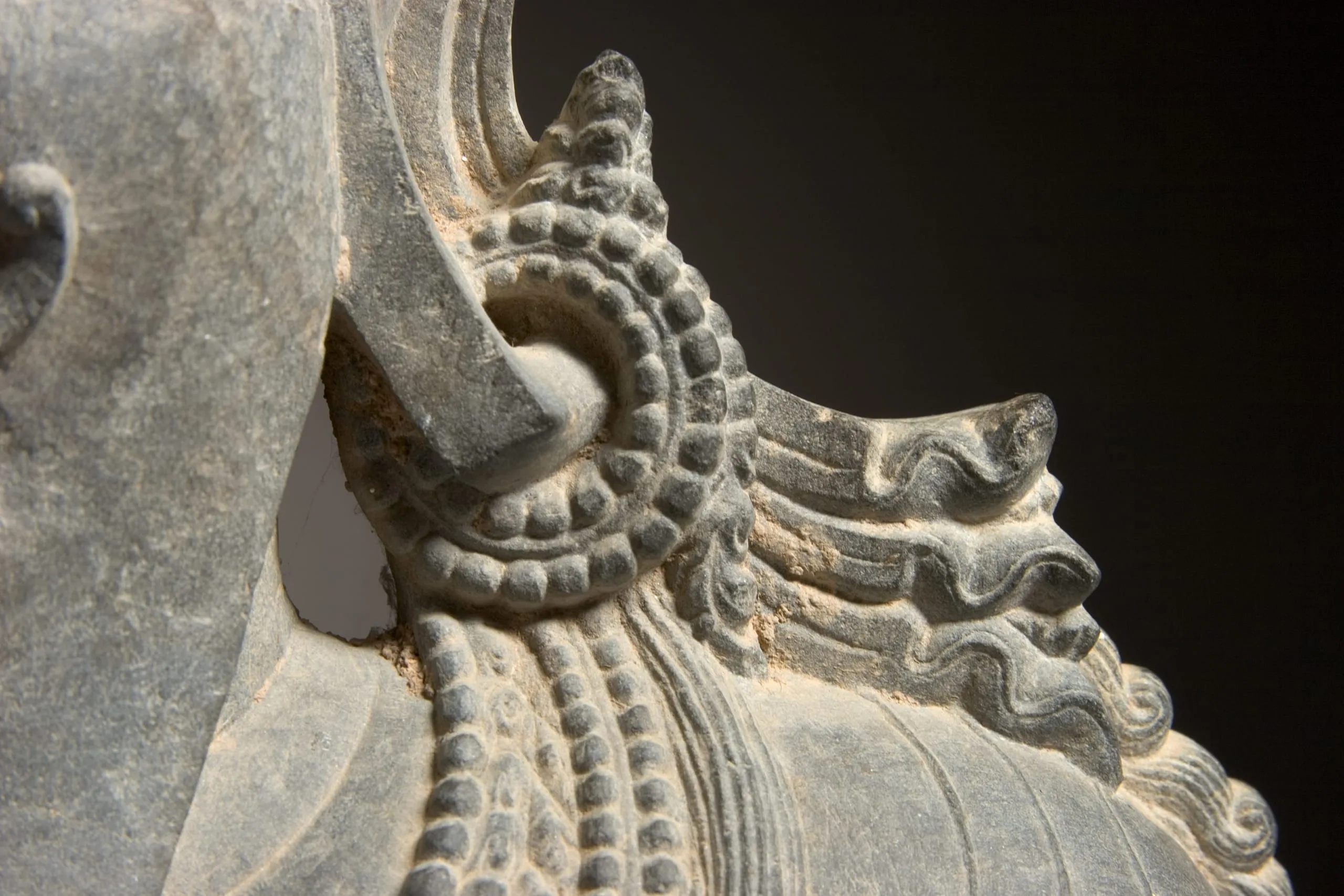
Close-up detail of a gray stone sculpture showing an ornate shoulder or neck joint with rows of carved beaded strands, a circular boss, and undulating flame-like projections with fine surface carving.
Stone relief carving, close-up detail showing a small human figure amid dense foliage and scrolling forms, bordered above by a beaded molding and lotus petal frieze, weathered gray stone surface.
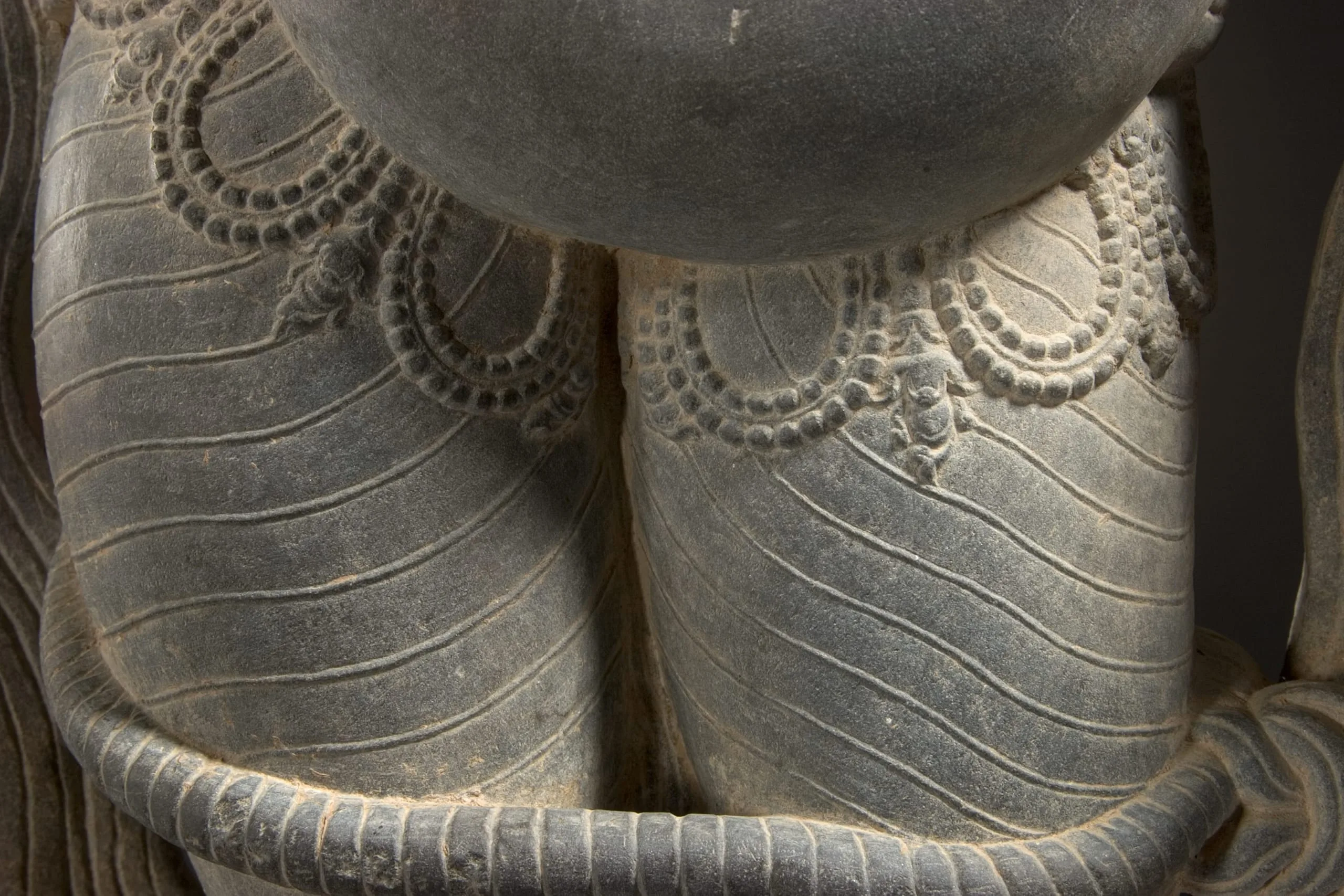
Close-up of a gray stone Buddhist sculpture showing draped robes with carved parallel wave folds and a beaded necklace with dotted borders across the chest.
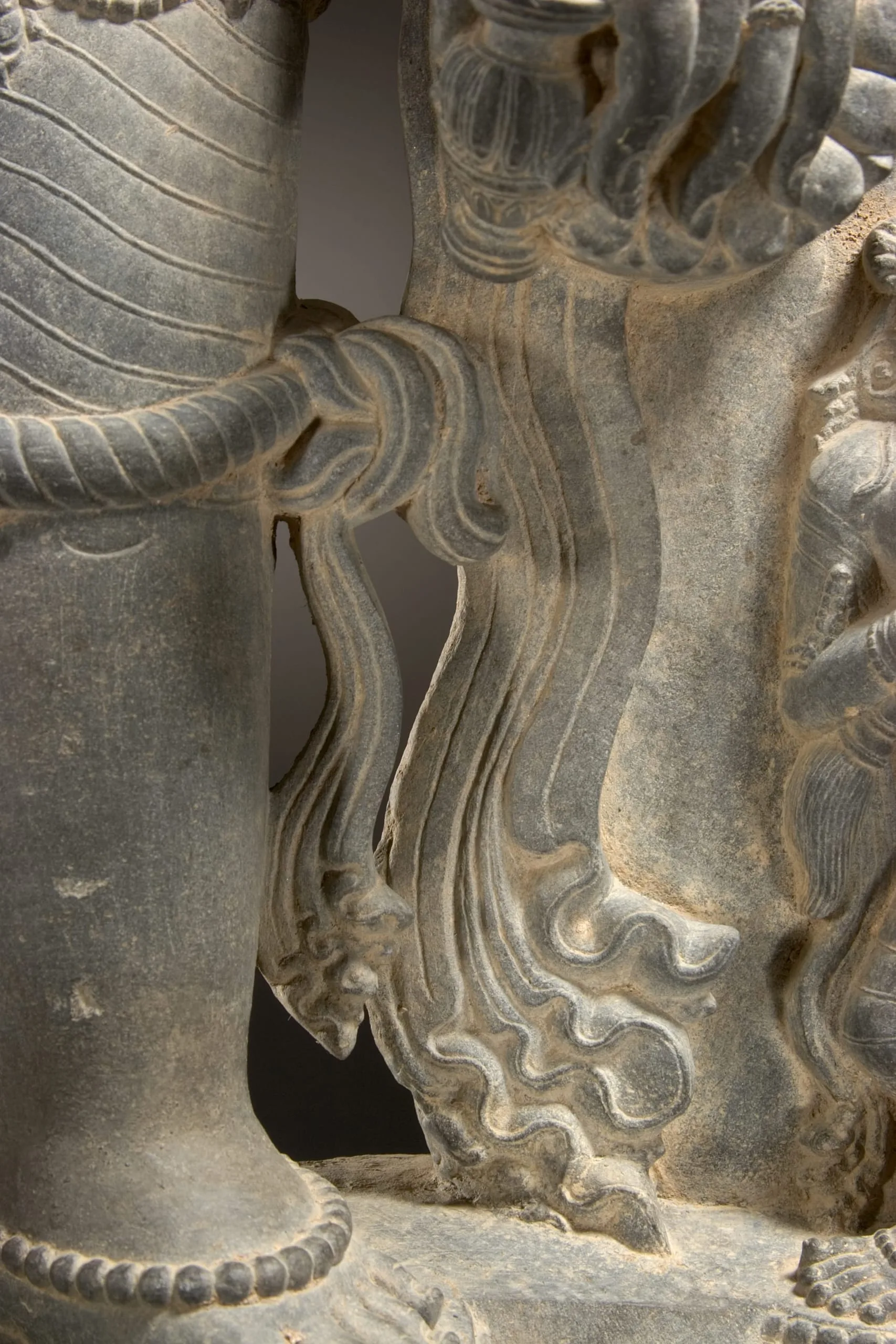
Close-up detail of a gray stone sculpture showing a hand grasping a cylindrical object, with deeply carved flowing drapery and flame-like decorative elements below, smooth weathered surface.
Stone sculpture, upper torso and head of a bodhisattva figure wearing an elaborate crown with coiled forms, beaded jewelry, and draped robes, with finely carved facial features and downcast eyes, gray weathered surface against a dark background.
Stone sculpture of a standing figure with a lion head, adorned with beaded jewelry, armlets, and elaborate lower garments, carved in relief against a stone slab with finely detailed surface work.
Gray stone relief sculpture of a standing deity figure, headless, with rounded torso, ornate beaded necklace, and knotted sash at the waist; flanked by a carved prabhavali (backplate) with foliate edges; fine surface detailing throughout.
Close-up of a gray stone sculpture showing a hand with a decorated bracelet resting atop a circular lotiform base, holding a small carved vessel; finely detailed finger joints and incised ornamental patterns visible.
Close-up detail of a gray stone sculpture torso, showing finely carved jewelry including a multi-strand necklace with a knotted pendant and draped chains, with a sacred thread across the chest.
Stone relief carving depicting a seated figure with an elaborate headdress, upper body bare, in a dynamic twisted pose surrounded by scrolling foliage and architectural elements in weathered gray stone.
Stone relief carving depicting a seated figure with upswept hair, positioned within a large lotus flower, hands engaged in an activity at center; surrounded by additional lotus blooms, leaves, and aquatic creatures in low relief.
Stone sculpture fragment showing a close-up of crossed arms and hands adorned with beaded bracelets, with carved textile details and decorative necklace visible, gray stone with weathered surface
Artist or Maker
Unknown
Title
The Maharishi (Great Sage) Agastya
Place Made
India, Bihar, Lakhi Sarai
Date Made
12th century
Medium
Chloritoid phyllite
Dimensions
26 3/4 x 14 1/4 x 4 3/4 in. (67.945 x 36.195 x 12.065 cm) Base (On base): 30 x 16 x 5 3/4 in. (76.2 x 40.64 x 14.605 cm)
Credit Line
Gift of the 2005 Collectors Committee
Accession Number
M.2005.30
Classification
Sculpture
Collecting Area
South and Southeast Asian Art
Curatorial Notes

This incomparable image of the revered Hindu sage Agastya is believed to be the only surviving representation of Agastya from medieval eastern India. The historical Agastya is believed to have been born in the 7th century in the ancient holy city of Banaras (modern Varanasi) in north India. In his early life, he was a great sage and religious ascetic. Then, after marrying a beauty queen and having a large family in order to fulfill a prophecy enabling his ancestors to go to heaven, Agastya moved to south India, where he and his descendants are credited with being responsible for the introduction of Hinduism and the worship of the important god Shiva. Agastya is also believed to have taught south Indians medicine and grammar, invented the eloquent Tamil language of south India, and even written a treatise on making religious images for temples. His biography was further embellished by being merged with the mythological exploits of another great sage, also named Agastya, whose momentous deeds had been praised in even more ancient Indian literary works. He is thus said to have had a miraculous birth, had mastery over mountains (hence, the meaning of his name: "Mover of Mountains"), and once even swallowed the entire ocean to expose a hoard of demon terrorists. This magical feat enabled him to travel to Cambodia and Indonesia, where he is recorded in ancient inscriptions and textual references as having founded numerous temples dedicated to Shiva. See also M.90.117.1.

See Stephen Markel, "Further Observations on Some Unusual Aspects of a Recently Acquired Pāla Masterpiece in the Los Angeles County Museum of Art," in Prajñādhara: Essays on Asian Art, History, Epigraphy and Culture in Honour of Gouriswar Bhattacharya, 2 vols., ed. G. Mevissen and A. Banerji (New Delhi: Kaveri Books, 2009), pp. 2: 281-287.
Selected Bibliography
  • El Universo de la India: Obras Maestras del Museo de Arte del Condado de Los Angeles. Santiago: Centro Cultural Palacio La Moneda, 2012.