LACMA

ShopMembershipMyLACMATickets
LACMA
Los Angeles County Museum of Art
5905 Wilshire Blvd.
Los Angeles, CA 90036
info@lacma.org
(323) 857-6000
Sign up to receive emails
Subscribe
© Museum Associates 2026
  • About LACMA
  • Jobs
  • Building LACMA
  • Host An Event
  • Unframed
  • Press
  • FAQs
  • Log in to MyLACMA
  • Privacy Policy
© Museum Associates 2026
Collections

Unknown
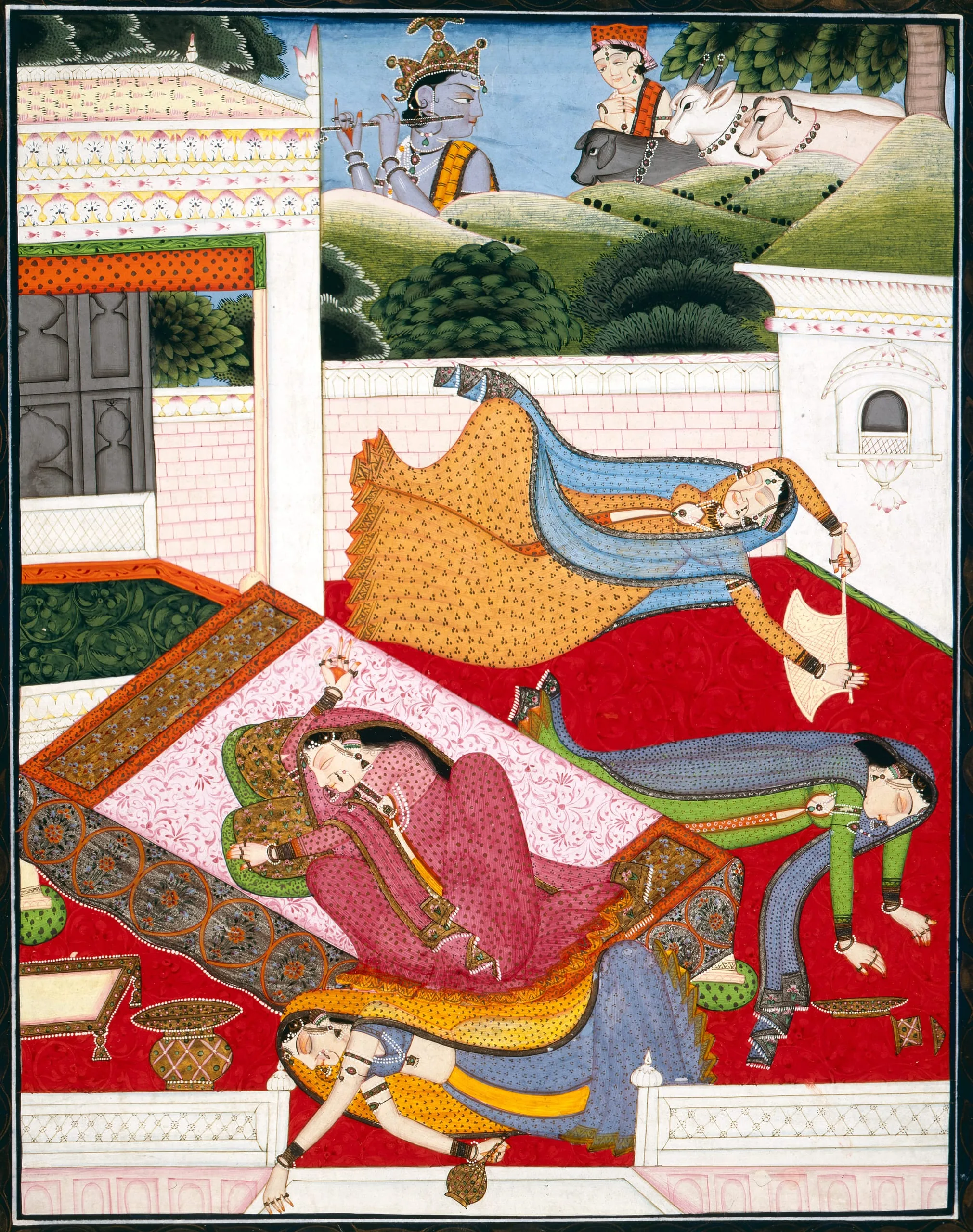
Krishna's Fluting Causes the Palace Women to Swooncirca 1830-1840

Not on view
Indian miniature painting, multiple figures on a red terrace including a reclining woman in pink and a prostrate woman in yellow, with blue-skinned divine figures in a green landscape above

Unknown, Krishna's Fluting Causes the Palace Women to Swoon, circa 1830-1840, Los Angeles County Museum of Art, Gift of the Joseph B. and Ann S. Koepfli Trust in honor of Dr. Pratapaditya Pal, photo © Museum Associates/LACMA

Artist or Maker
Unknown
Title
Krishna's Fluting Causes the Palace Women to Swoon
Culture
South Asia
Place Made
India, Himachal Pradesh, Hindur (?)
Date Made
circa 1830-1840
Medium
Opaque watercolor and gold on paper
Dimensions
Image: 9 1/2 x 7 1/4 in. (24.13 x 18.42 cm); Framed: 20 5/8 x 15 1/2 in. (52.39 x 39.37 cm)
Credit Line
Gift of the Joseph B. and Ann S. Koepfli Trust in honor of Dr. Pratapaditya Pal
Accession Number
M.2011.156.3
Classification
Drawings
Collecting Area
South and Southeast Asian Art
Curatorial Notes

Krishna is the Hindu god of devotion and an incarnation of the god Vishnu, the preserver of the universe. Krishna’s life stories and artistic depictions celebrate various aspects of his character: his triumph over demonic forces; his role as an adorable, mischievous child; and his amorous youth sporting in the Vrindavan forest with herdswomen, including Radha, his principal consort. Krishna’s romantic encounters embody the devotional practice of bhakti, a form of worship marked by a loving adoration for the deity. When Krishna plays his flute to call his female devotees to dally with him in spiritual bliss, it is a metaphor for the soul’s attraction for union with the transcendent god. The flute’s enchanting melodies function as a mantra to disrupt social strictures and enable the worshipper to aspire towards enlightenment and religious rapture.

In the painting’s upper register, Krishna is playing his flute while accompanied by cows and a cowherd. In the palace courtyard below, Radha or another paramour (reclining on the bed) and her three maidservants have swooned from the flute’s melodious sounds.

According to a rubber stamp impression on the verso, the painting was formerly in the collection of Dr W.B. Manley (1885-1972), who served in the Indian Police in the Bombay Presidency from 1905-1924 and as an officer in the Bengal Lancers from 1917-1919. Another rendition of this composition attributed to Mandi, c. 1820-30 is in the Victoria & Albert Museum, London (IS.30-1949).
Related Unframed

The Abiding Wonder of Alien Eyes
  • October 25, 2012