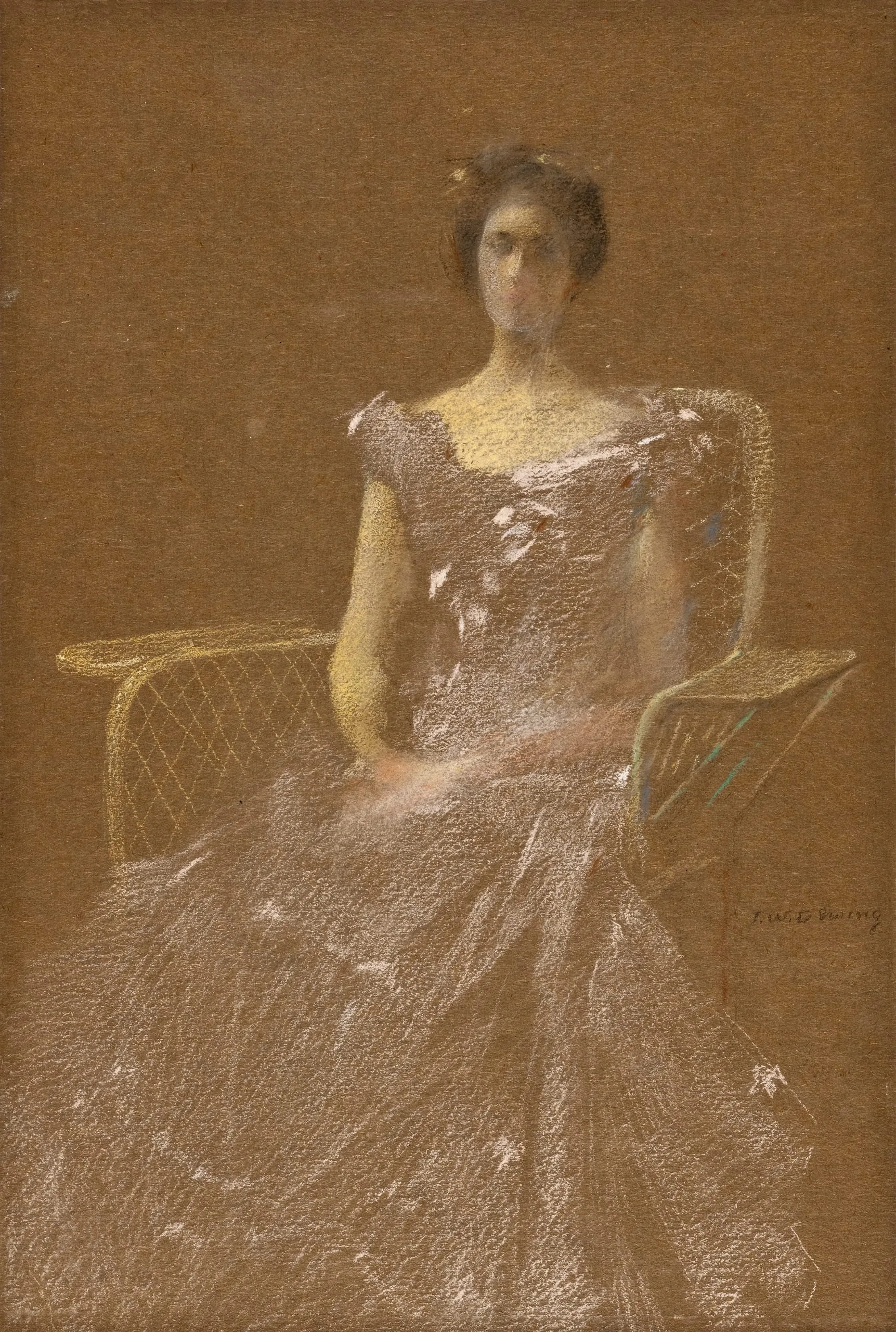
During the last quarter of the nineteenth-century artists in Europe, England, and the United States changed their attitude towards watercolor and pastel, no longer perceiving of them as only media for preparatory work. They were admired now for their intrinsic qualities and deemed as finished, independent works. As a result, artists began exhibiting them as such. Working in pastel became so popular in the United States that a group of New York artists in 1884 organized the Society of Painters in Pastel.
In 1890 Thomas Dewing, one of America's premier figure painters, adopted pastel, and within a short time became one of the leading proponents in the field. The medium was a perfect match for his subject matter and aesthetics. Dewing specialized in elegant and poetic interpretations of upper class young women, usually enveloped in a haze of atmosphere or mist. Whether set in a garden or a room, his lovely women seem quite unreal, their beautiful faces idealized into aristocratic portraits and their sweeping gowns transformed into diaphanous gauze. All appears dreamlike. Pastels allowed Dewing to convey an even greater sense of insubstantiality and softness than did his oils. The young woman sitting in the rattan chair definitely exists as her upright posture and strong shoulders indicate, but the shimmering gown that swaths her body seems to almost disappear. "Beauty for beauty's" sake became the aesthetic motto of Dewing's world.
Dewing probably first explored the new graphic medium as a result of his seeing James A. M. Whistler's popular 1889 exhibition of pastels at Wunderlich Gallery in New York City. Dewing was a great admirer of the American expatriate as they shared similar attitudes towards art. Dewing would eventually visit Whistler in Europe and study his work at the home of Charles Freer, whose collection included many examples by Whistler. As did Whistler, Dewing viewed subject matter only as a means to create an art that went beyond recording. With both men, an art work constituted its own formal elements and references to the exterior world were minimized. Both men viewed painting and drawing as visual harmonies analogous to the concept of music.
Dewing also borrowed from Whistler a preference for small scale and the use of colored paper (Dewing preferred a finer texture). He followed Whistler's practice of cutting the paper into approximately 10 1/2 x 6 3/4 in. format until around 1920 when he began producing larger examples specifically for exhibition.
In 1909, Dewing also began adding a small number below his signature for record keeping. As Lady in Rattan Armchair does not have such a number, it dates from before that time. This drawing will be the first work by Dewing to enter LACMA's collection, complimenting the collection of late nineteenth-century figure painting.