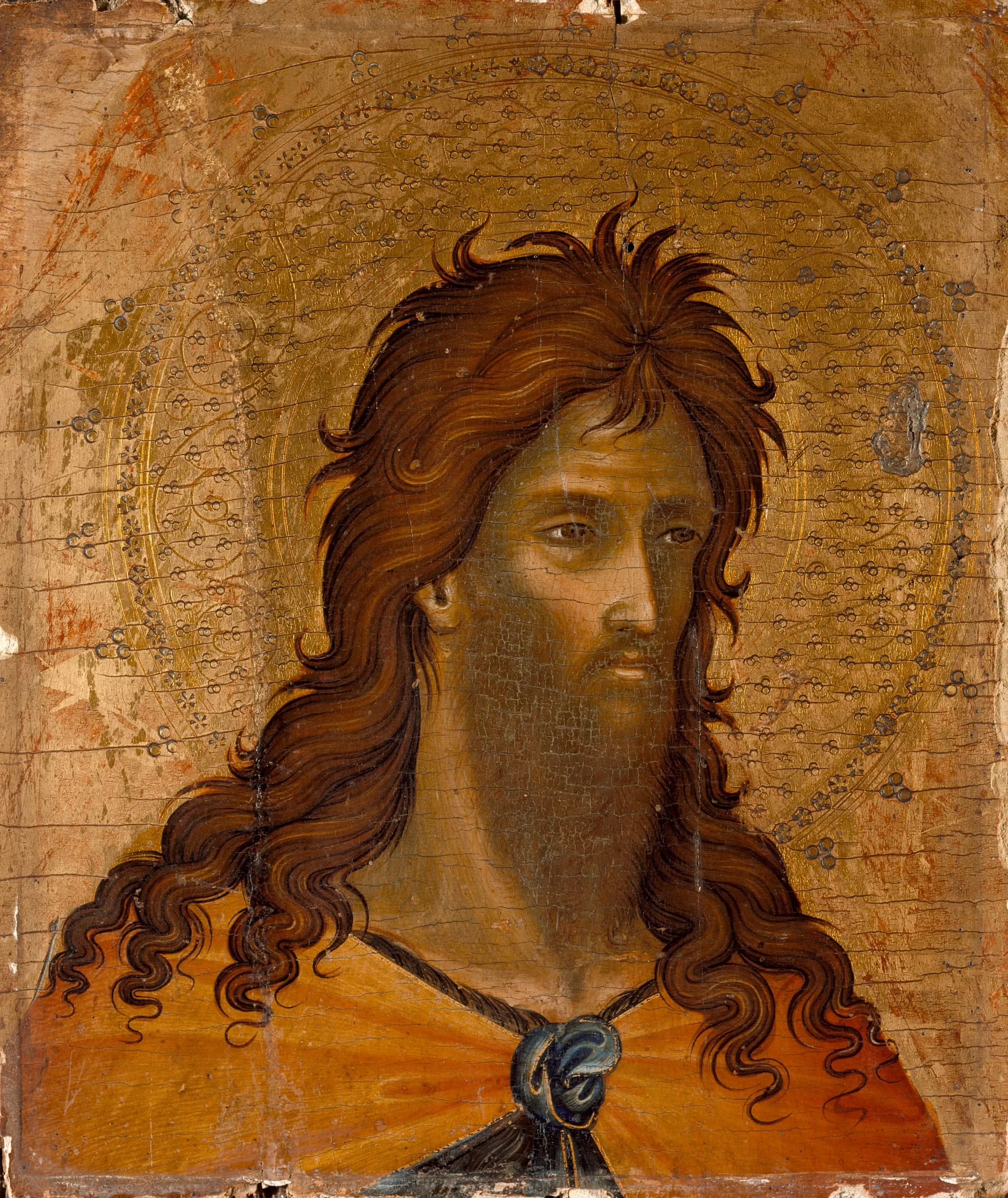
Saint John the Baptist, with shaggy flowing brown hair and long beard, gazes at something beyond the picture’s frame. An orange and blue cloak is fastened by a knot at the center of his chest, beneath which we catch a glimpse of his traditional camel-hair shirt. A major figure in biblical history, John was a member of an ascetic sect and a follower of Christ. According to the Gospel of Luke, he was the first to understand Christ as the Messiah, a recognition that came in the womb when his mother Elizabeth met with the pregnant Virgin Mary. The small panel likely belonged to a larger altarpiece, although its original viewing context remains a mystery. All four sides of the wood show signs that it has been cut down, suggesting that the image was once a large half- or full-length standing figure. The top of the panel was also likely arched, indicating a gilded engaged frame.
It was common for altarpieces of this period to feature individual saints set into separate architectural niches. Despite this painting’s uncertain provenance—it was unknown before its donation to the museum—it has been stylistically attributed to Paolo Veneziano, an innovative artist hailed as one of the most important painters active in Venice during the mid-fourteenth century. Not only does this fragment align with Paolo’s distinctive Byzantine-inflected style, it also contains the gold punchwork associated with his workshop. The punchwork forms the saint’s halo, patterned with curvilinear vine tendrils terminating in small circles.
2024