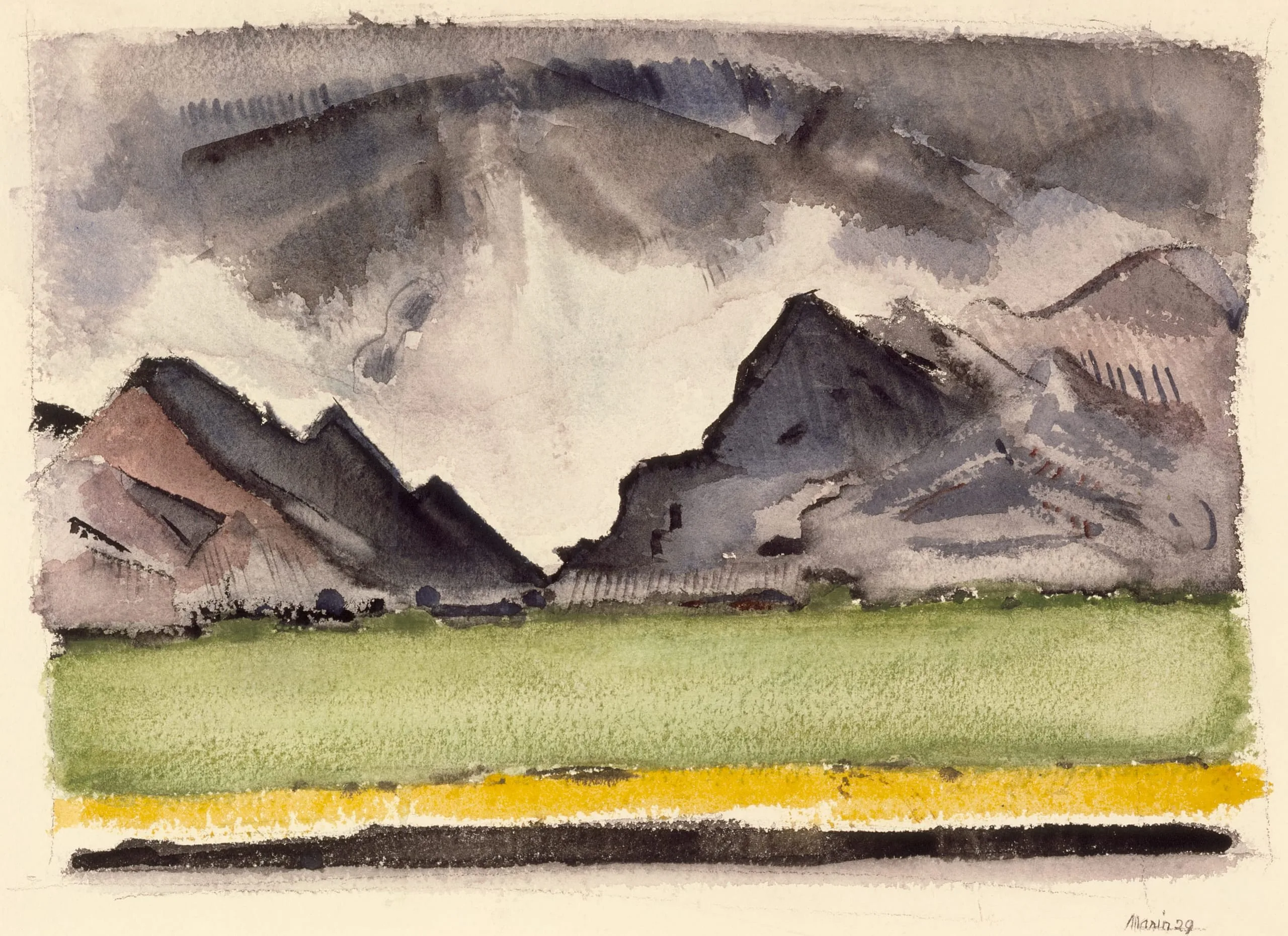
Marin spent the summers of 1929 and 1930 in New Mexico after Georgia O’Keeffe (1887-1986) and Rebecca Strand, wife of photographer Paul Strand, urged Mabel Dodge Luhan to extend an invitation to him. Marin was eager to leave the city and visit the Southwest, having become tired of "living in herds." He immediately responded to the expansive, wideopen land. While maintaining an allegiance to nature, Marin distilled the elements of the desert and mountains, coming close to abstraction.
According to art historian Van Deren Coke the setting for this watercolor is the area north of the Arroyo Seco, looking northeast toward the entrance of Hondo Canyon. Marin exaggerated the angularity and sharpness of the mountain slopes and peaks and flattened, simplified, and tilted up the foreground plain.
With horizontal stripes of gray, black, brilliant yellow, and bright green he succinctly summarized the flat, open spaces of the plateau. In few New Mexican watercolors of 1929 was Marin so extreme in his synthesis of visual elements, for he usually delineated the sagebrush more literally with swirling brushwork. Marin contrasts the angularity and grayness of the stormy sky and mountains with the plains, creating a visual tension analogous to the sensation felt as a storm approaches.
New Mexico, near Taos was one of the first of Marin’s New Mexico watercolors to be acquired by a public institution when it was bought by the Los Angeles Museum in 1947.