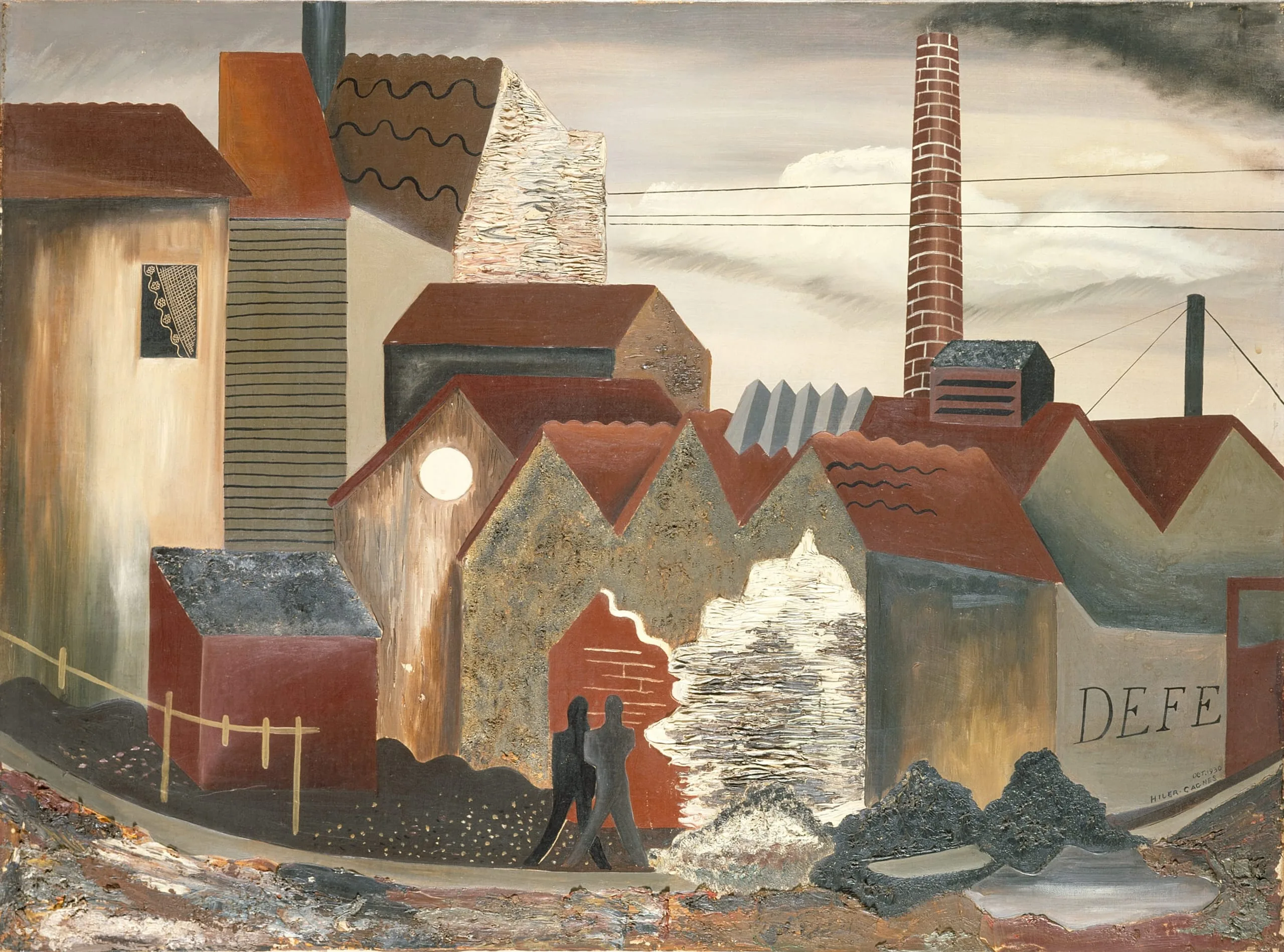
Around 1928 Hiler began to omit the figures from his urban views and focus on the city’s buildings as cubic forms and geometric planes. Eventually, as in Factories at Lyon, he also combined flatly painted surfaces with highly impastoed, striated areas. The textured areas often took on a life of their own, divorced from the overall scene, thereby destroying an already limited sense of painted reality. When Hiler included an occasional figure, he often presented it as a silhouette, as he did here, thereby enhancing the mysterious mood of the scene. Formally, the emphasis on textures relates to synthetic cubism while the flat, planar emphasis of the painting bears a resemblance to some of the precisionist images painted in New York in the 1920s. Not surprisingly, Hiler was a close friend of the artist Niles Spencer (1893-1952). They met in New York around 1917, and when both lived in Paris during the early 1920s they spent many hours discussing artistic issues of subject matter and geometry. However, Hiler’s own abstracted paintings demonstrate a concept invented by him, which Ezra Pound dubbed "neonaturism." As the artist explained in his book Why Abstract?, neonaturism was his attempt to combine design with representation, something which he thought was essential. Hiler felt that for a painting to be successful it had to demonstrate the "physiological appeal satisfying to man’s geometrical instinct through the use of strictly mathematical composition" ("Hiler’s Neo-Naturism in Philadelphia Show," Art Digest 8 [November 1, 1933]: 14).
The painting is inscribed with the name Cagnes, which may refer to the coastal town near Nice on the French Riviera where Hiler lived occasionally during the early 1930s, although the scene has none of the spirit of the resort town. Rather, by his emphasis on geometric, industrial imagery and use of a dark, dingy palette of brown, gray, and black, Hiler captured the spirit of Lyon, which in 1930 was one of the largest cities in France and a major chemical and engineering center.