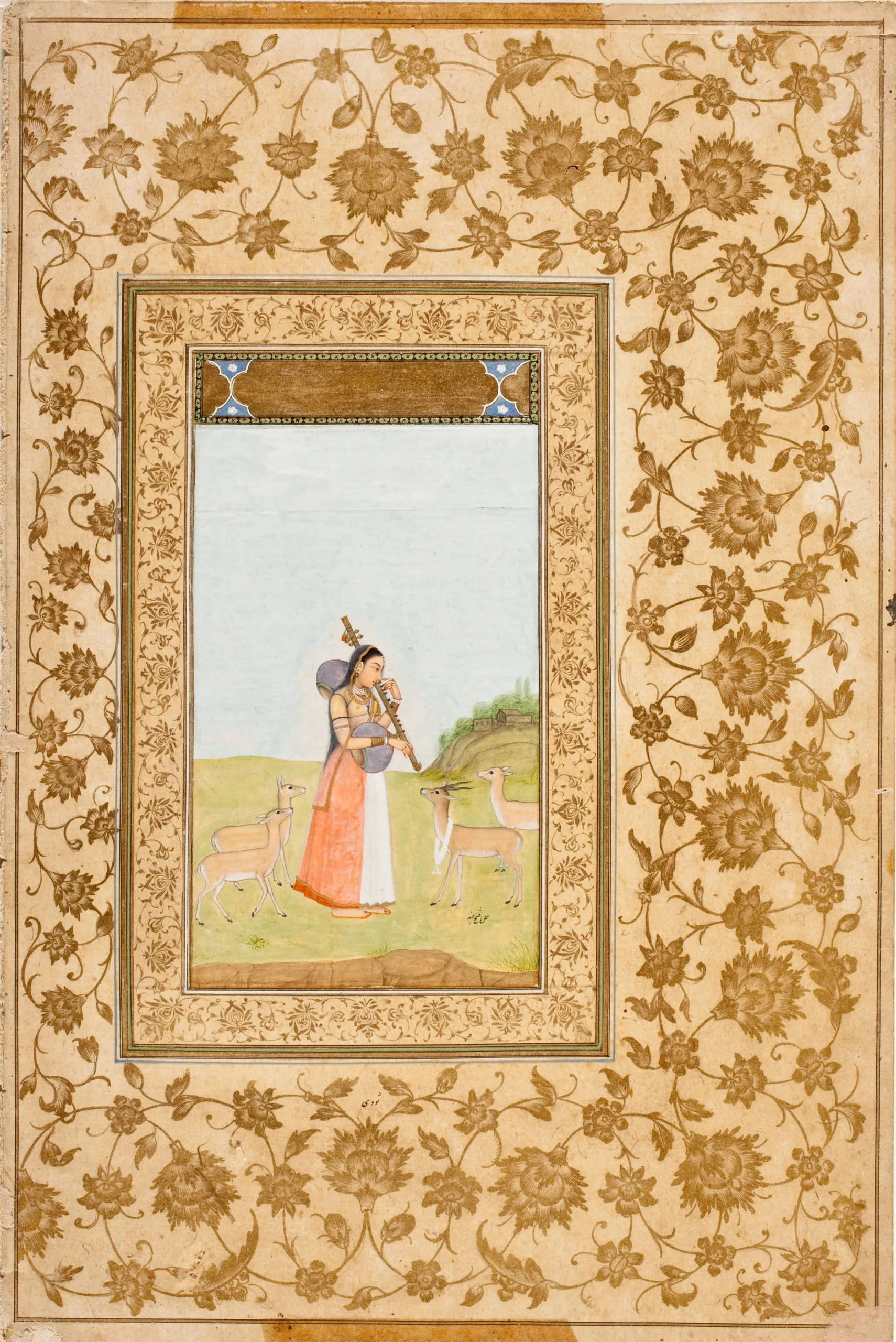
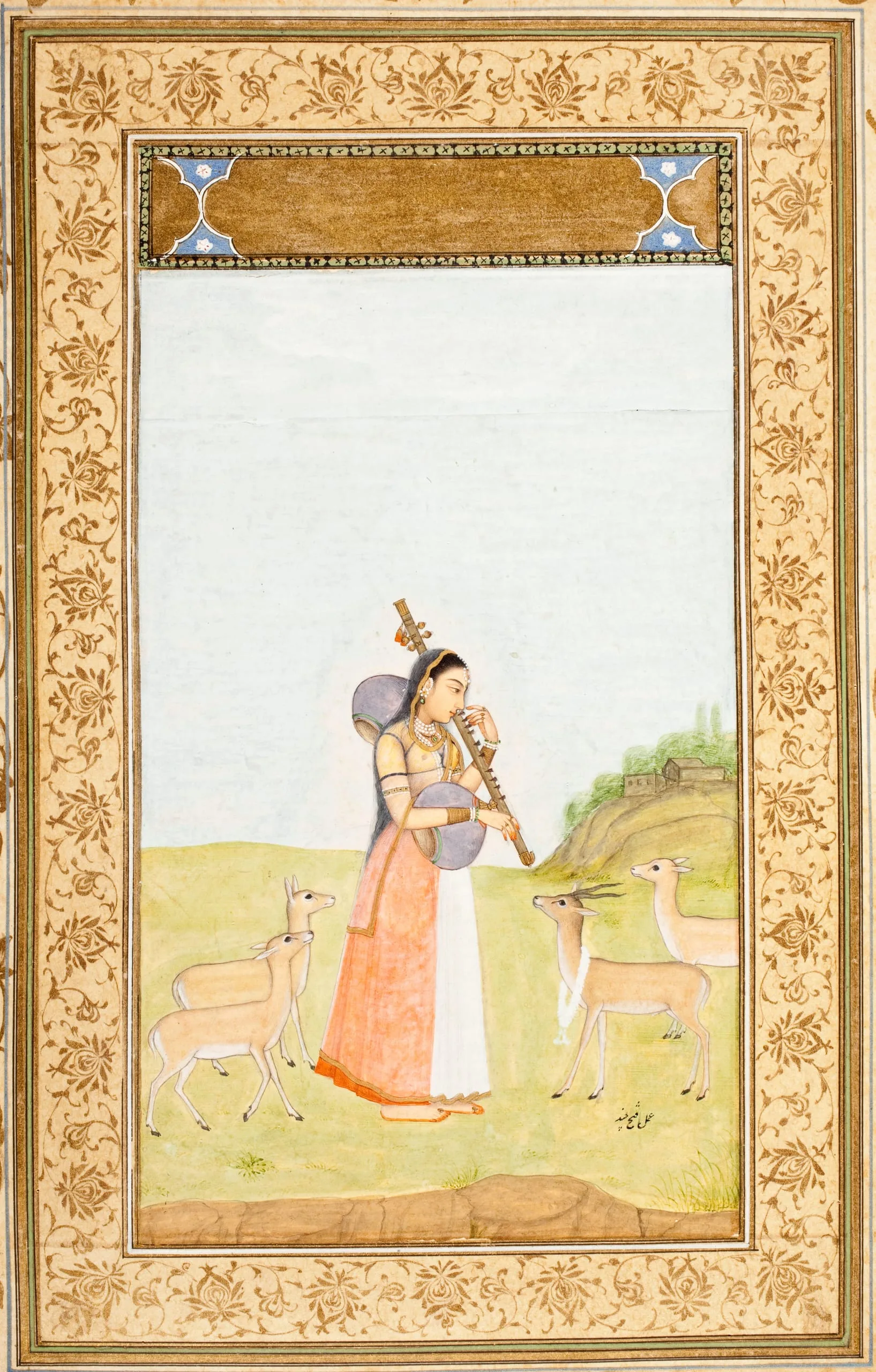
Todi Ragini is the second wife of Hindola Raga in the Rajasthani system of Ragamala classification. Todi Ragini may have originated as a tune sung by village girls who guarded the fields from foraging deer. The song was believed to mesmerize the deer. It is a tender early morning melody associated with winter. Todi Ragini is described in Ragamala poetry as a lovesick woman who walks alone through green groves and sings to the deer. The melody is usually personified as a woman carrying a vina and walking with deer and/or gazelles. She is occasionally shown accompanied by two female companions.
Here, Todi Ragini is envisioned as a woman playing a rudra vina (a stick zither with two resonator gourds). She stands in an open landscape accompanied by deer or gazelles who are mesmerized by her playing. A group of dwellings are roughly sketched on a distant hill. The blind cartouche embellished with gold paint in the header was presumably intended for the name of the ragini. See also M.71.1.42, M.77.130.1, M.77.154.6, and AC1999.127.11.
Fath Chand, whose signature in Urdu is below the garlanded gazelle, is noted for his delicate draftsmanship and subtle coloration. Dispersed in the 1960s, folios from this Ragamala set by Fath Chand and his collaborator, Muhammad Faqirullah Khan (active c. 1720-70) are in the British Library, London (Kakubha Ragini, Add.Or.485), San Diego Museum of Art (Dipak Raga, 1990.385), and the Victoria and Albert Museum, London (Bilaval Ragini, IS.42-1996).