LACMA

ShopMembershipMyLACMATickets
LACMA
Los Angeles County Museum of Art
5905 Wilshire Blvd.
Los Angeles, CA 90036
info@lacma.org
(323) 857-6000
Sign up to receive emails
Subscribe
© Museum Associates 2026
  • About LACMA
  • Jobs
  • Building LACMA
  • Host An Event
  • Unframed
  • Press
  • FAQs
  • Log in to MyLACMA
  • Privacy Policy
© Museum Associates 2026
Collections

Kim Hong-do
LandscapeJoseon dynasty (1392-1910), late 18th- early 19th century

Not on view
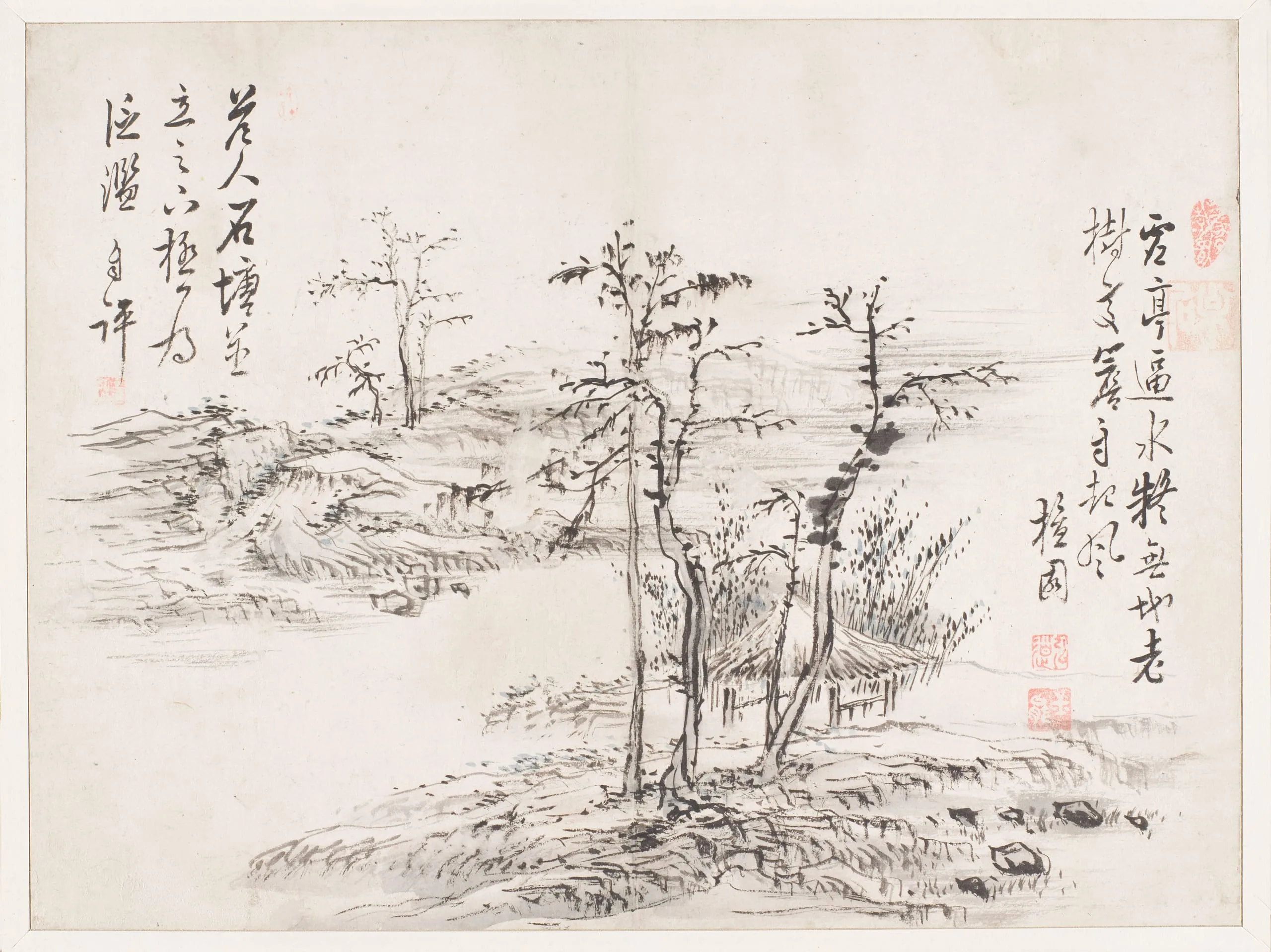
Ink drawing on off-white paper, Chinese landscape with spare trees on rocky shore, open water, distant hills, and calligraphic inscriptions with red seals
Ink wash landscape with several slender trees on a rocky shoreline, layered horizontal brushstrokes suggesting water and distant hills, executed with expressive, gestural ink marks on pale paper.
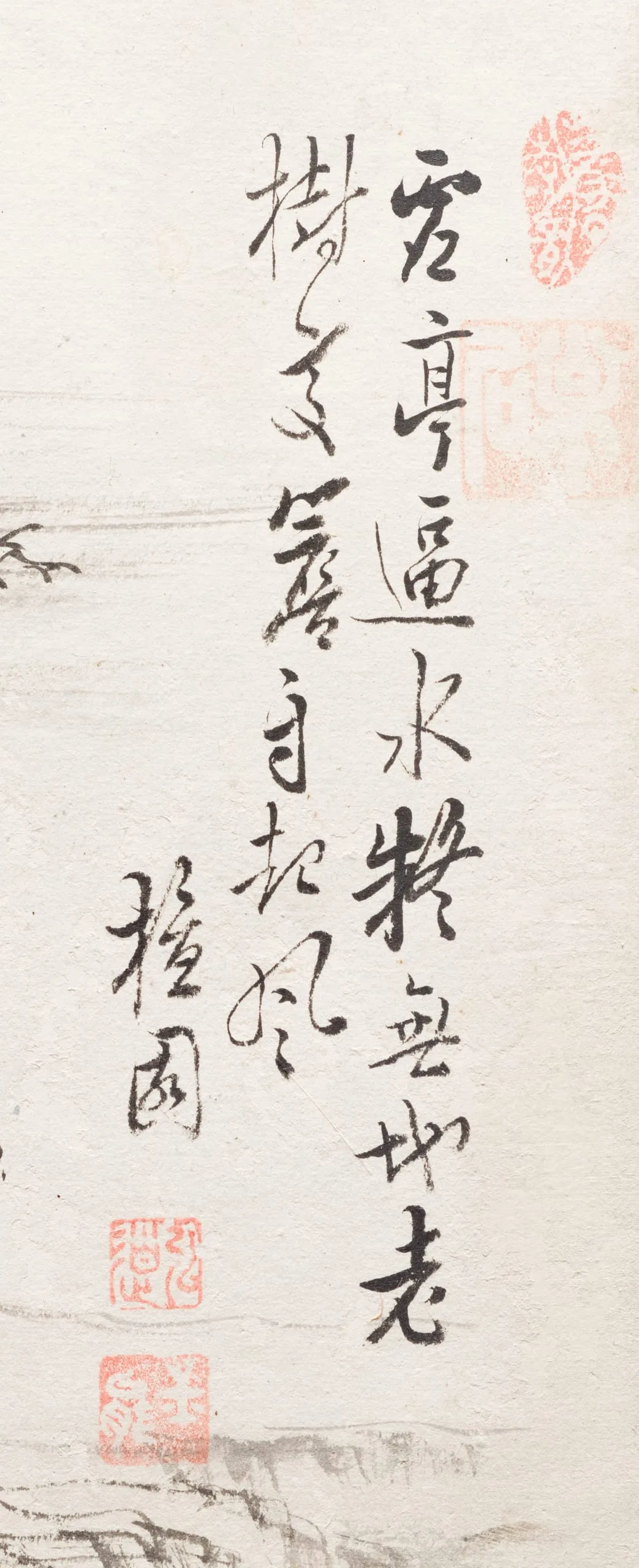
Detail of a hanging scroll showing two vertical columns of cursive Chinese calligraphy in black ink on aged paper, with three red seal impressions, one at upper right and two stacked at lower left.
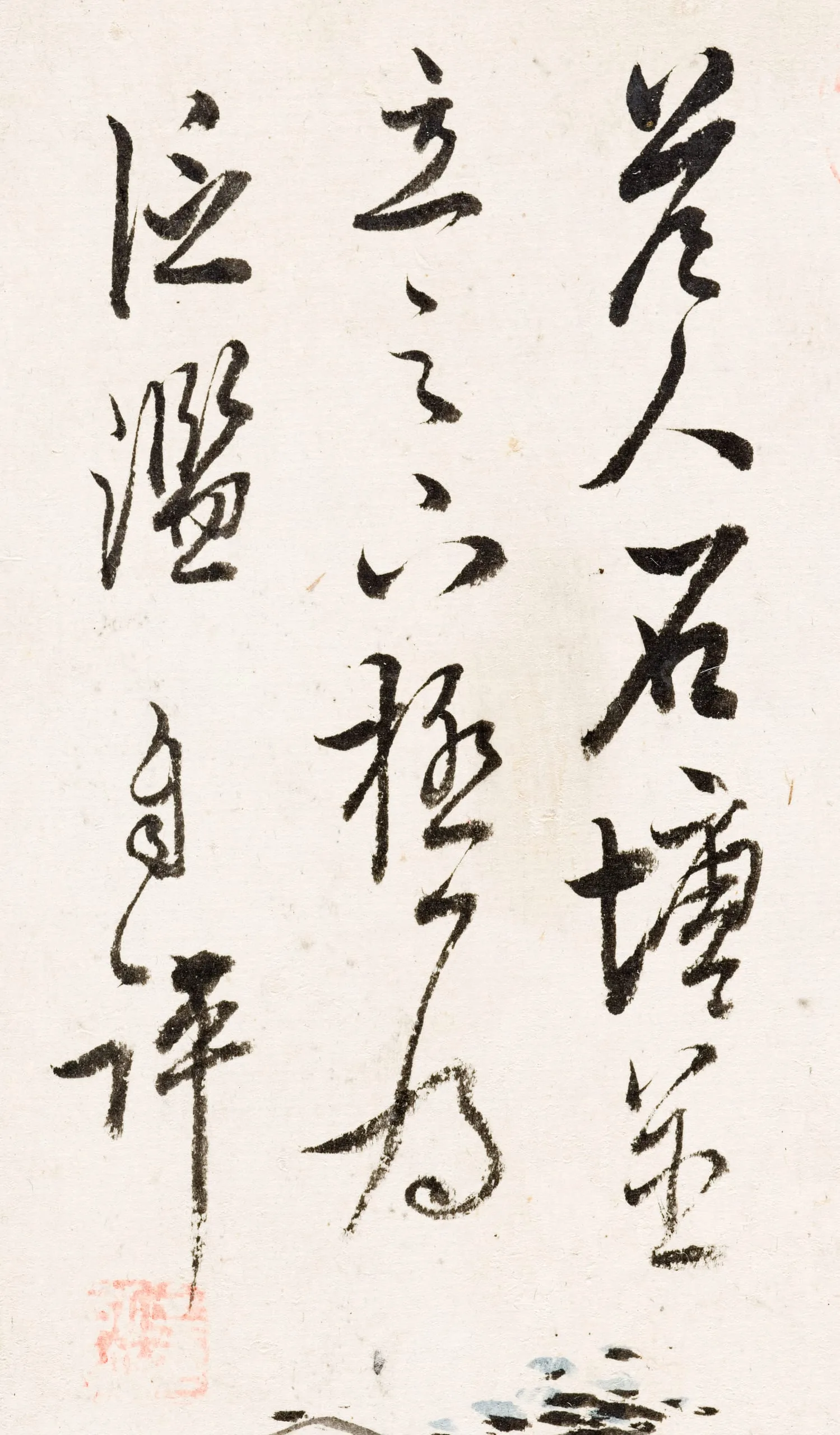
Ink on paper calligraphy in cursive script style, with bold black brushstrokes forming columns of Chinese characters on a cream ground; red seal impression at lower left.
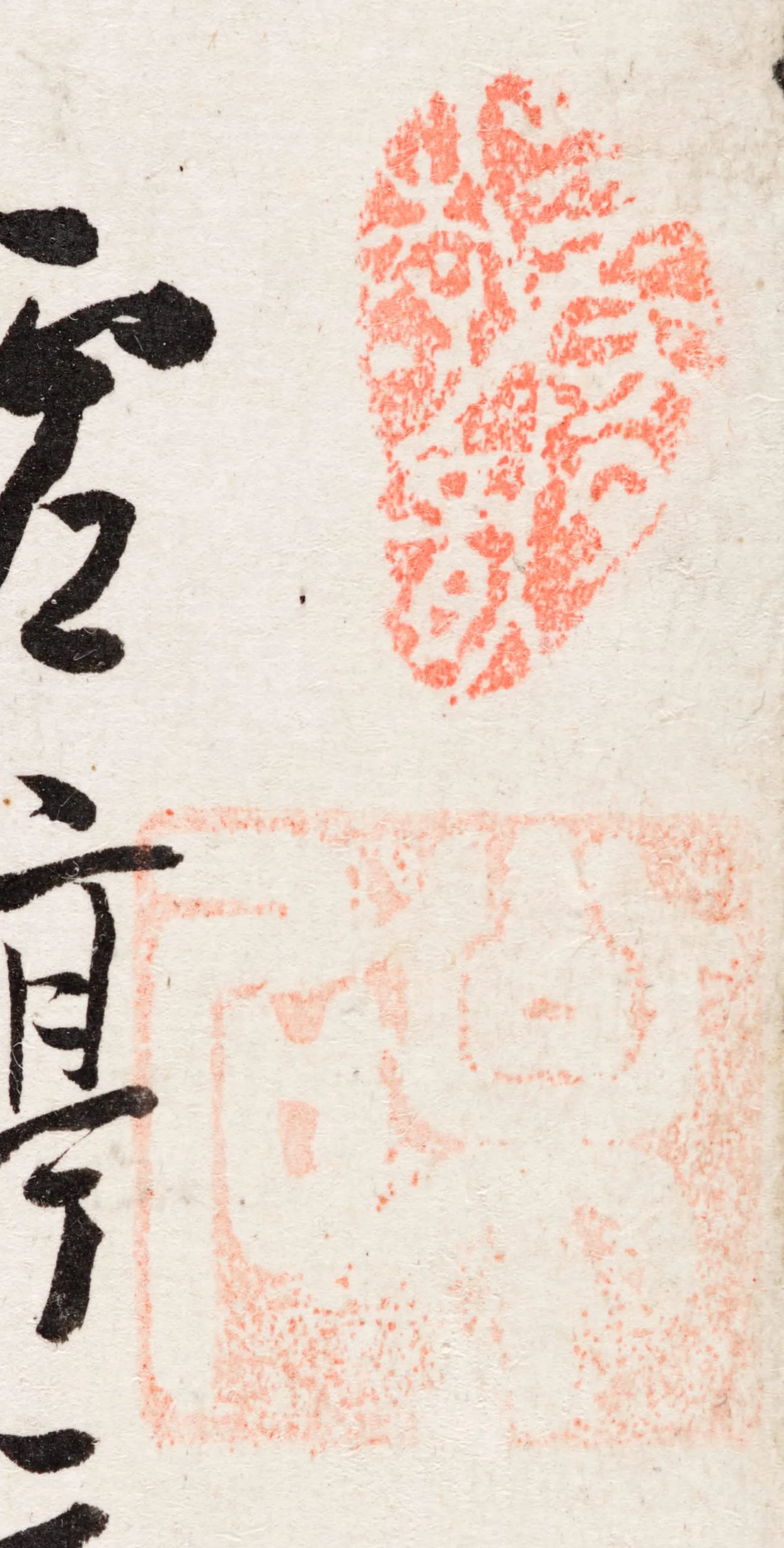
Detail of a work on paper showing two red seal impressions in cinnabar ink — one oval with dense interlocking characters, one square with a bordered frame — alongside a partial column of black Chinese cursive script at left.
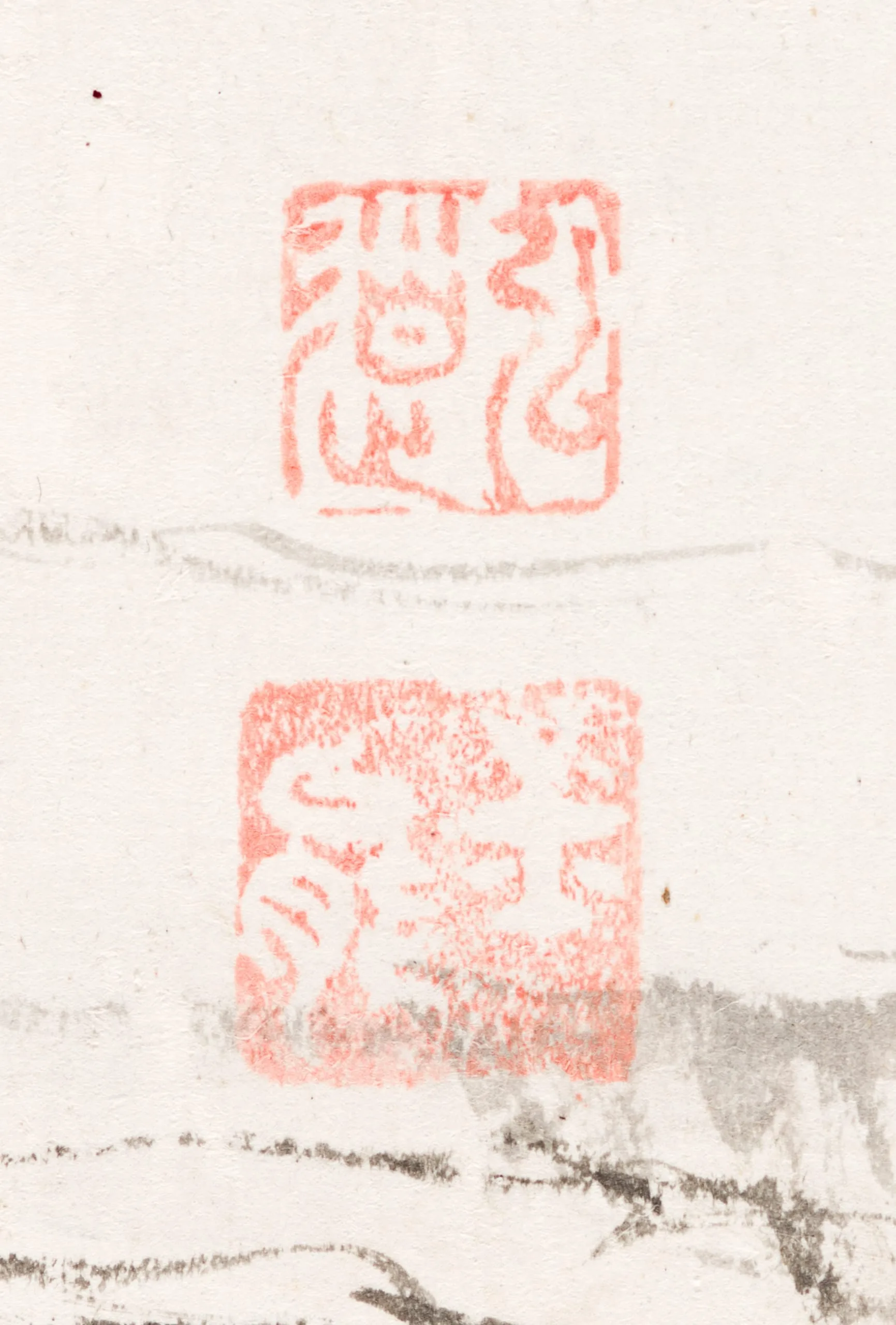
Detail of an ink painting on paper showing two red seal impressions in zhuanshu (seal script) above faint ink-wash landscape elements at lower edge.
Artist or Maker
Kim Hong-do
Korea, 1745-after 1814
Title
Landscape
Place Made
Korea
Date Made
Joseon dynasty (1392-1910), late 18th- early 19th century
Medium
Album leaf, ink on paper
Dimensions
Image: 11 x 14 3/4 in. (27.94 x 37.47 cm); Sheet: 12 x 15 1/2 in. (30.48 x 39.37 cm)
Credit Line
Gift of Mr. and Mrs. Jae Min and Hyun Joo Chang
Accession Number
M.2004.256
Classification
Paintings
Collecting Area
Chinese and Korean Art
Curatorial Notes

Kim Hongdo is probably the most well-known painter in Korean art history.[1] His reputation, to a large degree, has derived from his many great genre paintings depicting the daily life of ordinary people. Although he was especially acclaimed by modern critics for these paintings, he was equally famous for his many other accomplishments. During his lifetime, Kim was admired for his paintings on all subjects, including documentary paintings of events and celebrations, portraits of religious and secular figures, idealized as well as real (“true-view”) landscapes, and themes from nature such as animals, birds, and flowers. Kang Sehwang (1712-1791), another great artist of the eighteenth century and Kim’s mentor, praised his student’s artistic virtuosity:

These days painters have only one subject that they are good at and are unable to handle varied subject matter. However, Kim Saneung [Kim Hongdo], having practiced painting from a very early age, is capable of depicting everything. He achieves a high level of quality in painting figures, landscape, immortals, Buddha, flowers, fruits, animals, insects, fish and crabs, and so on.... He is also skilled in depicting the daily activities of our people, such as scenes of scholars studying, merchants heading to market, travelers, farmers, royal gates, multiple rooms, lines of houses, deserted mountains, and trees in fields.[2]

During the eighteenth century, the arts were flourishing under the patronage of King Youngjo (reigned 1724-1776) and King Jeongjo (reigned 1776-1800), which led to a renaissance in Korean academia, literature, music, and art. Kim benefited from this vibrant cultural atmosphere, but his creative genius allowed him to transcend the period’s trends.

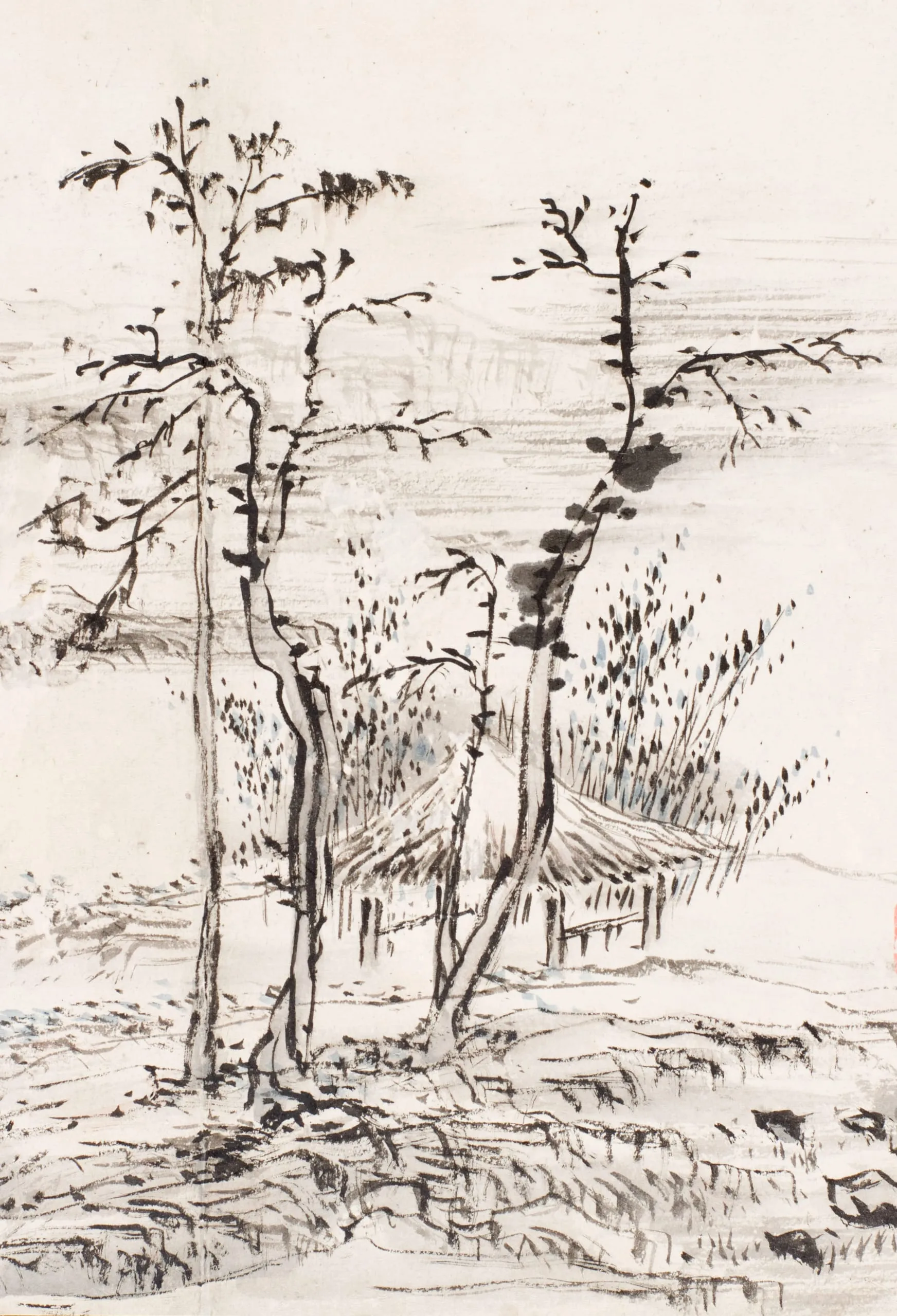
In the genre of landscape painting, Kim has received much attention for his true-view landscapes – realistic depictions of specific geographical locations – which scholars regard as an innovative style that emerged in the eighteenth century. However, Kim also created idealized landscapes, as can be seen in LACMA’s small album leaf. This painting depicting a solitary landscape demonstrates the influence that earlier Chinese landscape painting had on Kim Hongdo. The sparse trees, thatched hut, expansive water, and low, distant hills are elements associated with the paintings of Ni Zan (1301-1371), the influential Yuan dynasty scholar-artist.[3] In addition to the formulaic composition and absence of human figures, Kim used Ni Zan’s trademark painting style of dry, clean brushstrokes.

In this painting, however, Kim did not simply copy the style of earlier Chinese masters. Unlike the vast landscapes of Ni Zan, Kim created a rather intimate scene. To complement the painting, Kim inscribed two poems that reflect upon the calmness and loneliness of the landscape. The two seals below the poem on the right are the artist’s (det. 1).

An excellent example of Kim’s late landscapes, the painting displays skillful brushstrokes. It was probably done late in his career, around the beginning of the nineteenth century, when Kim was in his fifties. The painting style is quite similar to his Full Moon amidst Sparse Trees, dated 1796 (fig. 1). Another very similar painting, Autumn Landscape, also by Kim, is now in the Gansong Art Museum in Seoul (fig. 2). Previously owned by Mr. Bokryol Yoo, a twentieth-century Korean connoisseur and collector, the painting has been at LACMA since 2004.

Footnotes

[1] There have been three special exhibitions of Kim Hongdo’s paintings: Danwon Kim Hongdo: His Life and Art (Gansong Art Museum, 1993); Danwon Kim Hongdo (National Museum of Korea, 1990); and Danwon Kim Hongdo: Special Exhibition Commemorating the 250th Anniversary of His Birth (National Museum of Korea and Samsung Ho-Am Art Museum, 1995). For a more detailed discussion of Kim Hongdo’s art, see Oh Juseok, Danwon Kim Hongdo (Seoul: Yeolhwadang, 1998); Jin Junhyun, Danwon Kim Hongdo Yeongu (Seoul: Yiljisa, 1999); and You Hongjoon, “Danwon Kim Hongdo,” in Hua’in yeoljeon (Seoul: Yeoksa bipyonsa, 2001).

[2] Jin Junhyun, “Danwon Kim Hongdo,” in Ahn Hwijoon et al, Inmulro boneun Hanguk misulsa (Seoul: Sahui pyongron, 2006), pp. 216-17.

[3] The great late Ming dynasty scholar, artist, and theorist Dong Qichang (1555-1636) considered Ni Zan to belong to the Southern school of painting exemplified by literati or amateur scholar-artists who valued expression and amateurism in stark contrast to more professional artistic trends.
Selected Bibliography
  • Korean Art Collection of the Los Angeles County Museum of Art, U.S.A. Daejeon, Republic of Korea: National Research Institute of Cultural Heritage, 2012.

Related Unframed

Related Unframed

Everything You Need to Know About LACMA’s New David Geffen Galleries
  • May 8, 2026
  • Alexander Schneider
Discover LACMA’s New Architectural Landmark at These Free Workshops with AIA Los Angeles
  • May 8, 2026
  • Alexander Schneider
The Art of Transparency: Reiko Sudō’s Textile Innovation for LACMA
  • May 5, 2026
  • Alexander Schneider
New Acquisition: Alejandro Otero’s “Tablón 32”
  • April 20, 2026
  • Ilona Katzew
“Most movies don’t take 10,000 years to make”: Jonathon Keats on “Deep Time Cinematography”
  • March 27, 2026
  • Sheridan Hunter
Join The Art Parade 2026 at LACMA
  • March 19, 2026
  • Editors
50 Works 50 Weeks: Sarah Rosalena’s “Threading the Infinite: Omnidirectional Terrain”
  • March 10, 2026
  • Sarah Rosalena, Alexander Schneider
50 Works 50 Weeks: Mariana Castillo Deball’s “Feathered Changes”
  • January 7, 2026
  • Alyce de Carteret
Exhibitions to See in 2026
  • December 31, 2025
  • Editors
Diffuse Control by Beeple Iteration: Future Past
  • December 22, 2025
  • Koni Zhang
Digital Art Conversations in Miami Beach: A Look Back at LACMA’s Second Annual Gathering
  • December 17, 2025
  • Sosse Krikorian
50 Works 50 Weeks: Raymond Loewy’s Studebaker Avanti
  • December 17, 2025
  • Bobbye Tigerman
Celebrate NexGenLA with Family Fun Inspired by Our Modern Art Galleries
  • December 3, 2025
  • Katherine Satorius
LACMA and Genesis Embark on New Multi-Year Partnership
  • November 14, 2025
  • Editors
Planting Jeff Koons’s “Split-Rocker”
  • September 29, 2025
  • Alexander Schneider
Andell Family Sundays: Explorations in Ink at Home
  • September 17, 2025
  • Elly Dallas
This Week at LACMA
This Week at LACMA
  • September 7, 2025
  • Editors
50 Works 50 Weeks: Henri Cartier-Bresson’s “Typical landscape of the Chinese countryside, with an ancient temple. Near Sanmenxia, on the Yellow River. August 1958.”
  • August 20, 2025
  • Wallis Annenberg Photography Department
The Henry and Rose Pearlman Foundation to Gift Its Collection of Impressionist, Post-Impressionist, and Modern Artworks Across Three U.S. Institutions
  • August 4, 2025
  • Editors
Artists Represent Themselves: Widline Cadet on “Seremoni Disparisyon #1 (Ritual [Dis]Appearance #1)”
  • July 15, 2025
  • Widline Cadet, Dhyandra Lawson
Building Project: June 27 Update
  • June 27, 2025
  • Editors
Building Project: June 20 Update
  • June 20, 2025
  • Editors
Building Project: June 13 Update
  • June 13, 2025
  • Editors
New Acquisition: Six Works by Japanese American Modernists
  • May 1, 2025
  • Shannon Vittoria