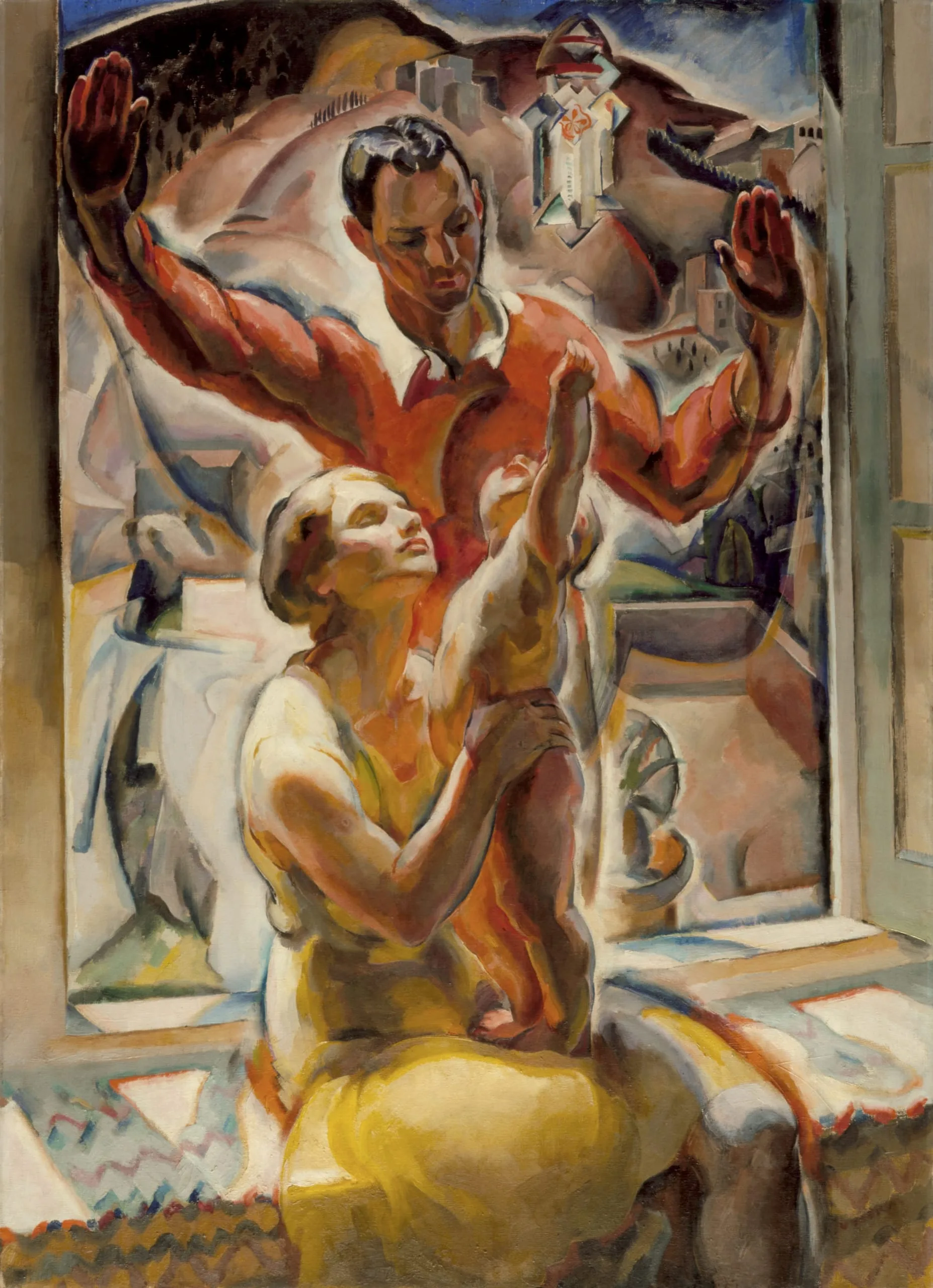
In the catalogue for the Vysekal memorial exhibition held at the Los Angeles Museum in 1940, Arthur Millier declared The Herwigs to be "a landmark in the figure painting" of Southern California. During his lifetime Vysekal became best known for multifigured compositions evidencing his early academic training. He had an excellent command of anatomy and depicted his characters brimming with life, their physiques healthy and robust. In The Herwigs he moved further from his training. Although Vysekal depicted fellow artist William K. Von Herwig (b. 1901) and his family, the figures were only a means to exercise his interest in color abstraction. This becomes more apparent when the unusual presentation of the figures is considered: the mother sits inside on a window seat playing with the child while the father looks on from outside, his hands pressed against the window. The figures form a contemporary Holy Family: the placement of the father outside the house accords with the not uncommon practice of depicting Saint Joseph slightly apart from the Virgin and Child. The family is encircled by the Hollywood Hills, which the artist has transformed into a bright background of color and light. The child’s gesture of stretching upward leads the viewer’s eye toward the prismatic glass wind chime, which recalls the coloristic and formal experiments of modernist artists.
As early as 1916 Vysekal became fascinated by the abstract quality of color, and by 1921 this was reflected in the titles of many of his now lost paintings, such as Mlle R.: Arrangement in Green; Brickyard: Violet Major; and Arrangement: Scale of Orange. Color theories were popular among artists during the early twentieth century, and Vysekal may have been first introduced to them at the presentation of the Armory Show in Chicago. The art and teaching of STANTON MACDONALD-WRIGHT in Los Angeles during the 1920s no doubt encouraged Vysekal to apply color theory to his solidly rendered figure studies. In a warm palette of oranges and yellows Vysekal constructed the figures of the Herwigs with flickering planes of light and dark. While he did not completely relinquish modeling of the figure, he was more daring in his treatment of the background, abstracting the landscape into arcing color bands. Moreover, the use of a screen between the figures enabled him to play with the refraction of color and light. The brilliant light almost dissolves the forms while creating a halo effect. Arthur Millier described the glowing color as "spiritualizing" the painting’s conception.