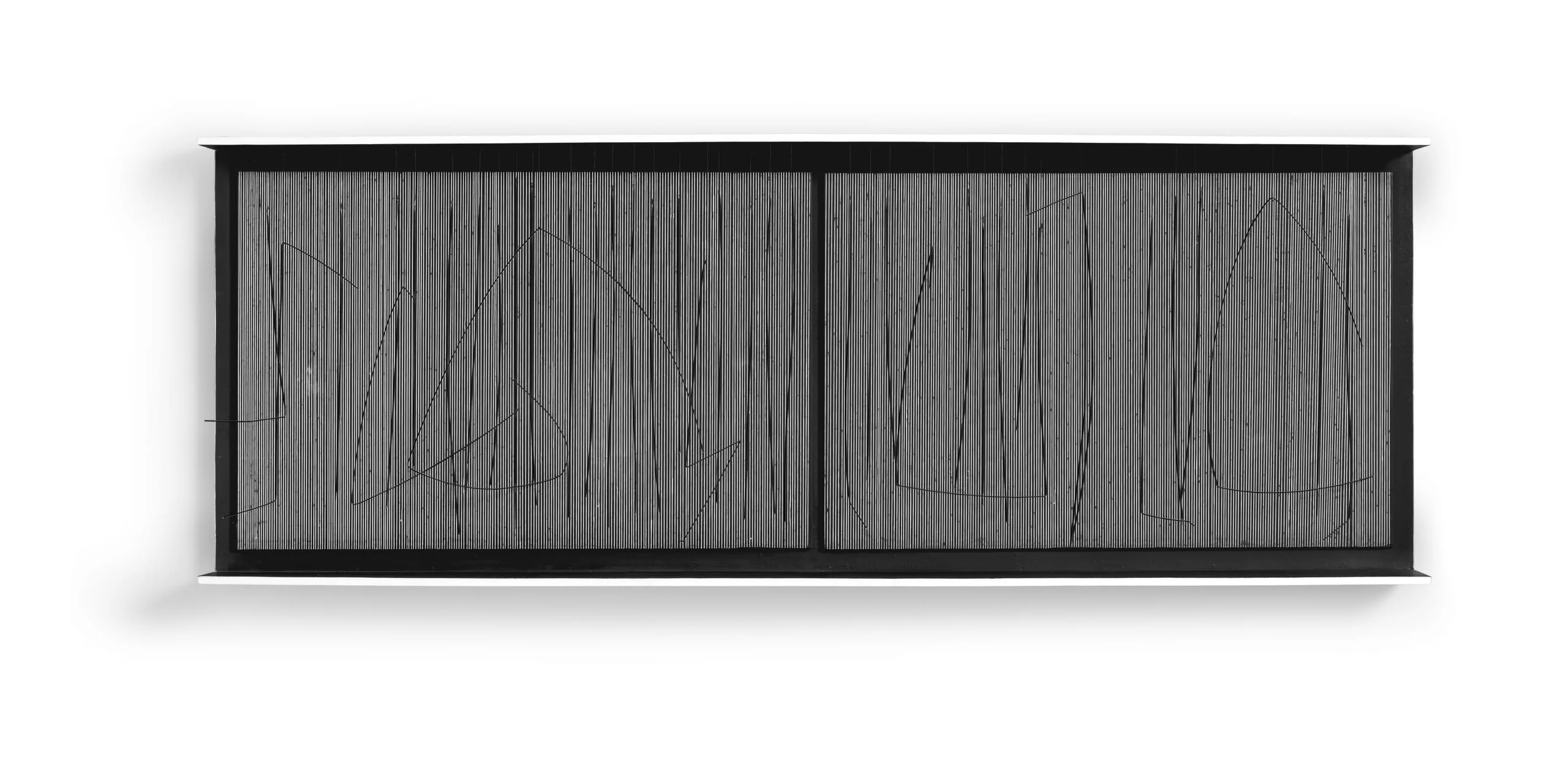
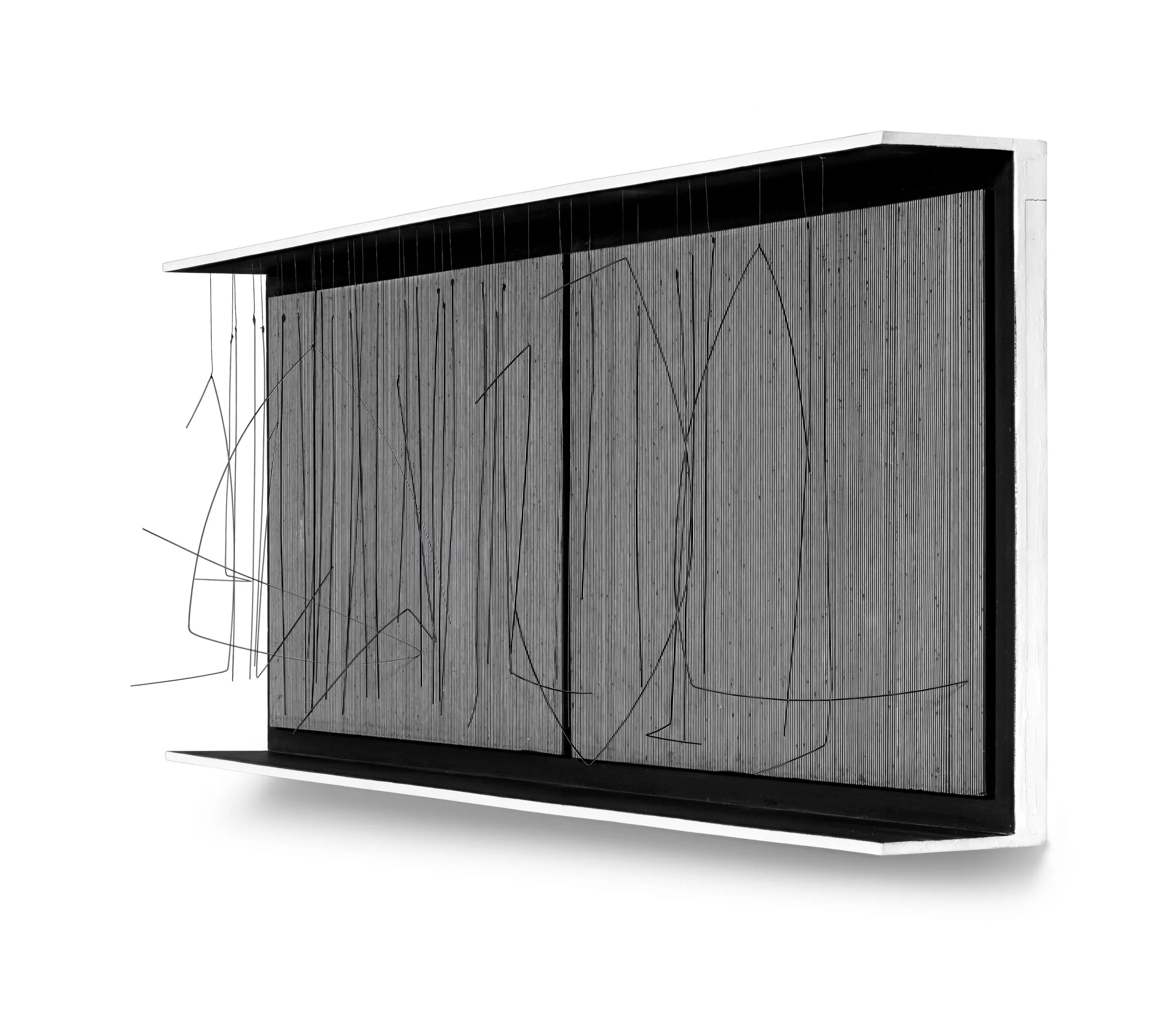
Jesús Rafael Soto was an internationally renowned figure associated with Op and kinetic art. Almost Immaterial Vibration is one of his early Escrituras, vibrant paintings with hanging rods that resemble handwriting. The Escrituras freed Soto from the confines of a flat surface, allowing him to draw in space. The work is activated by the viewer: with each slight movement, the surface seems to vibrate, embodying Soto’s lifelong interest in the intangible quality of light and the dematerialization of solid matter. By giving the spectator agency, Soto challenged traditional ways of seeing and promoted a more democratic approach to art. Through this radical form of engagement, he hoped to alter viewers’ perceptions, unleash their imaginations, and “make visible the deeper reality that binds everything together.”
Soto’s interest in art developed in his native Ciudad Bolívar, in Venezuela, where he worked as a sign painter for cinemas. There he employed inexpensive industrial paints (cobalt blue, black, white, green, yellow, and red), which became the trademark colors of his mature work. From 1942 to 1947, he studied fine arts at the Escuela de Artes Plásticas (School of Fine Arts) in Caracas but became disillusioned with its conservative teaching methods. Fascinated with Cubism and Constructivism (especially the works of Georges Braque, Piet Mondrian, and Kazimir Malevich), which he knew only through reproductions, in 1950 he relocated to Paris—a hub of artistic experimentation and a mecca for Latin American artists. There he met the legendary gallerist Denise René (1913–2012) and participated in her historic 1955 kinetic exhibition Le Mouvement, which helped launch his international career.
Ilona Katzew
2024