LACMA

ShopMembershipMyLACMATickets
LACMA
Los Angeles County Museum of Art
5905 Wilshire Blvd.
Los Angeles, CA 90036
info@lacma.org
(323) 857-6000
Sign up to receive emails
Subscribe
© Museum Associates 2026
  • About LACMA
  • Jobs
  • Building LACMA
  • Host An Event
  • Unframed
  • Press
  • FAQs
  • Log in to MyLACMA
  • Privacy Policy
© Museum Associates 2026
Collections

Emanuel de Witte
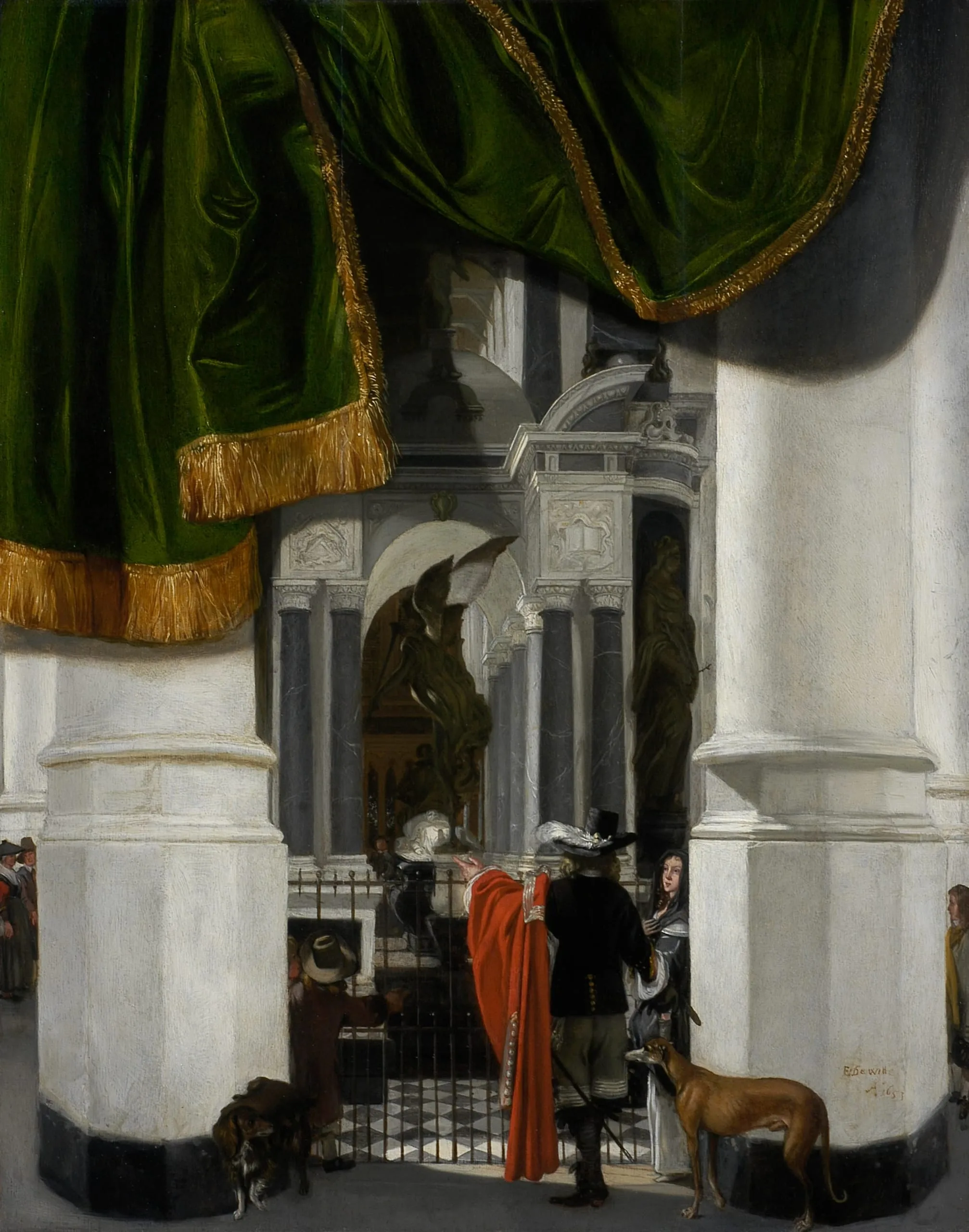
Interior of the Nieuwe Kerk in Delft with the Tomb of William the Silent1653

On view:
Geffen Galleries
Oil painting of a church or palace interior with two white columns, a green velvet curtain with gold fringe, and figures in 17th-century dress gathered at an iron gate before an ornate monument
Artist or Maker
Emanuel de Witte
Northern Netherlands, 1617-1692
Title
Interior of the Nieuwe Kerk in Delft with the Tomb of William the Silent
Date Made
1653
Medium
Oil on wood panel
Dimensions
Panel: 32 3/8 × 25 5/8 in. (82.23 × 65.09 cm) Framed: 39 1/2 × 33 × 3 1/4 in. (100.33 × 83.82 × 8.26 cm)
Credit Line
Gift of Mr. and Mrs. Edward W. Carter
Accession Number
M.2003.108.5
Classification
Paintings
Collecting Area
European Painting and Sculpture
Curatorial Notes

By 1653, Emanuel de Witte had painted several views of the interior of the Nieuwe Kerk in Delft, prominently featuring the Tomb of William the Silent (1533−1584), founder of the Dutch Republic. In the present composition, light enters from the upper left corner, illuminating the marble tomb’s interior vault. The bronze figure of Fame in the center blows a trumpet to proclaim William’s eternal glory. The tomb itself, a stone canopy, surmounts the recumbent effigy of the prince. A golden-fringed green satin curtain, suspended from an unseen point and partially obscuring the monument, references the seventeenth-century practice of attaching cloth to frames to protect expensive artworks from light and dust.

Interestingly, an X-ray of this painting shows that the artist finished the architectural interior prior to adding the curtain and staffage. But the illusion of this green curtain is complicated by the shadow it casts across the image, effectively emphasizing the image’s two-dimensionality. By breaking the illusion of space, de Witte invites the viewer to contemplate the boundaries between what is real and what is painted: is the picture a portable window onto the tomb, or is it a cherished artwork displayed in a collector’s home? De Witte’s curtain motif may also evoke the theatrical practice of seventeenth-century Dutch spectacles, known as vertooninge, in which curtains were used to reveal tableaux vivants—living pictures—that synthesized a play’s moral aspects. Perhaps de Witte was gesturing here to the virtues of William the Silent, who, in his liberation of the country from Spanish troops, helped Protestantism become the dominant faith in the Netherlands.

2024

Provenance

Possibly anonymous (sale, Soeterwoude near Leiden, 15 June 1779, lot 10, described as "Het Choor van de nieuwe Kerk te Delft, met het Monument van Prins Willem den Eersten; ’t welk gedeeltelyk door een gordyn (dat daar voor schynt te hangen) bedekt word, konstig op panel geschildert. Hoog 24, breed 20d,"(1) sold for 125 florins to); [Abraham Delfos (1731–1820), Leiden].(2) [Newhouse Galleries, New York, sold 1978 to]; Mr. and Mrs. Edward William Carter, Los Angeles, given 2003 to; LACMA.

Footnotes

(1) "The choir of the New Church of Delft, with the monument of Prince William the First; which is partly covered with a curtain (that appears to hang), artfully painted on panel, height 24, width 20 duim." A duim (thumb) is approximately equivalent to an inch. The Carter painting is the only painting presently known that fits this description, except for dimensions. Rotterdam 1991, p. 185n1, notes that errors in measurements often appear in old auction catalogues. The reference may, however, refer to another, now-lost, painting.

(2) Abraham Delfos was active in Leiden as an engraver, dealer, and auctioneer. According to the Getty Provenance Index, Sales Catalogs Database, N-113, Delfos at various times "owned works of considerable importance, and on occasion acted as agent for both Mr. Pieter Cornelis van Leyden (1717–1788) and his son Diderick, baron van Leyden (1744–1810)."
Selected Bibliography
  • Walsh, Jr., John., and Cynthis P. Schneider. A Mirror of Nature: Dutch Paintings from the Collection of Mr. and Mrs. Edward William Carter (Second Edition). Los Angeles: Los Angeles County Museum of Art, 1992.

  • Walsh, Amy L. The Mr. and Mrs. Edward Carter Collection of Dutch Paintings. Los Angeles: Los Angeles County Museum of Art, 2019. https://archive.org/details/Carter_Collection_Dutch_Paintings (accessed May 23, 2022).