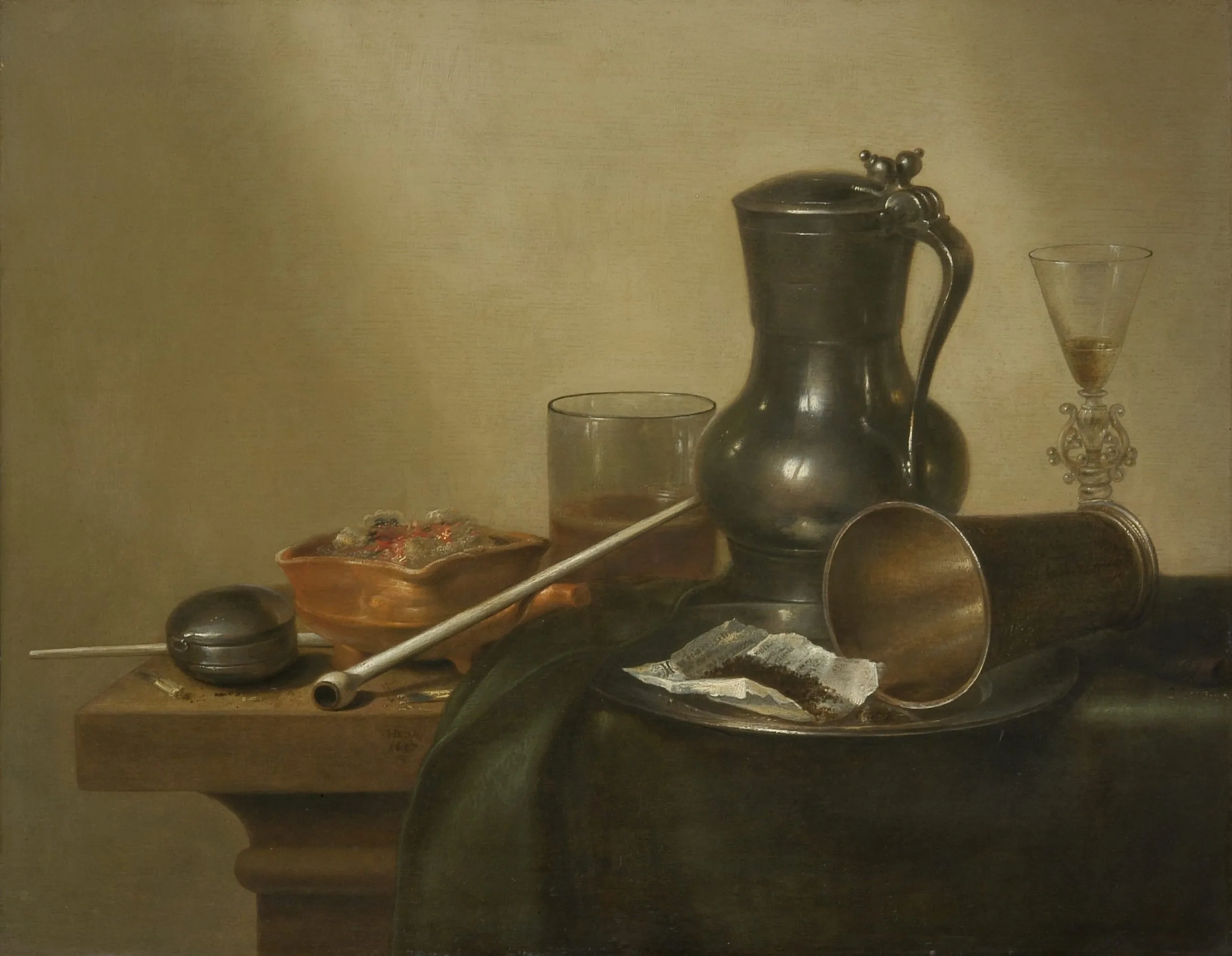
In addition to the central ingredients of tobacco consumption—unrolled paper piled with the American commodity itself—Willem Claesz. Heda’s still life assembles a range of implements that developed around smoking: a brazier with lit embers, zwavelstokjes (an early form of matchstick), clay pipes, and a brass tobacco box. By the 1630s, when this painting was created, smoking was a popular activity called tabacksuijghen, or tobacco drinking. Many cities had “tobacco inns,” establishments where alcohol and tobacco were consumed. Here, the tobacco accoutrements are complemented by various types of drinkware, including a pewter jug, a silver beaker, a Venetian-style wineglass, and a glass of beer whose heights and materials balance and add texture to the composition.
Tobacco held a contested position in sixteenth- and seventeenth-century Dutch society. To some it had medicinal properties, to others it was a dangerous addictive drug leading society astray. In vanitas images, it stood as a warning against excess, and tobacco smoke symbolized the transience of life. But for many, tobacco was a lucrative commodity and social lubricant, a view embodied in Heda’s painting.
Belying the benign still-life genre of tabakje or toebakje (“little tobacco”) were the harsh realities of global trade. Tobacco was introduced from the Americas to Europe by colonial explorers in the late fifteenth century. By the early 1600s, the Dutch West India Company was importing tobacco to the Netherlands from Venezuela and British-controlled North American colonies, where plantations operated with indentured and eventually enslaved labor. Tobacco’s widespread use generated industries across the country, from Amsterdam and Rotterdam, which received and processed the raw material, to Gouda, which produced smoking pipes. In addition to imported tobacco leaves, tobacco crops were grown locally as a cheaper alternative to the colonial product.