LACMA

ShopMembershipMyLACMATickets
LACMA
Los Angeles County Museum of Art
5905 Wilshire Blvd.
Los Angeles, CA 90036
info@lacma.org
(323) 857-6000
Sign up to receive emails
Subscribe
© Museum Associates 2026
  • About LACMA
  • Jobs
  • Building LACMA
  • Host An Event
  • Unframed
  • Press
  • FAQs
  • Log in to MyLACMA
  • Privacy Policy
© Museum Associates 2026
Collections

Frans Post
Imagined Landscape of Dutch Colonial Brazilcirca 1655

On view:
Geffen Galleries
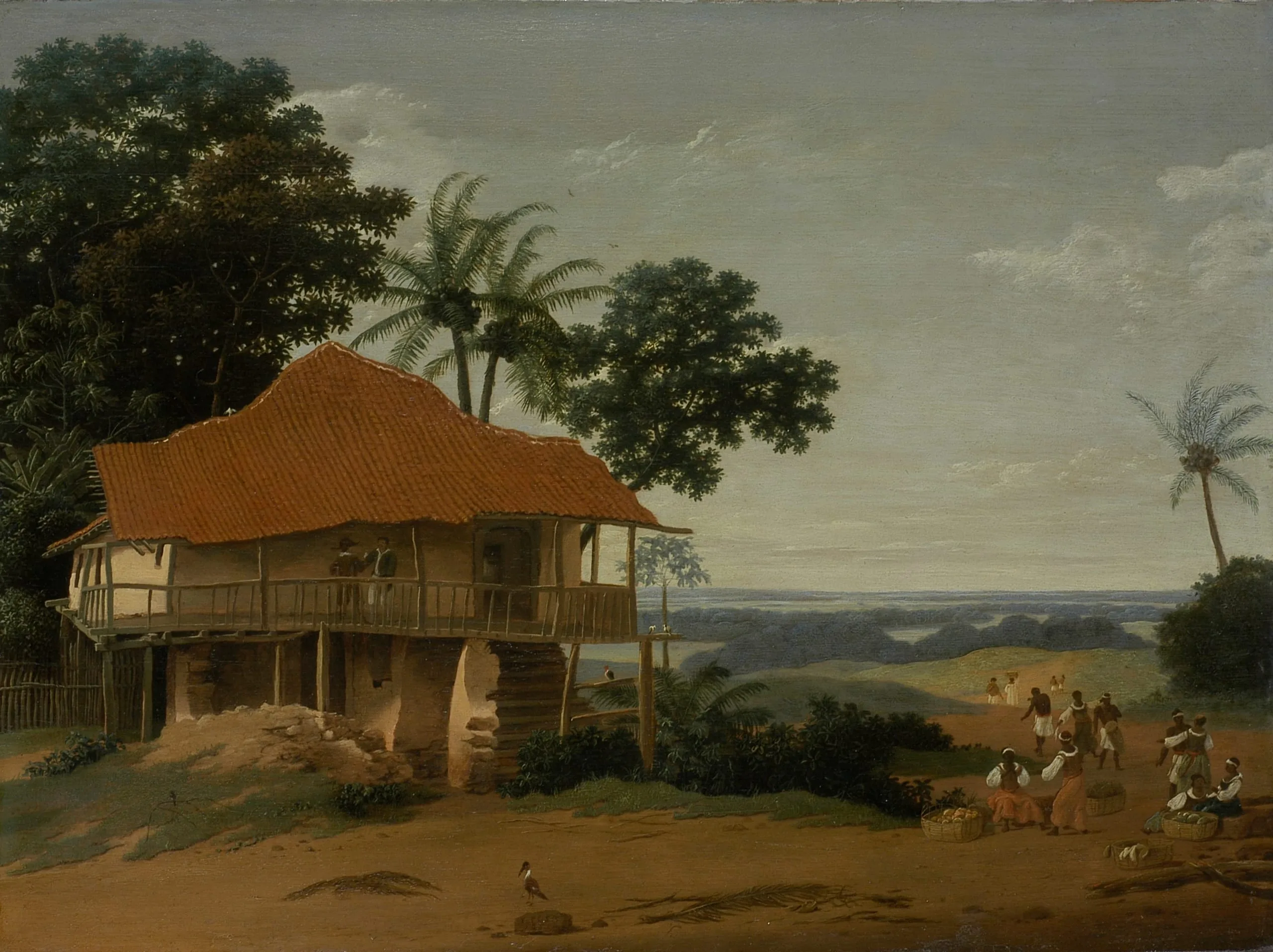
Oil painting landscape with a raised tropical building under an orange tiled roof, surrounded by palm trees, with a wide river valley in the distance and a group of figures to the right

Frans Post, Imagined Landscape of Dutch Colonial Brazil, circa 1655, Los Angeles County Museum of Art, Gift of Mr. and Mrs. Edward W. Carter, photo © Museum Associates/LACMA

Artist or Maker
Frans Post
Northern Netherlands, 1612-1680
Title
Imagined Landscape of Dutch Colonial Brazil
Date Made
circa 1655
Medium
Oil on wood panel
Dimensions
Panel: 18 1/4 × 24 3/4 in. (46.36 × 62.87 cm) Framed: 26 × 32 × 3 1/2 in. (66.04 × 81.28 × 8.89 cm)
Credit Line
Gift of Mr. and Mrs. Edward W. Carter
Accession Number
M.2003.108.3
Classification
Paintings
Collecting Area
European Painting and Sculpture
Curatorial Notes

Along with naturalists, botanists, and scientists, artist Frans Post traveled to Brazil with Johan Maurits, governor-general of the colony established by the Dutch West India Company in 1630. This colony on Indigenous land was sustained by the work of enslaved people in forced labor camps known as sugar plantations. In this scene, Post depicts two Portuguese plantation managers—the Dutch continued to employ middle managers from the Portuguese colonizing force they ousted—speaking on the balcony of a dilapidated structure. Enslaved Africans walk along a path on the right side of the painting, while Indigenous people clad in white garments can be seen in the distance. Works such as this served the interests of Post’s client, Maurits, who was anxious to promote an image of a harmonious society against the terrible reality of a system reliant on forced labor. To achieve this, Post omitted references to industrial production and sparsely populated his landscapes with Indigenous and enslaved African people who submissively perform their assigned tasks within the colonial order. Nor does Post ever depict the frequent punishment of enslaved people in foot stocks, their branding with owners’ initials, or the grinding machinery necessary to process sugar cane, which carried the constant risk of amputation. Instead, as here, he created pastoral fantasies in which enslaved people leisurely break from their labor to talk, play a drum, and dance.

After the 1654 collapse of Maurits’s Dutch colony and its return to the Portuguese, Post’s scenes were positioned as accurate representations of a lost paradise ruled by benevolent colonizers, an image that has persisted in both Brazil and the Netherlands. His paintings have been celebrated as neutral documents produced by an artist who sought to simply record the daily life, peoples, plants, and animals of Dutch Brazil. This uncritical praise has perpetuated the dangerous and harmful image of Indigenous American lands as expanses of untapped wilderness whose human and animal inhabitants benefitted from the purported order of European colonial rule.

2024

Provenance

Heinrich Theodor Hoch (1845–1905),(1) Munich (sale, Munich, J. M. Heberle, 19 Sept. 1892, lot 167). Adolph Bayersdorfer (1842–1901), Munich.(2) Germanisches Nationalmuseum, Nuremberg, in 1909, by exchange 3 Oct. 1947 to;(3) Valentin J. Mayring (1905–2000),(4) Hollfeld, bei Bayreuth. Private collection, Switzerland; [David Koetser, Zurich, sold 1977 to]; Mr. and Mrs. Edward William Carter, given 2003 to; LACMA.

Footnotes

(1) Heinrich Theodor Hoch was a wealthy real estate developer. His father, Theodor, was an economist. Bellinger and Regler-Bellinger 2012, pp. 368ff.

(2) The art historian Adolph Bayersdorfer was a curator at the Alte Pinakothek, Munich, and the founder of the Deutsches Institut Florenz.

(3) Nurnberg 1909, no. 396 (340), p. 120, as Germanisches Museum 334, gallery 89. A document dated 10 August 1950, signed by Dr. Peter Strieder, Haupt Conservator, Germanisches National-Museum, Nurnberg, states, "Laut Tauschvertrag von 3 Oktober 1947 in das Eigentum des Herrn Valentin Mayring, Hollfeld bei Bayreuth, ubergegangen ist." The painting was apparently traded for Portrait of a Bridegroom, Half Length, Standing in a Landscape, by Anton Heusler (act. Annaberg, Saxony, 1525–1561) (inv. no. GM 1462).

(4) Valentin J. Arnold Mayring (1905–2000), Munich, was trained as an apothecary. An estate sale of his property took place in Munich at Neumeister, Munchner Kunstauktionshaus, 21 Mar. 2001. Mayring may have purchased the painting by Heusler from the sale by Paul Graupe, Berlin, 17–18 June 1936, lot 52, as by Monogrammist A.G. The painting had belonged to the Jewish firm A. S. Drey before it was included in the forced sale at Graupe. It was restituted to the successors of A. S. Drey in 2007 and sold by them through Sotheby’s, London, 6 Dec. 2007, lot 137.
Selected Bibliography
  • Walsh, Jr., John., and Cynthis P. Schneider. A Mirror of Nature: Dutch Paintings from the Collection of Mr. and Mrs. Edward William Carter (Second Edition). Los Angeles: Los Angeles County Museum of Art, 1992.

  • Lago, Pedro Corrêa do, and Bia Corrêa do Lago. Frans Post, 1612-1680: Catalogue Raisonné. Milan: 5 Continents, 2007.
  • Walsh, Amy L. The Mr. and Mrs. Edward Carter Collection of Dutch Paintings. Los Angeles: Los Angeles County Museum of Art, 2019. https://archive.org/details/Carter_Collection_Dutch_Paintings (accessed May 23, 2022).
  • Zumaya, Diva. The World Made Wondrous: the Dutch Collector's Cabinet and the Politics of Possession. Los Angeles: Los Angeles County Museum of Art, 2023.