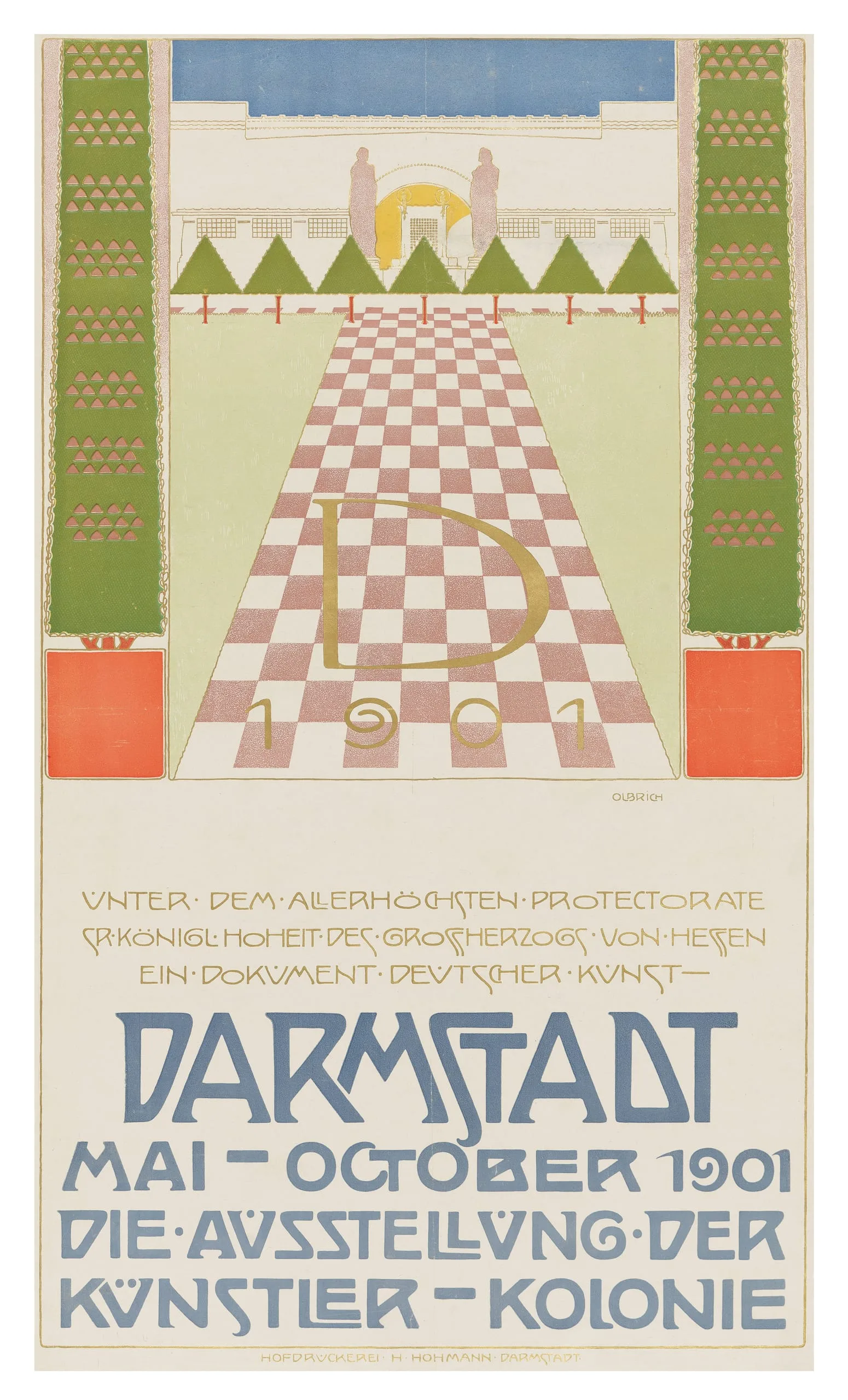
This poster commemorates the first exhibition of the Darmstadt Künstler Kolonie, which was founded in 1899 by Ernst Ludwig, grand duke of Hesse. Staged in 1901 on the Mathildenhöhe overlooking the city of Darmstadt (now a UNESCO World Heritage Site), the exhibition’s theme was “A Document of German Art.” The poster’s designer, Josef Maria Olbrich, was also one of the colony’s most important artists. Olbrich had been a member of the Vienna Secession and designed its iconic building in 1897−98. He carried the movement’s stylistic ideas with him to Darmstadt. The poster shows the south portal to the Ernst Ludwig House—which Olbrich also designed—behind a frieze of abstracted trees, its connection to the Secession building apparent in its color scheme and flat, patterned ornamentation. Over its entrance was inscribed the quote: “The artist will show his own world, which never has existed and never will exist,” a utopian sentiment asserting the artist’s capacity to imagine—and build—a more ideal world.
The Darmstadt Artists’ Colony was influenced by the English Arts and Crafts movement through its patron Ludwig, a grandson of Queen Victoria. Ludwig visited Britain often and connected with Arts and Crafts proponents there. Interested in promoting the crafts of Hesse and countering the negative effects of industrialization on craft production, Ludwig initially invited artists from England to Darmstadt. He ultimately decided to establish a colony of German-speaking artists and designers and selected the members himself. Rather than a spontaneous gathering of like-minded individuals, it was a curated group of creators who shared a knowledge of and interest in the application of artistic principles across the applied arts. In total, twenty-three members came between 1899 and 1914, the year the colony disbanded due to the outbreak of World War I. Ludwig also founded a ceramics manufactory, workshops for applied arts, and a press, all in the name of advancing the decorative arts and crafts of Hesse.
Erin Sullivan Maynes
December 2024