LACMA

ShopMembershipMyLACMATickets
LACMA
Los Angeles County Museum of Art
5905 Wilshire Blvd.
Los Angeles, CA 90036
info@lacma.org
(323) 857-6000
Sign up to receive emails
Subscribe
© Museum Associates 2025

Museum Hours

Monday

11 am–6 pm

Tuesday

11 am–6 pm

Wednesday

Closed

Thursday

11 am–6 pm

Friday

11 am–8 pm

Saturday

10 am–7 pm

Sunday

10 am–7 pm


  • About LACMA
  • Jobs
  • Building LACMA
  • Host An Event
  • Unframed
  • Press
  • FAQs
  • Log in to MyLACMA
  • Privacy Policy
© Museum Associates 2025
Collections

Cesar Carl Robert Andreas Klein
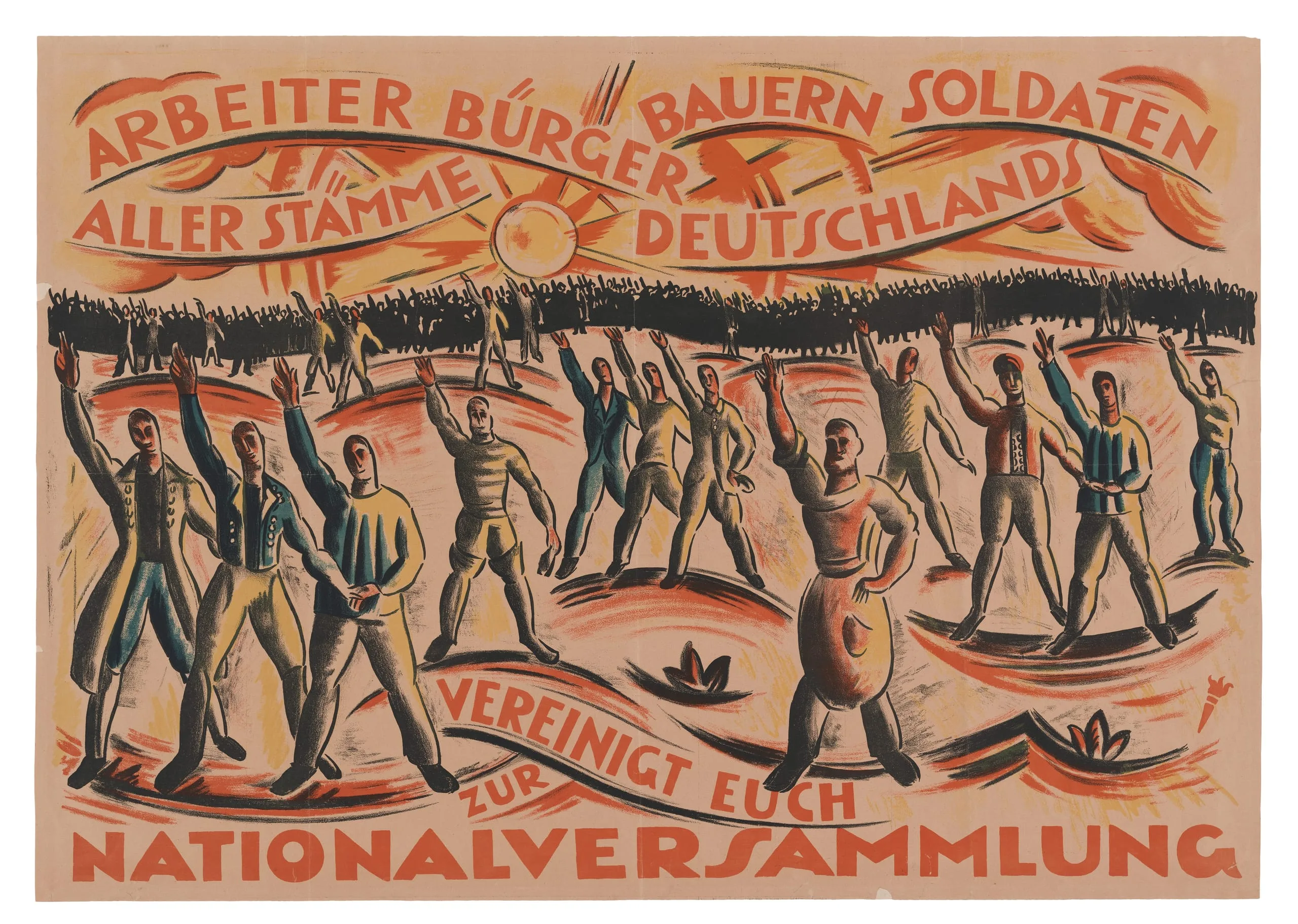
Workers, Citizens, Farmers, Soldiers from All Parts of Germany, Unite for the National Assembly1919

Not on view
Horizontal lithograph with bold red-orange and black lettering and a crowd of figures with arms raised, in German, advertising a national assembly
Artist or Maker
Cesar Carl Robert Andreas Klein
Germany, 1876-1954
Publisher
Werbedienst der deutschen Republik
Germany, 1918-1919
Printer
Bauer & Gemberg
Germany
Title
Workers, Citizens, Farmers, Soldiers from All Parts of Germany, Unite for the National Assembly
Place Made
Germany
Date Made
1919
Medium
Lithograph
Dimensions
Sheet: 26 1/2 × 37 5/8 in. (67.31 × 95.57 cm) Image: 25 1/2 × 37 in. (64.77 × 93.98 cm)
Credit Line
Gift of the Robert Gore Rifkind Collection, Beverly Hills, CA
Accession Number
M.2003.115.33
Classification
Prints
Collecting Area
Robert Gore Rifkind Center for German Expressionist Studies
Curatorial Notes

At the end of World War I, Germany’s former government and military propaganda office was reinvented as the Werbedienst (Publicity Office) and tasked with promoting the needs of the new government. Its director, Paul Zech, commissioned work by Expressionist artists in the belief that the modern artistic style would project an image of the government itself as progressive and forward-looking. This poster by César Klein is arguably one of the Werbedienst’s most successful. All of its elements project a utopian vision of social unity and cohesion. Individuals of different professions and class backgrounds are grouped together, some joining hands, all raising their right arms in a show of solidarity. The text appears in a series of abbreviated banderoles that weave together, their up-and-down movement echoed in the rise and fall of the ground below. The thick black band on the horizon is, on closer inspection, an unbroken chain of bodies, individuals that have fused into a unified mass.

The impetus for this aspirational image of national community was the first election to the National Assembly, scheduled for January 19, 1919. Citizens were to elect leaders responsible for drafting the first constitution of the republic. The new government’s legitimacy depended upon voters turning out in large numbers. This image of unity was not merely imaginative projection: the vote would be more inclusive than any in German history, with women participating for the first time and the voting age lowered from twenty-five to twenty. Ultimately, however, the Communist Party boycotted the election; committed to the cause of revolution, they refused to recognize the new government.

Erin Sullivan Maynes

2022 (adapted from Pressing Politics: Revolutionary Graphics from Mexico and Germany, 56)
Selected Bibliography
  • Kaplan, Rachel, and Erin Sullivan Maynes. Pressing Politics: Revolutionary Graphics from Mexico and Germany. Los Angeles: Los Angeles County Museum of Art, 2022.
Selected Exhibition History
  • Pressing Politics: Revolutionary Graphics from Mexico and Germany. October 29, 2022 - July 22, 2023
  • Pressing Politics: Revolutionary Graphics from Mexico and Germany. October 29, 2022 - July 22, 2023