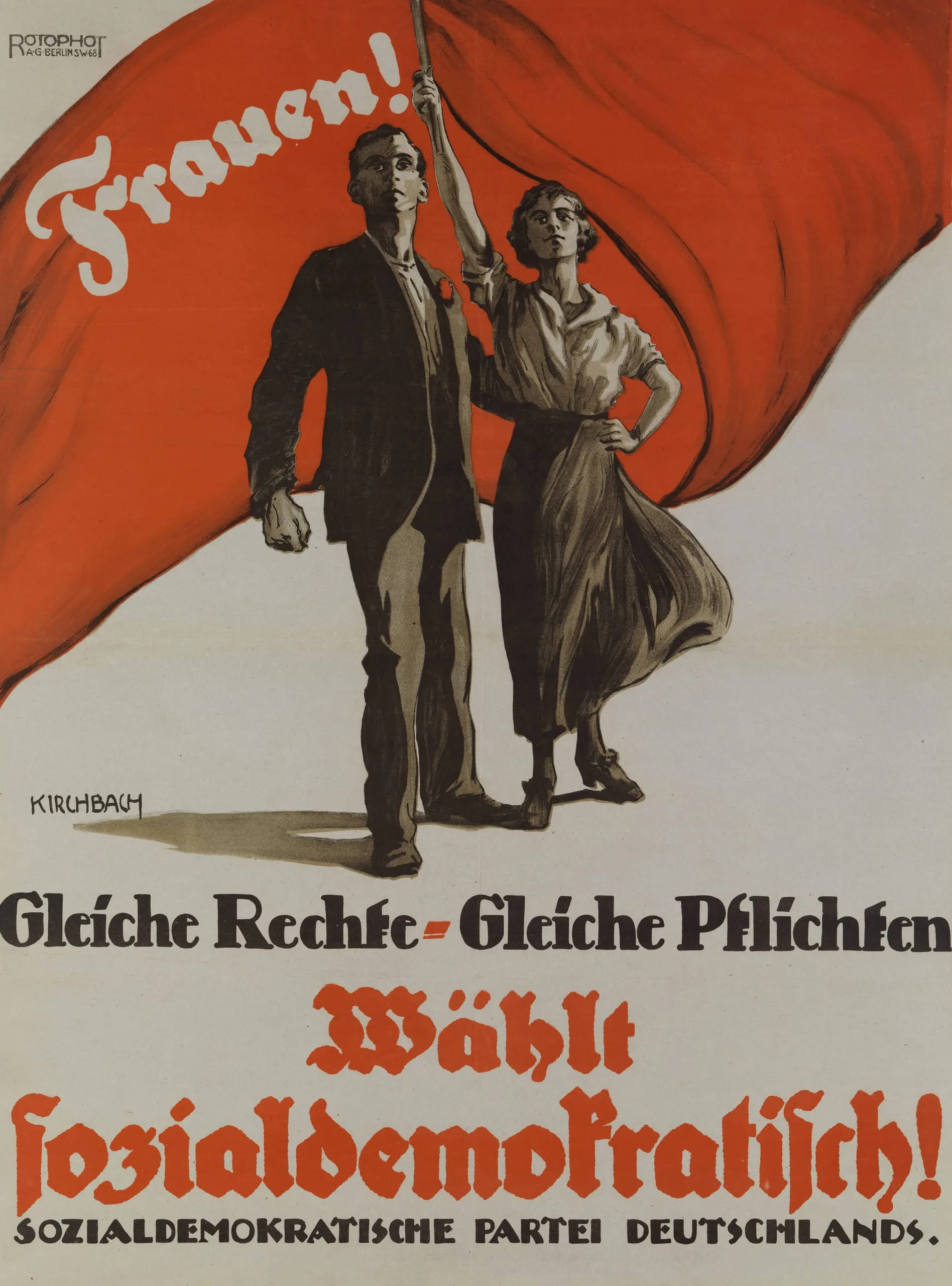
The advent of the Weimar Republic heralded many changes for German citizens, among them the extension of voting rights to women. This poster by Gottfried Kirchbach celebrates the expansion of the franchise but also underscores the obligations that accompanied the vote. “Women!” its text declares, “Same Rights—Same Responsibilities. Vote Social Democratic!” Women would vote for the first time in January 1919, and political parties were looking for ways to appeal to this large, engaged, and wholly new constituency. Here, Kirchbach does not reduce women to their roles as wives or mothers, as wartime imagery often did. The woman confidently faces the viewer, a red flag in one hand, the other on her hip. The man, turned slightly, his foot half a step ahead, seems to nudge her forward. Both text and image suggest that women are ready to play an equal role as full citizens, and that men are prepared to advance their cause. The text links the Social Democratic Party (SPD) itself with this more egalitarian, if aspirational, vision of citizenship.
The red flag had a long history as a symbol of the workers’ movement in Germany. Both the SPD and the recently formed Communist Party identified with this history, tying their parties to the fight for workers’ rights and the concept of class struggle. The red flag appears on numerous posters produced during the revolution, and red itself became a common addition to the black-and-white palette of political graphics.
Erin Sullivan Maynes
2022 (adapted from Pressing Politics: Revolutionary Graphics from Mexico and Germany, 54)