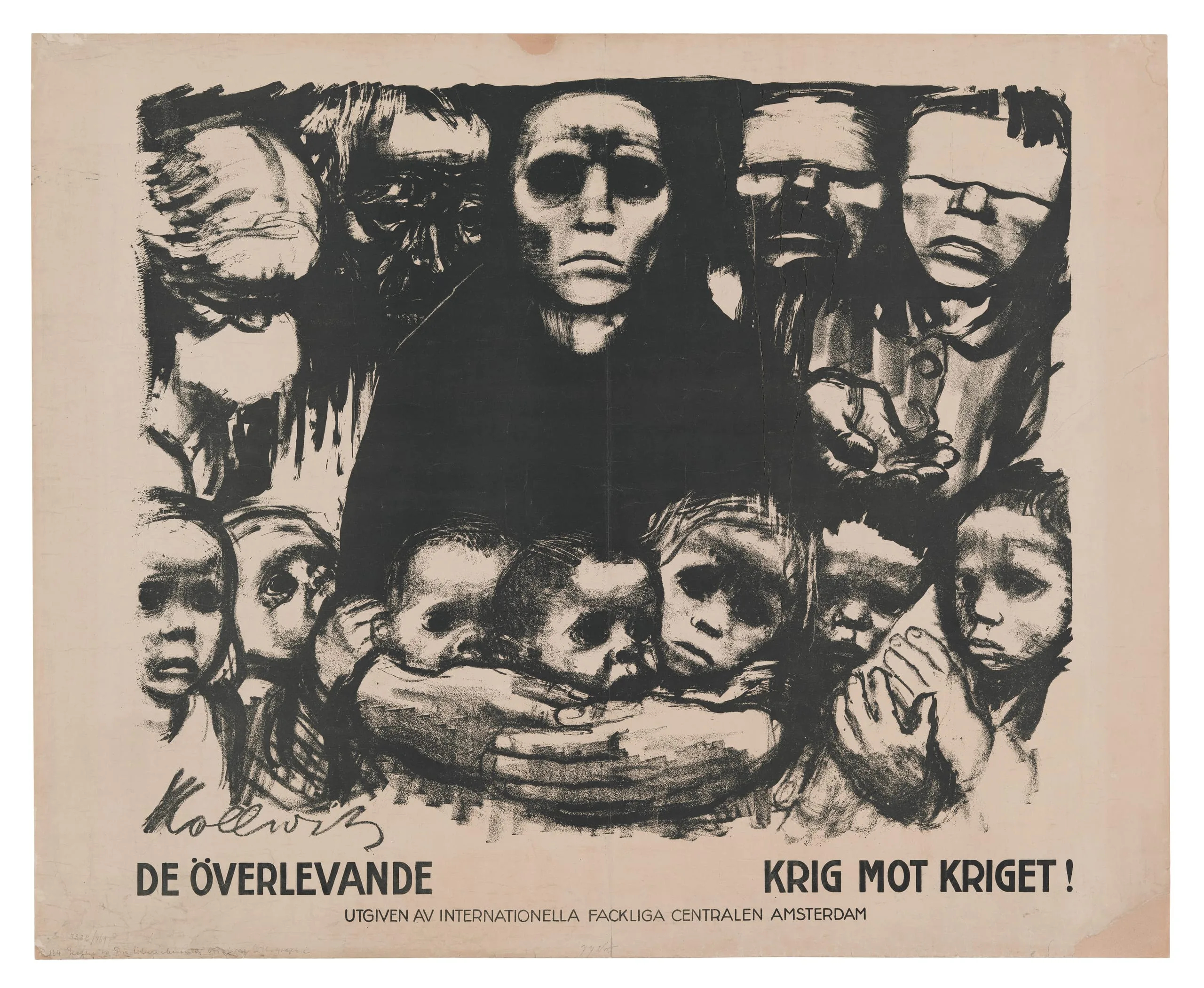
The horrors of World War I motivated Käthe Kollwitz to advocate for pacifism through her art. Her youngest son, Peter, had been killed in action at the age of eighteen. Her first public meditation on Peter’s death and the war was her print portfolio Seven Woodcuts on War (Sieben Holzschnitte zum Krieg), also known simply as War, published in 1924, the tenth anniversary of the war’s outbreak, and exhibited alongside Otto Dix’s fifty-print The War (Der Krieg) at Berlin’s Anti-War Museum the same year. When the International Trade Union Congress invited Kollwitz to design a poster with an antiwar message, she adapted the composition from her print The People (Das Volk), the final sheet in her War portfolio.
The mother at center holds her children against her black mantle, recalling Christian iconography of the Virgin of Mercy. The two blindfolded men on the upper right represent the victims of gas attacks, many of whom were permanently blinded. Kollwitz translated the stark black-and-white of the woodcut into a lithograph, using black tusche (ink) and crayon to portray the figures emerging from the darkness. The poster presents a more inclusive vision of war’s survivors, showing not only wounded soldiers but also the less visible victims such as widows, bereft parents, and orphaned children.
The poster was produced in an edition of 1,000 with German, Dutch, Danish, and Swedish titles. The phrase “War against War!,” seen here in Swedish at the bottom right, had become a pacifist slogan. This was not Kollwitz’s only antiwar poster; she also created the iconic Never Again War! (Nie wieder Krieg!) around the same time.
Erin Sullivan Maynes
2022 (adapted from Pressing Politics: Revolutionary Graphics from Mexico and Germany, 28)