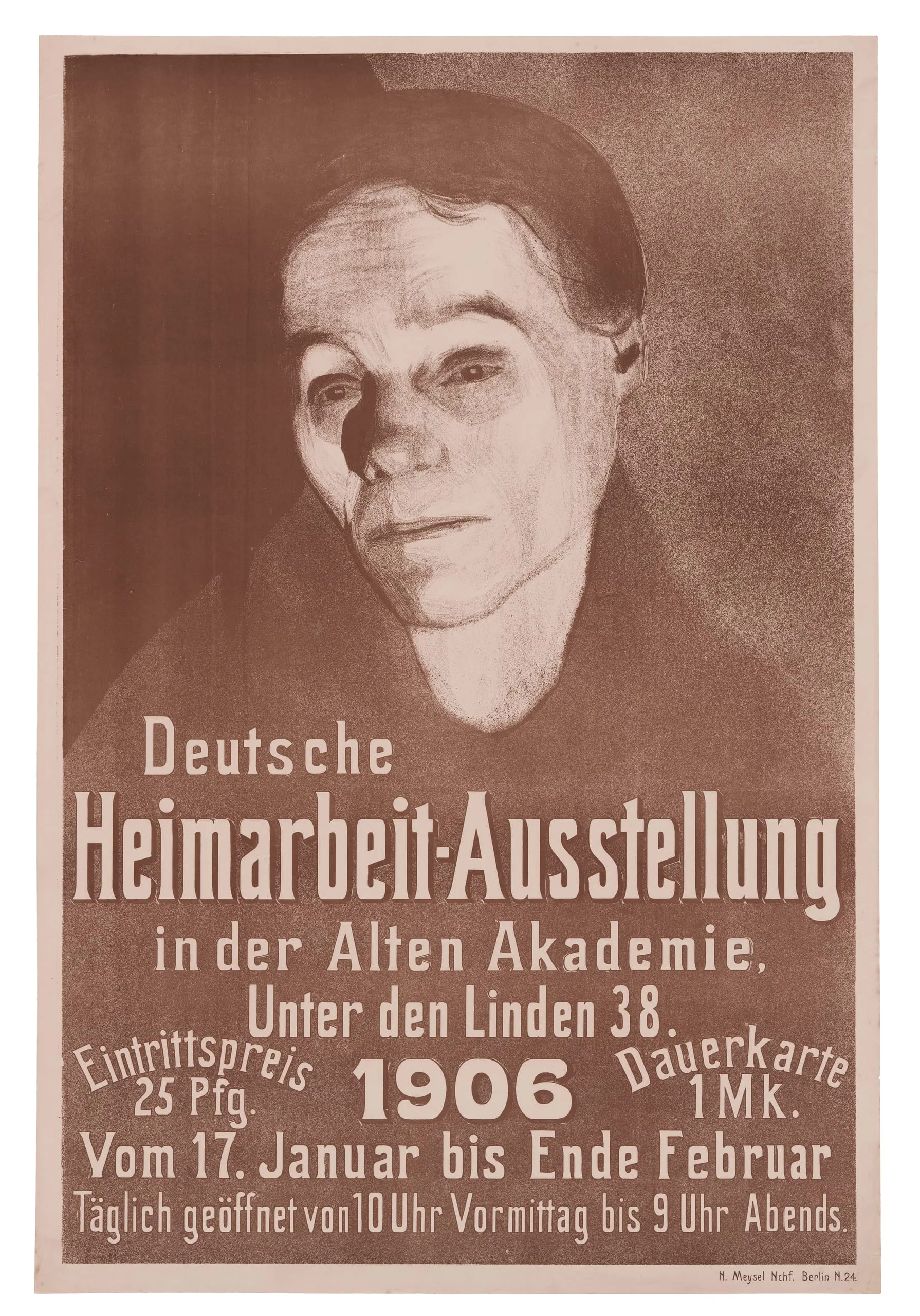
The 1906 German Cottage Industry Exhibition in Berlin was organized by the Bureau for Welfare Policy, a coalition of social reformers and trade unionists, with the aim of publicizing the harsh conditions of low-wage home work, generally performed by women. Käthe Kollwitz was invited to design the exhibition poster due to the success of her print series A Weavers’ Revolt (Ein Weberaufstand), in which she had portrayed a nineteenth-century textile workers’ strike with sympathy and sensitivity. Kollwitz’s poster focuses on the worker, not her work. The woman is monumentalized, her haggard face and bleary eyes lit from below by a single light source, suggesting late-night labor by candlelight. We are given no further information about the kind of work the woman does, but we see what the work has done to her. The rest of the composition is radically simplified; details are swallowed in shadow, which sets off the text advertising the exhibition.
The artist was reportedly unhappy with the initial proofs of this lithograph, feeling that nuances were lost in the printing. A friend who observed Kollwitz at work, however, noted that such an image needed a Fernwirkung (distance effect) to be legible from far away; the “starker and more severe” appearance left a stronger impression (Marcus 1985). Some reports claim that the German empress Augusta Victoria hated Kollwitz’s poster and refused to visit the exhibition until it was literally papered over on all Litfaßsäule (advertising columns) displaying it. The story makes plain that Kollwitz’s image unsettled audiences by depicting the suffering of working-class women up close.
Erin Sullivan Maynes
2022 (adapted from Pressing Politics: Revolutionary Graphics from Mexico and Germany, 94)
Bibliography
Marcus 1985. Franz Marcus. “Die Entstehung eines Kunstwerkes: Käthe Kollwitz’ Plakat 1906.” Philobiblon 29, no. 2 (June 1985): 120−24.