- Title
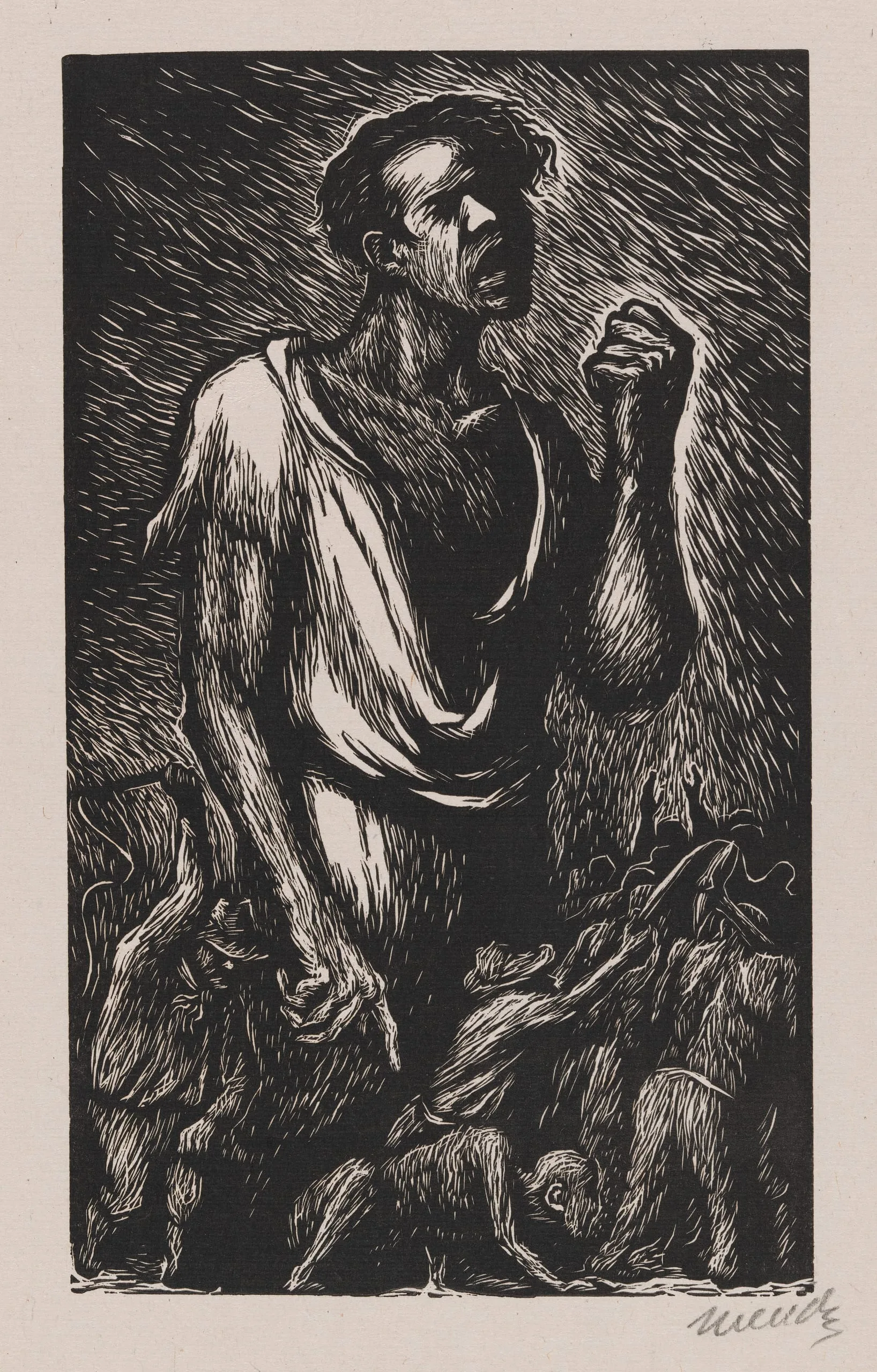
- Protest (La protesta)
- Date Made
- 1937, published 1943
- Medium
- Woodcut
- Dimensions
- Sheet: 9 5/8 × 7 1/2 in. (24.45 × 19.05 cm); image: 7 11/16 × 4 5/8 in. (19.53 × 11.75 cm)
- Accession Number
- M.2003.92.58
- Curatorial Notes
In the late 1930s and early 1940 Leopoldo Méndez often played with scale as a narrative and compositional device. By enlarging key figures in his prints, the artist created a charged scene and symbolically exposed relationships of power and control. In Protest (La protesta), Méndez portrays the power of the people—represented by the large central figure clenching his fist—confronting their oppressors. Below the protester, in a scene rendered much smaller, his comrades fall victim to men with whips. The gargantuan protester emerges from these injustices, emboldened by the collective might of the oppressed, personifying the moment of uprising. By portraying the masses as a singular giant, Méndez made use of a visual strategy seen in earlier artworks such as The Colossus (after 1808), attributed to Francisco de Goya (1746–1828).
For more information see the catalogue entry by Rachel Kaplan in Pressing Politics: Revolutionary Graphics from Mexico and Germany, 2022, pp. 30–31.
- Provenance
Taller de Gráfica Popular, Mexico City, 1943; Dr. Jules Heller (1919–2007), Scottsdale, Arizona, 1947; LACMA, 2003.
- Selected Bibliography
- Kaplan, Rachel, and Erin Sullivan Maynes. Pressing Politics: Revolutionary Graphics from Mexico and Germany. Los Angeles: Los Angeles County Museum of Art, 2022.
- Selected Exhibition History
- Pressing Politics: Revolutionary Graphics from Mexico and Germany. October 29, 2022 - July 22, 2023
- Copyright
- © Artists Rights Society (ARS), New York / SOMAAP, Mexico City