LACMA

ShopMembershipMyLACMATickets
LACMA
Los Angeles County Museum of Art
5905 Wilshire Blvd.
Los Angeles, CA 90036
info@lacma.org
(323) 857-6000
Sign up to receive emails
Subscribe
© Museum Associates 2025

Museum Hours

Monday

11 am–6 pm

Tuesday

11 am–6 pm

Wednesday

Closed

Thursday

11 am–6 pm

Friday

11 am–8 pm

Saturday

10 am–7 pm

Sunday

10 am–7 pm


  • About LACMA
  • Jobs
  • Building LACMA
  • Host An Event
  • Unframed
  • Press
  • FAQs
  • Log in to MyLACMA
  • Privacy Policy
© Museum Associates 2025
Collections

F. Childe Hassam
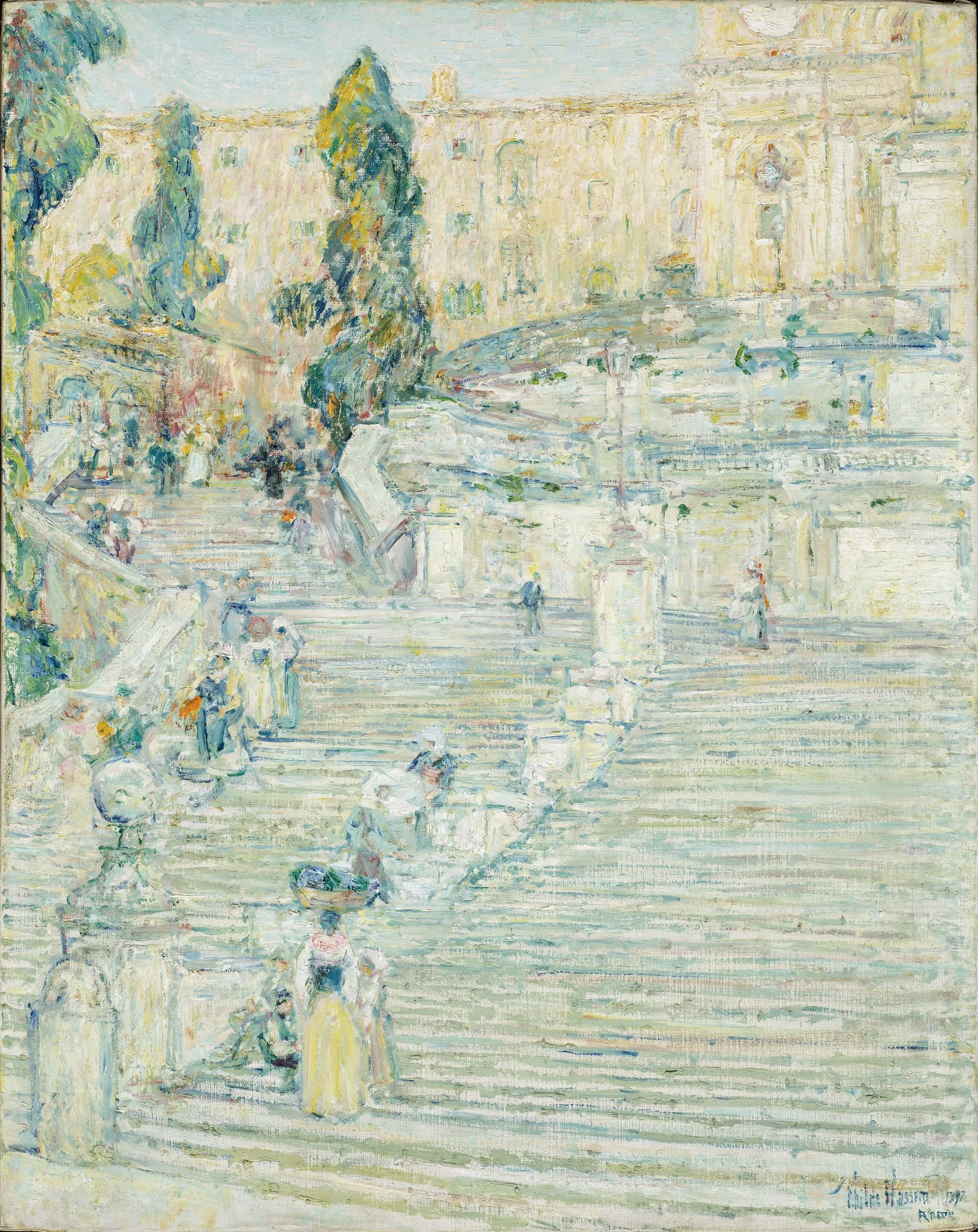
The Spanish Stairs, Rome1897

On view:
Resnick Pavilion, floor 1
Impressionist oil painting of the Spanish Steps in Rome, with loose brushwork in pale whites, greens, and yellows, scattered figures on broad stone stairs, and a grand building in the distance
Artist or Maker
F. Childe Hassam
United States, Massachusetts, Boston, 1859-1935
Title
The Spanish Stairs, Rome
Place Made
United States
Date Made
1897
Medium
Oil on canvas
Dimensions
29 5/16 x 23 3/8 in. (74.45 x 59.3 cm)
Credit Line
William Randolph Hearst Collection
Accession Number
46.4.4
Classification
Paintings
Collecting Area
American Art
Curatorial Notes
The Spanish Stairs in Rome have been favored by tourists since they were constructed. The monumental double staircase with more than 130 steps was built in 1725 by the French on land owned by them. The stairs lead up a steep hill from a plaza to San Trinità dei Monti, which had been constructed earlier by Charles viii of France. Such throngs of people immediately flocked to see the stairs that guards from the nearby Spanish embassy were sent to keep order. While the French protested the Spanish intrusion onto their land, the Roman authorities ruled that the stairs fell under the jurisdiction of the Spanish. The public then began referring to the staircase as the Spanish Stairs.
Hassam, painted the stairs during his trip to Europe in 1896-98, when he spent the month of January 1897 in Rome. As so many Americans before him, Hassam became entranced by this scenic spot in the Holy City, and he is known to have painted it at least three times. A comparison of this version with the one in the Newark Museum, of the same size, reveals a change in the artist’s perception of the subject: in the museum’s version Hassam viewed the staircase as a tourist image, presenting an expansive view of the stairs and church above while in the Newark version he moved closer to the scene, thereby eliminating the church and the full sweep of the grand staircase.
In true impressionist fashion, Hassam may have used the motif of the Spanish Stairs to explore the effect of natural light during different times of the day. The Newark version has the brilliant color and intensity of a noonday sun, while the museum’s painting has a more delicate, opalescent palette, suggesting the faint light at the onset of twilight. The hues subtly change from the warm orange of the light of the setting sun caught by the top of the church in the upper right corner of the painting to cooler tones of blue and lavender proceeding down the stairs. The indistinctness of the figures also suggests the crepuscular light of late afternoon. Hassam exhibited a painting titled Le Soir Piazza de Spagna (Rome) at the 1897 Salon of the Société National des Beaux Arts, and the museum’s version, which has on its verso part of a French label dating from the 1890s, may be this evening scene.
Selected Bibliography
  • Fort, Ilene Susan and Michael Quick. American Art: a Catalogue of the Los Angeles County Museum of Art Collection. Los Angeles: Los Angeles County Museum of Art, 1991.