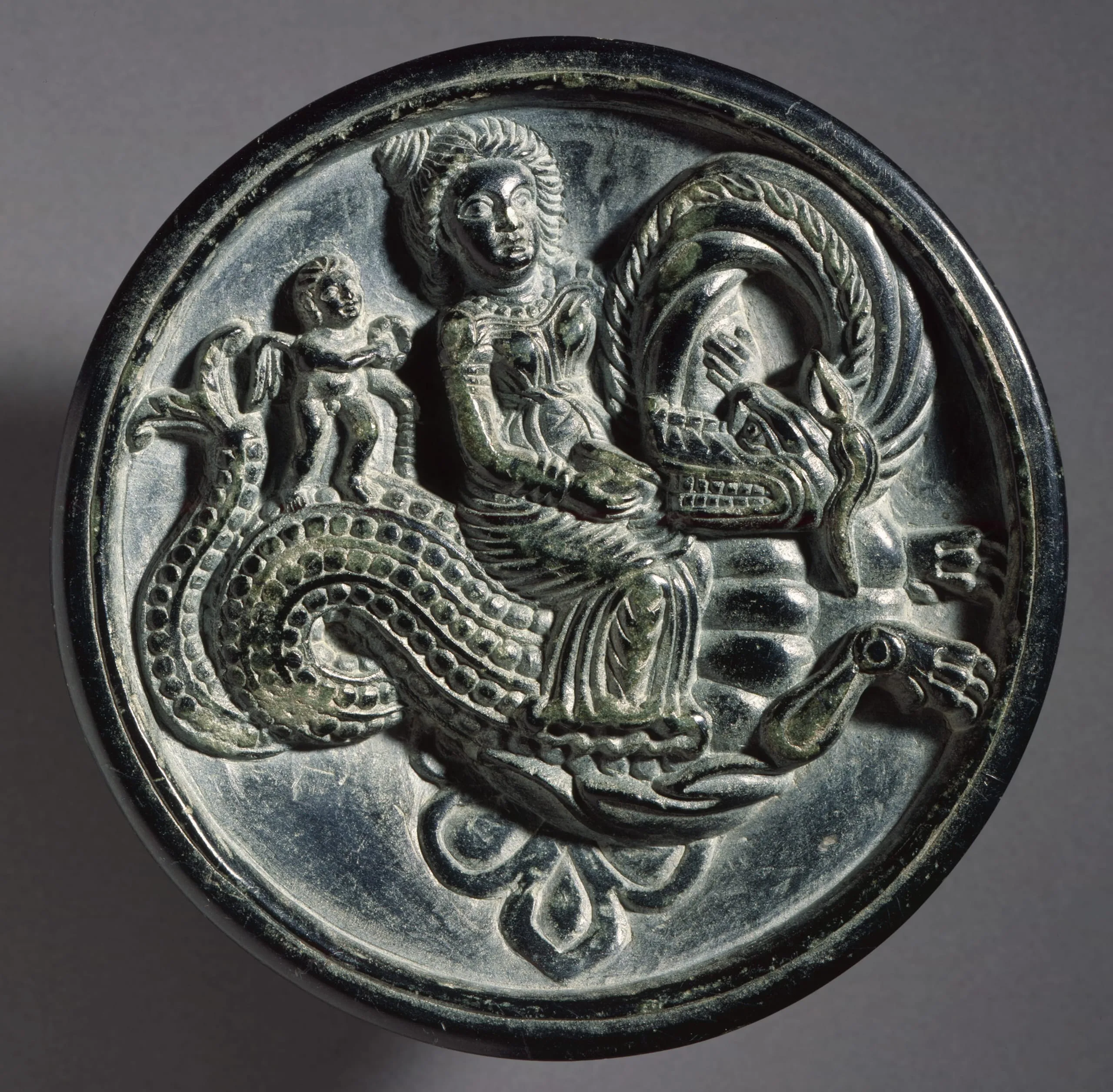
This ritual tray depicts a Greek mythological scene frequently portrayed in Western Classical art. A Nereid (sea nymph) elegantly garbed in a chiton rides the sea monster Keto with a dragon’s head and serpentine tail. The sea monster turns its head back towards the Nereid to receive a drink, oblation, or unguents from the bowl she holds. An adoring cherub stands behind her.
The original function of South Asian ritual trays remains a matter of scholarly debate. When many of the extant trays were first excavated in Taxila by Sir John Marshall in 1913–1934, they were identified as toilet trays or cosmetic palettes because most of the Kushan period (1st–3rd centuries CE) trays are divided into small compartments. This hypothesis has been questioned because none contains cosmetic remnants. A more recent interpretation is that they are cultic objects whose Classical imagery was adapted to symbolize the spiritual journey of Buddhist practitioners’ rebirth and apotheosis into the Buddhist celestial paradise of Sukhavati. This is supported by the prevalence of Dionysiac couples having paradisiacal associations. By the Kushan period, trays typically featured Buddhist and pan-South Asian imagery. The Gandharan ritual trays are thus significant for demonstrating how Classical figurative subjects were initially copied from foreign prototypes in South Asia and then supplanted by indigenous imagery. See also M.85.224.2, M.85.224.4, and M.85.281.
Comparable trays with similar iconography are in the Ashmolean Museum, University of Oxford (EA1996.82); and Victoria and Albert Museum, London (IS.3-1958).