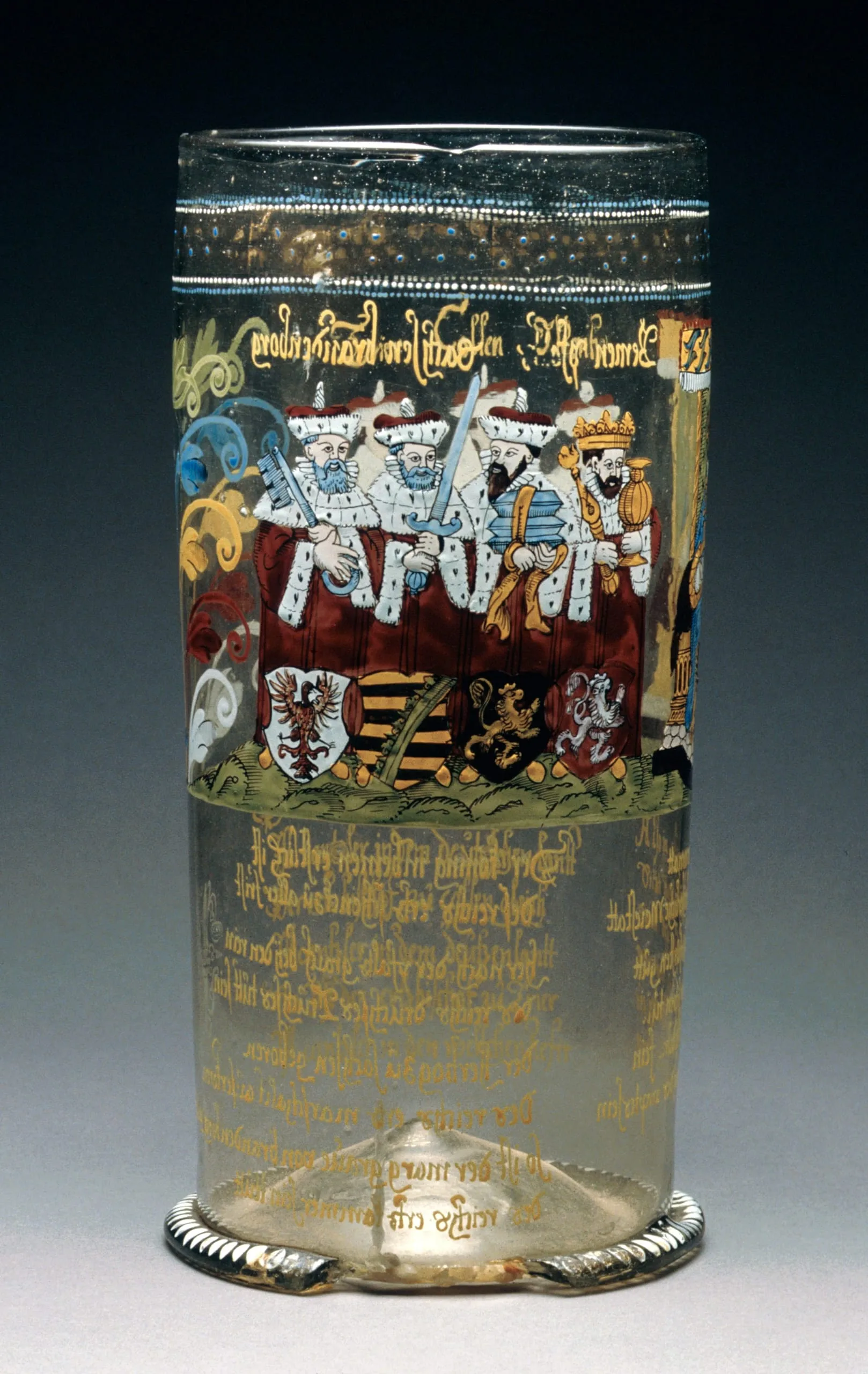
This free-blown glass electors beaker (Kurfürsten Humpen) depicts the Holy Roman Emperor, leader of a Germanic political alliance comprising hundreds of large and small sovereign territories, each with its own ruler. To the right of the emperor stand the three ecclesiastical electors (Cologne, Trier, Mainz) and on the left the four secular electors (Bohemia, Saxony, Brandenburg, the Palatinate), so-called because they were responsible for choosing the emperor. Whereas the electors wear red cloth hats, the Holy Roman Emperor wears a crown topped with arches and carries the imperial regalia: a scepter and orb. Below each elector is his coat of arms, names, and attributes. An additional inscription at the bottom identifies the emperor and explains the function of each elector. This version of a design for an electors beaker is earlier and more rare than a later design in which the electors are seated on horses.
Initially, Venetian glassmakers produced vessels with heraldic motifs for a Northern European market, even after enameled glass fell out of fashion in Venice. As craftspeople and their techniques migrated north, Bohemia and Silesia—part of present-day Germany, Poland, and the Czech Republic—became known as centers of glasswork in the sixteenth and seventeenth centuries. Additional glassmaking districts formed near Potsdam and Dresden, with specific sites determined by the availability of wood for fuel. These glass artists achieved the bright colors of the decorative scheme with enamel paints. They combined crushed clear glass, pigments, and a gum binder that allowed the mixture to be brushed onto a glass vessel, which was then fired to fuse the applied powder to the body. Firing the enamel revealed its colors and made the decoration durable and stable.
Large glass beakers for communal beer drinking were popular in the late sixteenth and seventeenth centuries. They were held with two hands and passed around the table at banquets and other celebrations. Many beakers survive from the court cellars of the Holy Roman Empire. In times of political turmoil, toasts made with a beaker like this one clearly demonstrated one’s loyalty to the empire, which survived for nearly 1,000 years until it was dissolved in the early nineteenth century as a result of internal division following Napoleon’s conquest of Europe.
In the twentieth century, William Randolph Hearst amassed a collection of medieval and early modern European art. He displayed such enameled glass at Wyntoon, the Hearst family estate near Mount Shasta, which was decorated in a Germanic style.
Cynthia Kok
2025