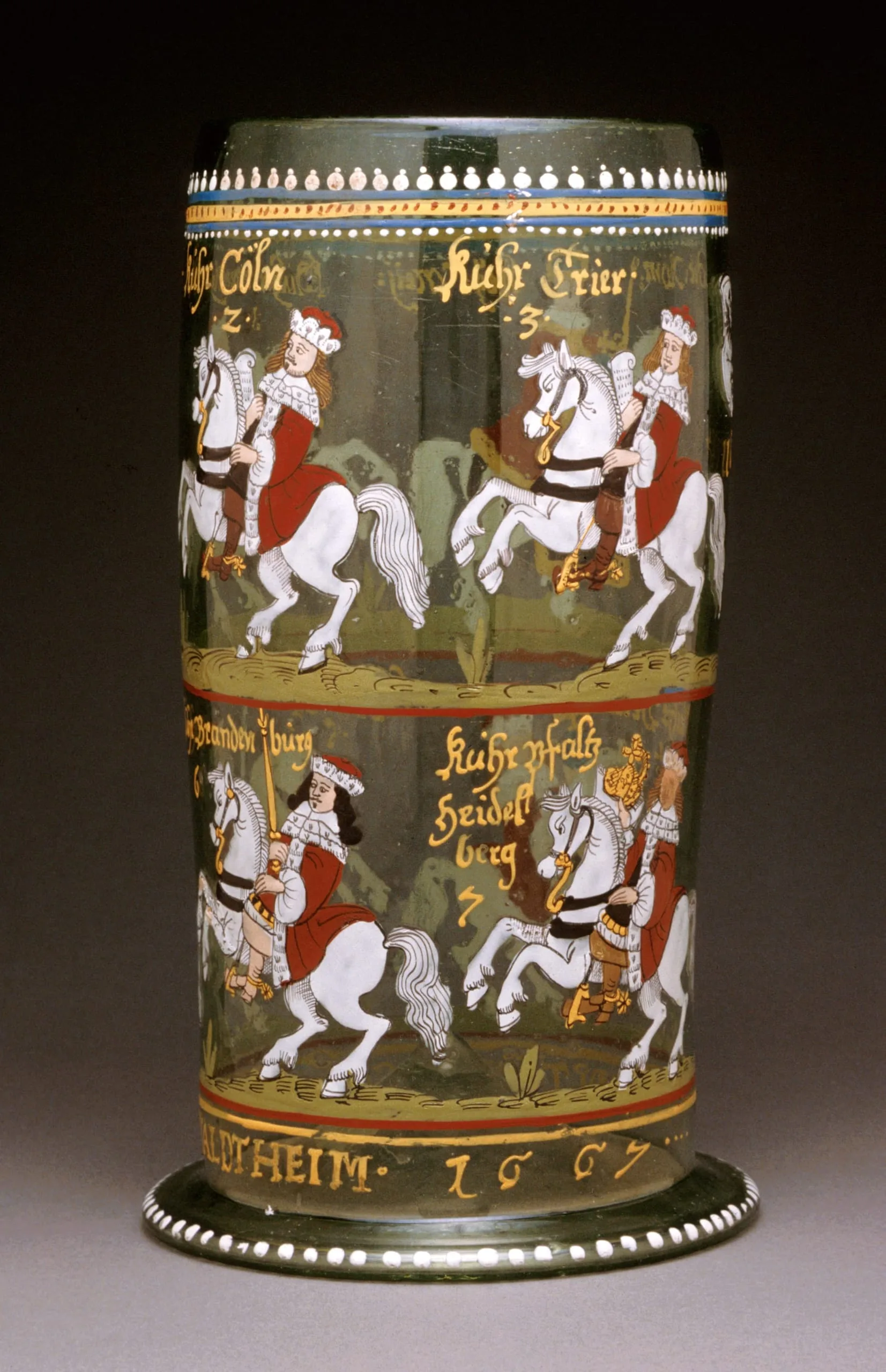
- Title
- Electors Beaker (Kurfürstenhumpen)
- Date Made
- 1667
- Medium
- Glass, enamel, gilt
- Dimensions
- Height: 9 7/8 in. (25.08 cm); Diameter of rim: 4 5/8 in. (11.75 cm); Diameter of base: 5 5/8 in. (14.29 cm)
- Accession Number
- 48.24.160
- Curatorial Notes
Large glass beakers for communal beer drinking were popular in late sixteenth- and seventeenth-century Germany. They were held with two hands and passed around the table at banquets and other celebrations. Many beakers survive from the court cellars of the Holy Roman Empire, a German political alliance comprising hundreds of large and small sovereign territories, each with its own ruler. A smaller group of seven people, known as prince electors, included both ecclesiastical and secular rulers who were responsible for choosing the emperor. This vessel, known as an electors’ beaker, is decorated with figures of seven electors on horseback. The upper part features the emperor and three ecclesiastical electors (Cologne, Trier, Mainz), while the lower register has four secular electors (Bohemia, Saxony, Brandenburg, the Palatinate). Whereas the electors wear red cloth hats, the Holy Roman Emperor wears a crown with arches on top and carries the imperial regalia: a scepter and orb. In times of political turmoil, toasts made with a beaker like this one demonstrated one’s loyalty to the empire, which survived for nearly a thousand years until was dissolved in the early nineteenth century as a result of internal divisions following Napoleon’s conquest of Europe.
- Selected Bibliography
- Levkoff, Mary L., ed. Hearst the collector. Exh. Cat. New York: Abrams and Los Angeles: Los Angeles County Museum of Art, 2008.