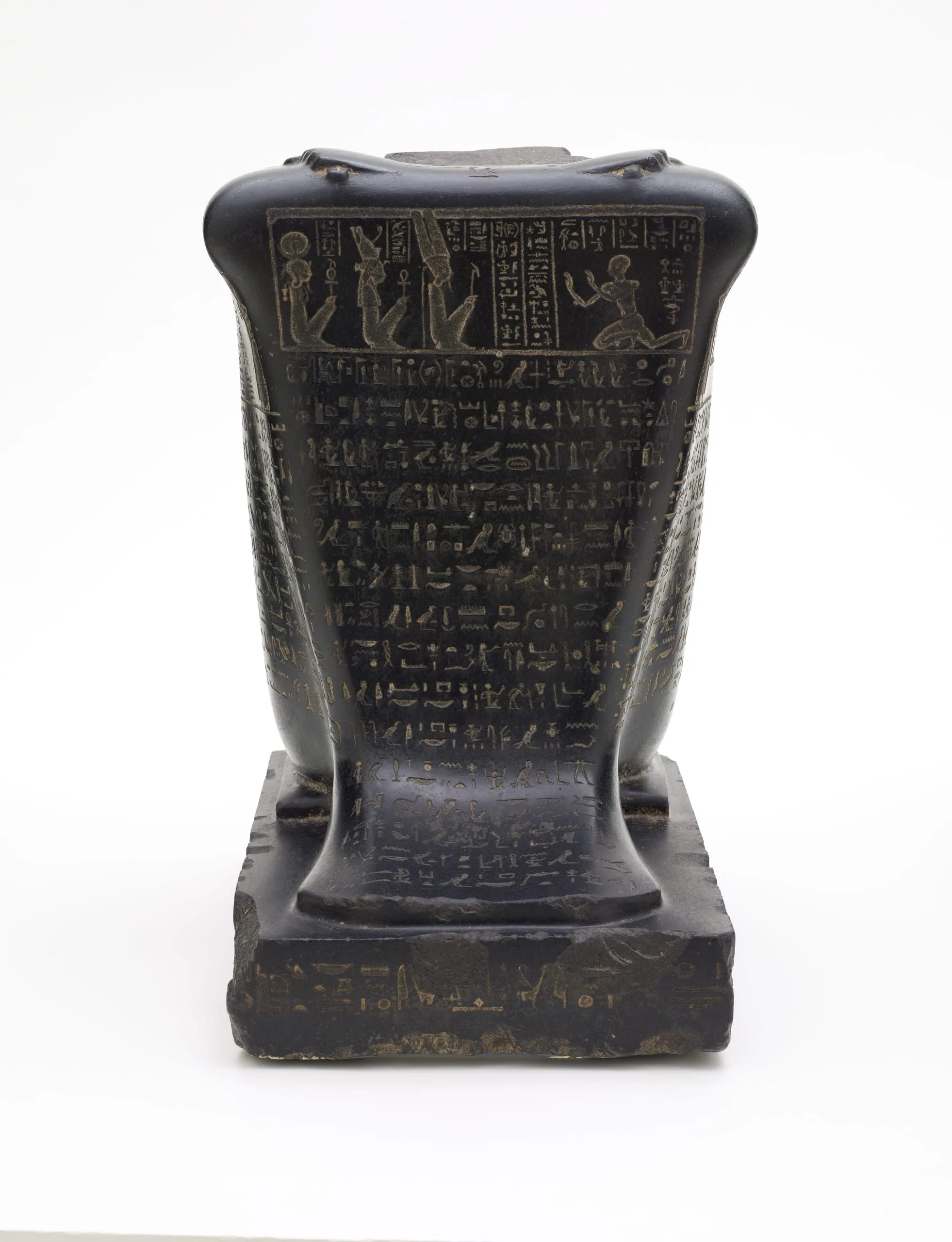
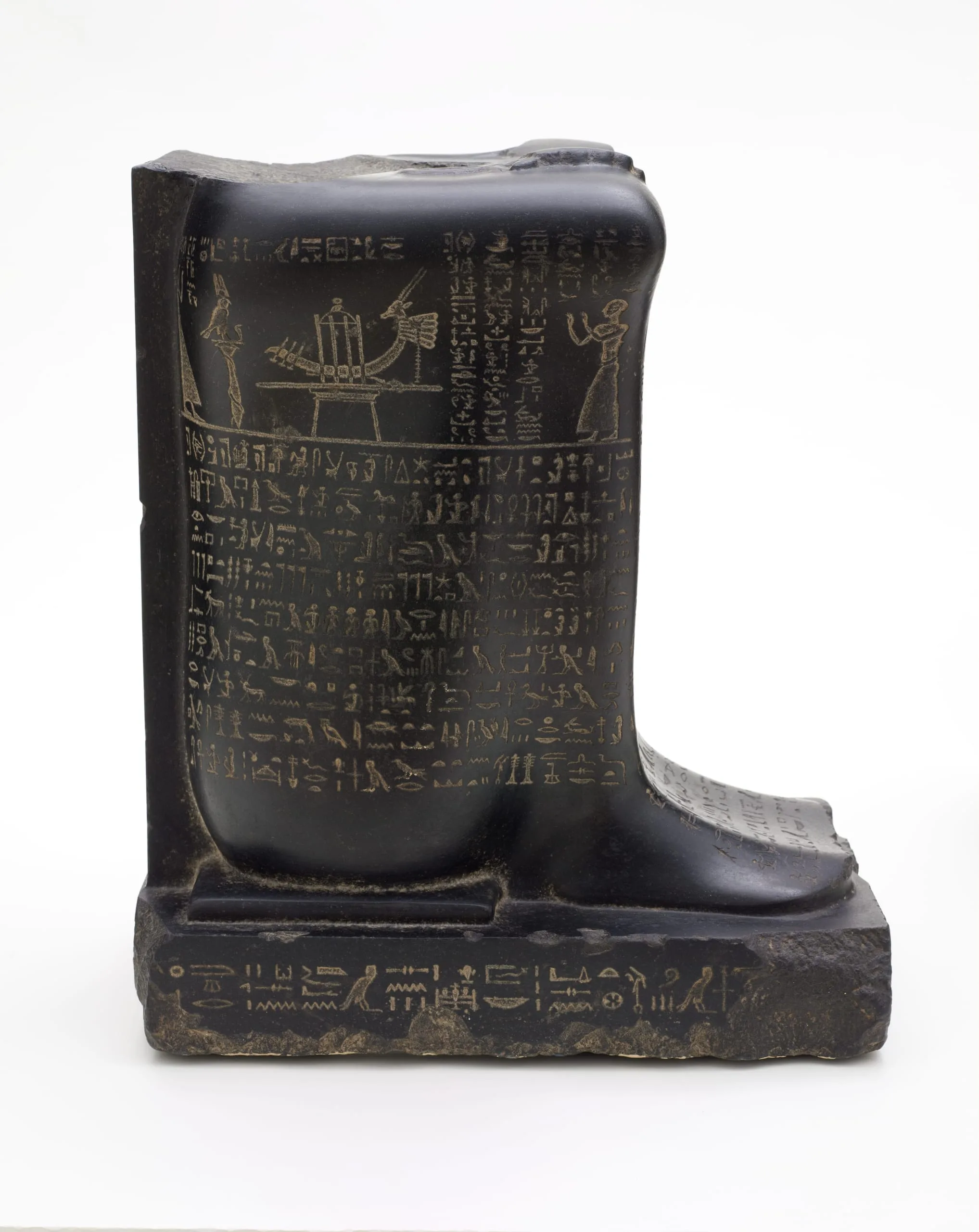
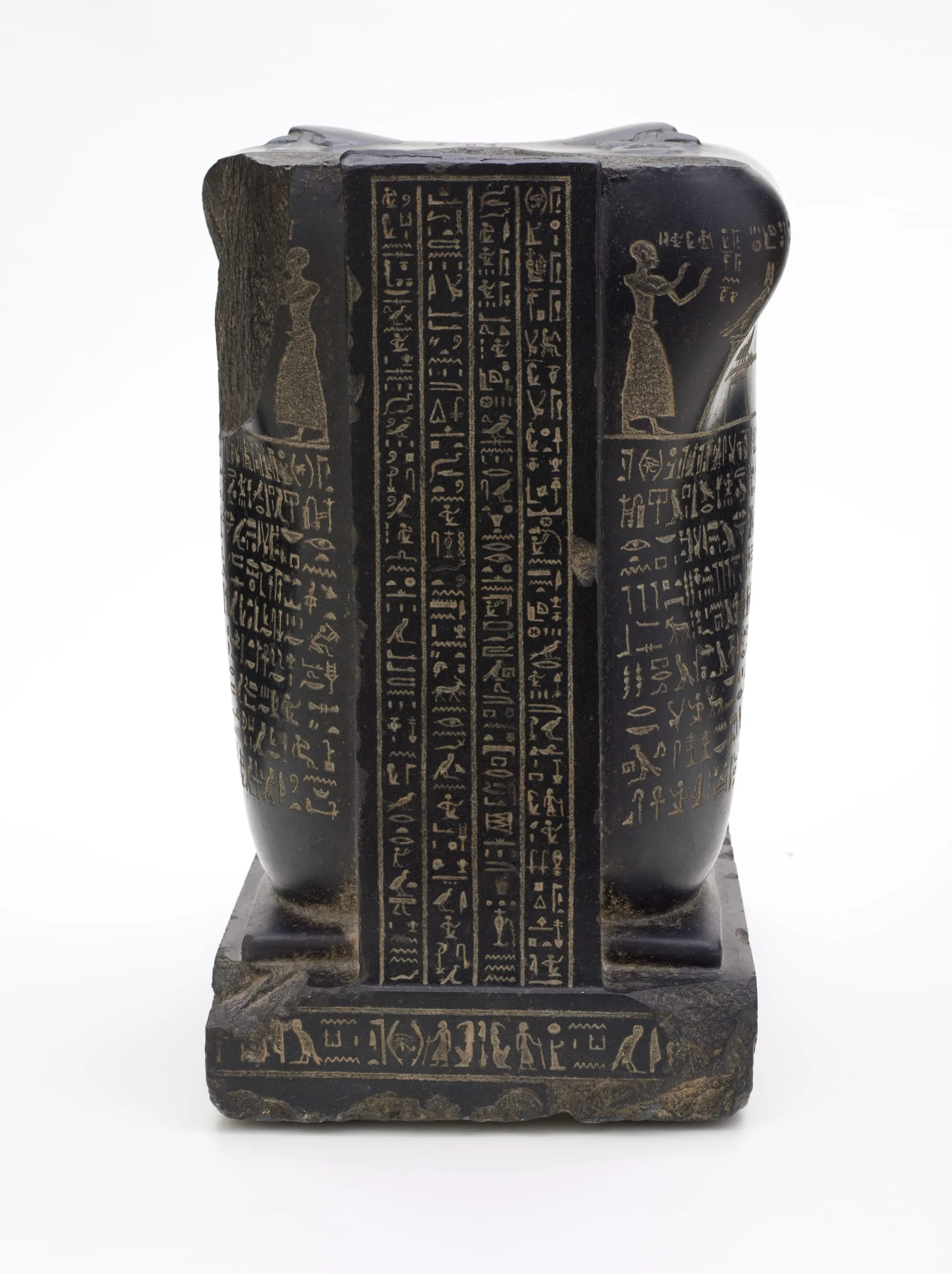
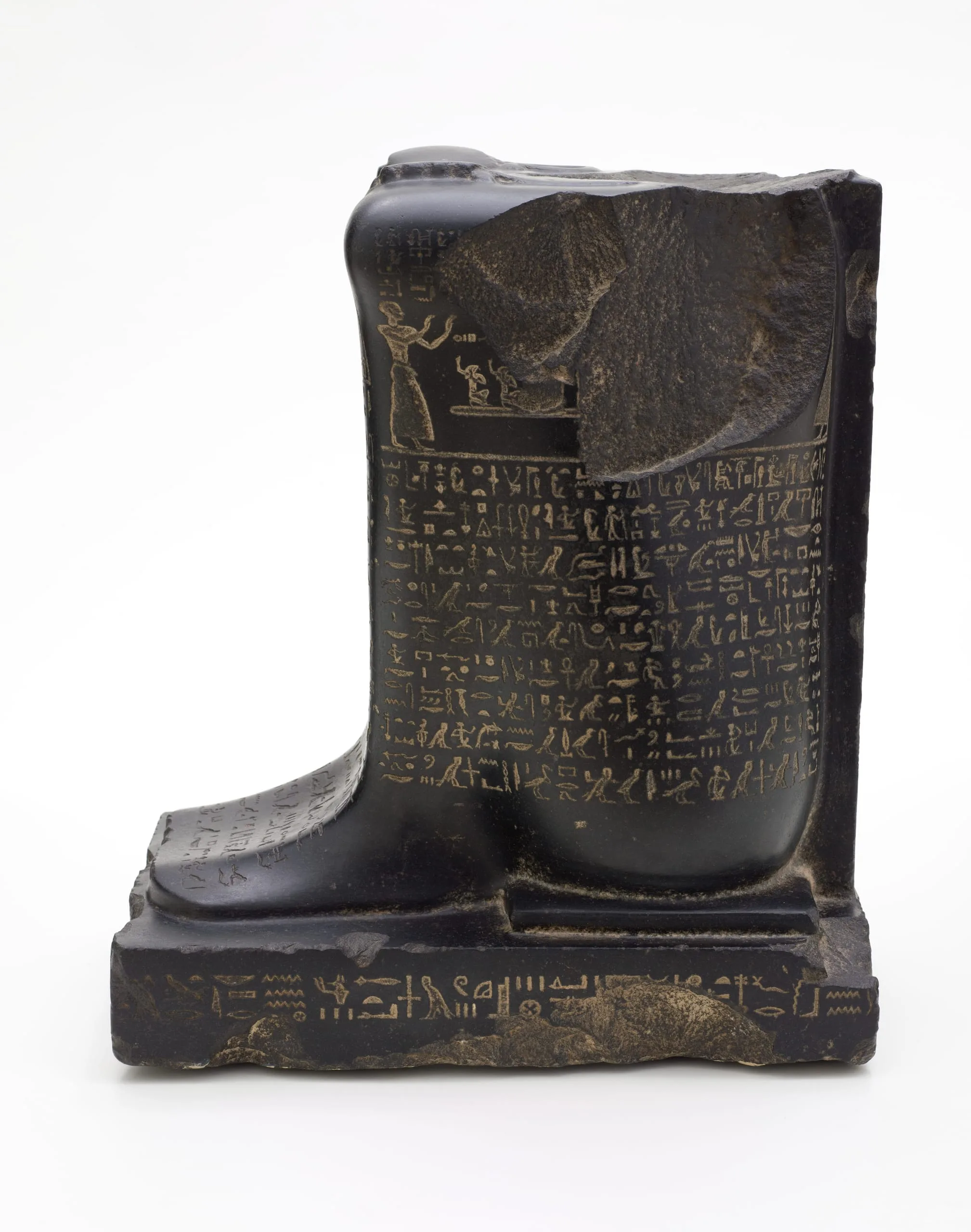
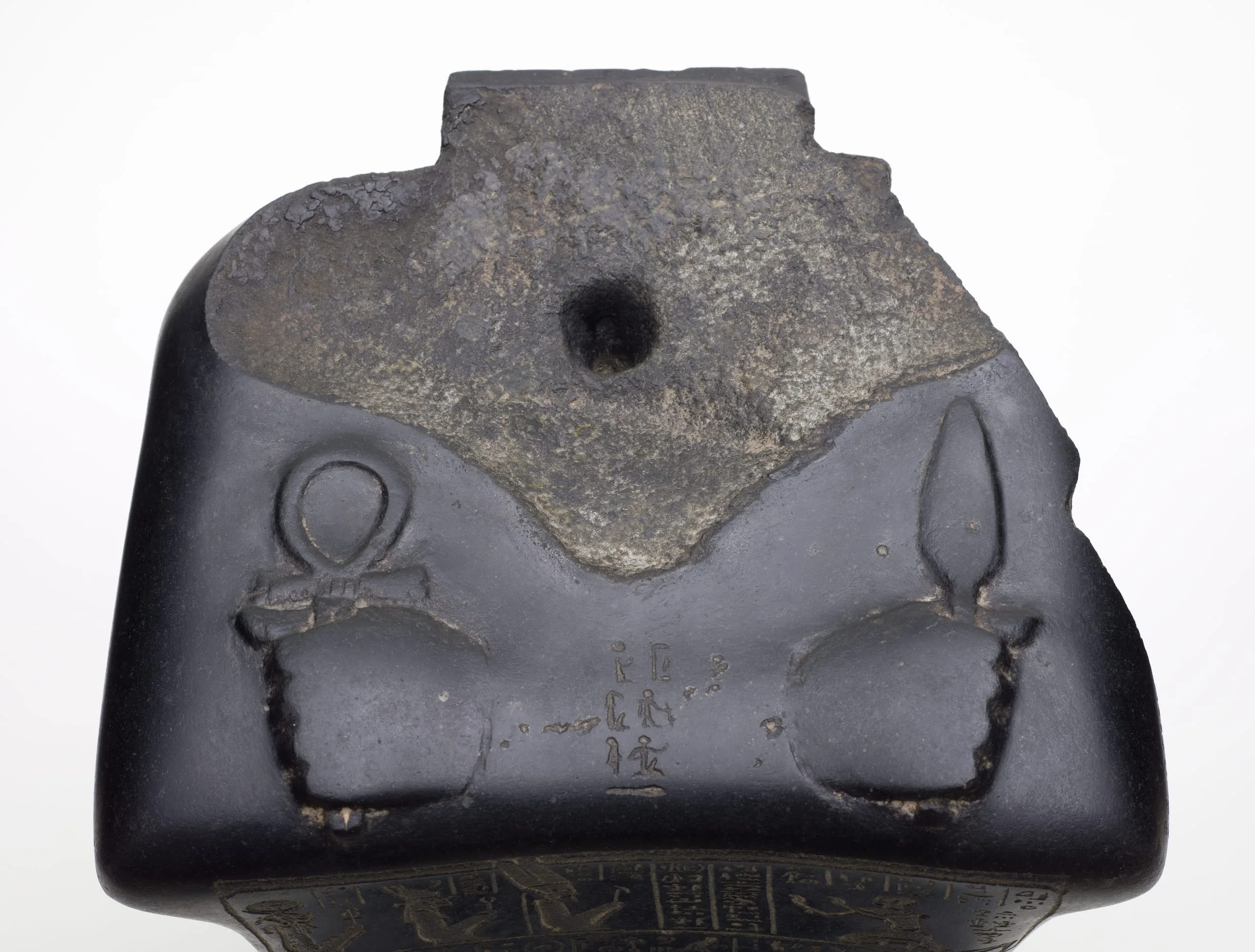
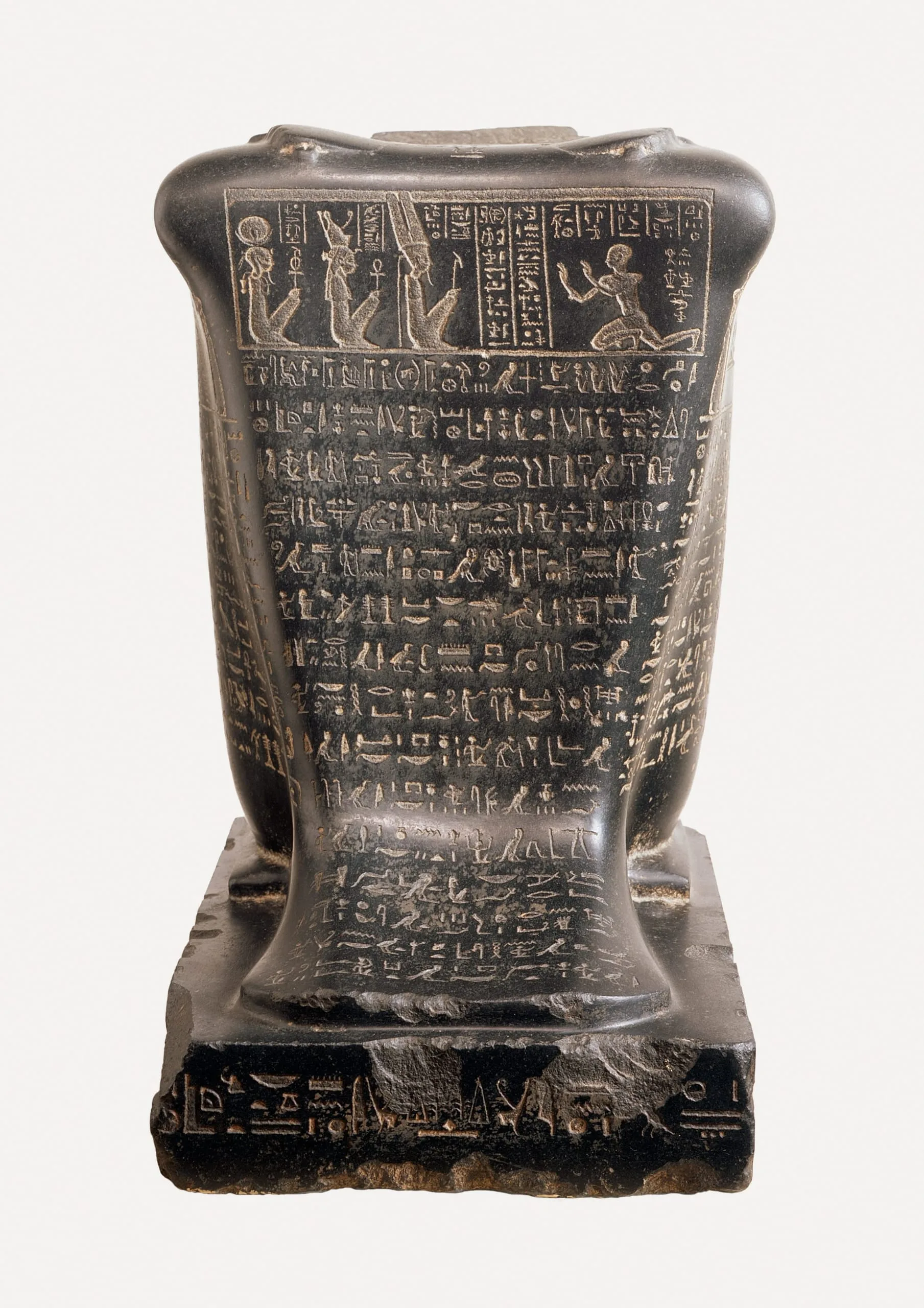
This now-headless statue depicts the squatting scribe Ser-Djehuty. Although excavation records are unclear, it may have been among the 800-plus statues recovered at the Temple of Amun at Karnak between 1903 and 1907. The front panel relief shows Ser-Djehuty kneeling in supplication before the three gods of the Theban triad: Amun, his consort Mut, and their son Khonsu. Inscriptions identify Ser-Djehuty as chief scribe of the Temple of Amun treasury, head of the sculptor’s studio, and chief artist. Befitting his role, all surfaces of the highly polished body, back pillar, and base are inscribed with finely executed incised hieroglyphs and relief scenes. Texts include prayers to various Egyptian gods and requests for food offerings for Ser-Djehuty. In his hands are an ankh and a knifelike object identified as a “thin lettuce plant.” A hole at the top of the statue indicates where the missing head would have been inserted. Additional monuments bearing Ser-Djehuty’s name and titles were found in the nearby precinct of the goddess Mut, but despite efforts by several Egyptologists, the missing head has not been located. Excavation records of the Karnak cachette by Georges Legrain do not specifically identify the block statue of Ser-Djehuty, so it is possible that it was deposited at the Temple of Mut.
Block statues were a popular sculptural form adopted in the Middle Kingdom (c. 1980−1760 BCE); the form was abandoned after the 26th and 27th Dynasties, then revived during the Ptolemaic Period (323−30 BCE). The shape represents a figure squatting with knees drawn to the chest, providing large flat surfaces for texts in the form of prayers and requests. During the Middle Kingdom, nonroyal individuals were permitted to dedicate and place sculptures of themselves within temple precincts, symbolically allowing the owner to receive the religious benefits of temple rituals.
Provenance: Possibly Karnak cachette CK 994 or Mut Temple; Formerly William Edkins (possibly 1813-1891) Collection, Bristol, England, sold 1891; Sotheby’s London, May 21, 1891, no. 571; Christie, Manson & Woods, London, sale March 20, 1930, cat 78 purchased by William Randolph Hearst; Gift of William Randolph Hearst Foundation, July 15, 1948.
Selected Bibliography
Klotz, David. “The Cuboid Statue of Ser-Djehuty, Master Sculptor in Karnak, Los Angeles County Museum of Art 48.24.8.” Revue d’Égyptologie 66 (2015): 51109.
Porter, Bertha, and Rosalind L. B. Moss, with Ethel W. Burney. Topographical Bibliography of Ancient Egyptian Hieroglyphs, Texts, Reliefs, and Paintings, vol. 2, Theban Temples. 2nd rev. ed. Oxford: Clarendon Press, 1974,