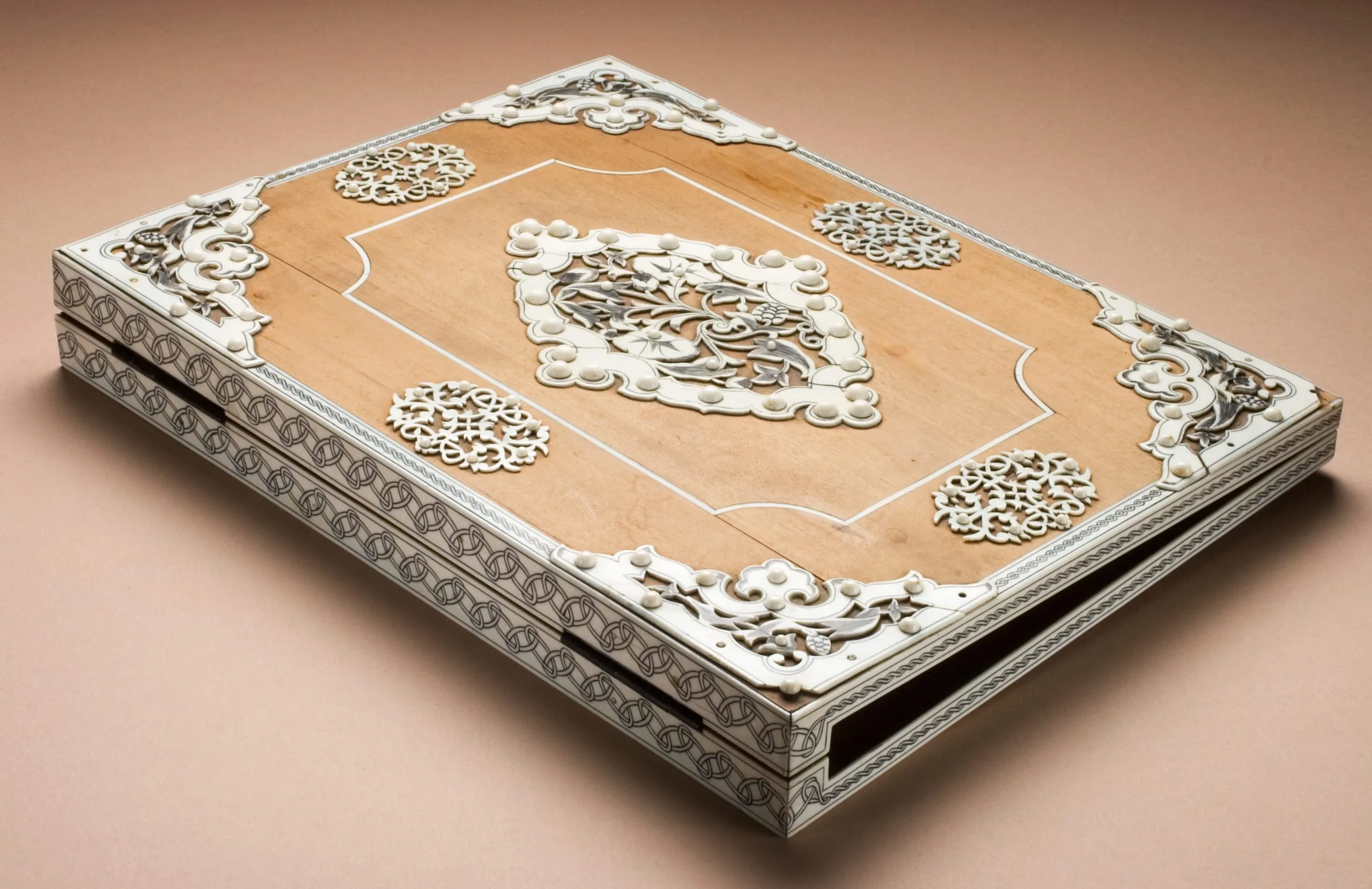
This ornate folio case is made of sandalwood embellished with ivory fretwork highlighted with lac. The exterior front cover has four arabesque medallions and a central lobed cartouche and lobed corner braces enclosing flowering poppies. The floral designs were first incised and then filled with black molten lac, a resinous secretion of South Asian lac insects commonly used to make shellac and lacquer. The edges and sides have ivory veneer borders with cable molding (resembling braided wire) and/or interlacing chainlink designs delineated in lac. The back cover is plain apart from an outer border of inlaid bison horn. The interior front cover is also plain except for a large lobed cartouche inlaid in ivory.
Folio cases were often included in writing sets consisting of a portable writing desk (known as a writing slope), inkstand, pen tray, paper weight, and candlestick holder. Sandalwood folio cases, writing slopes, jewelry and sewing boxes, assorted containers, take and larger items such as table bureaus and armchairs were chiefly produced at the port of Vishakhapatnam (formerly Vizagapatam) on the southeast coast of India. The port was an important trade and furniture manufacturing center on the sea route south of Kolkata (formerly Calcutta) in the late 17th century to mid-20th century.