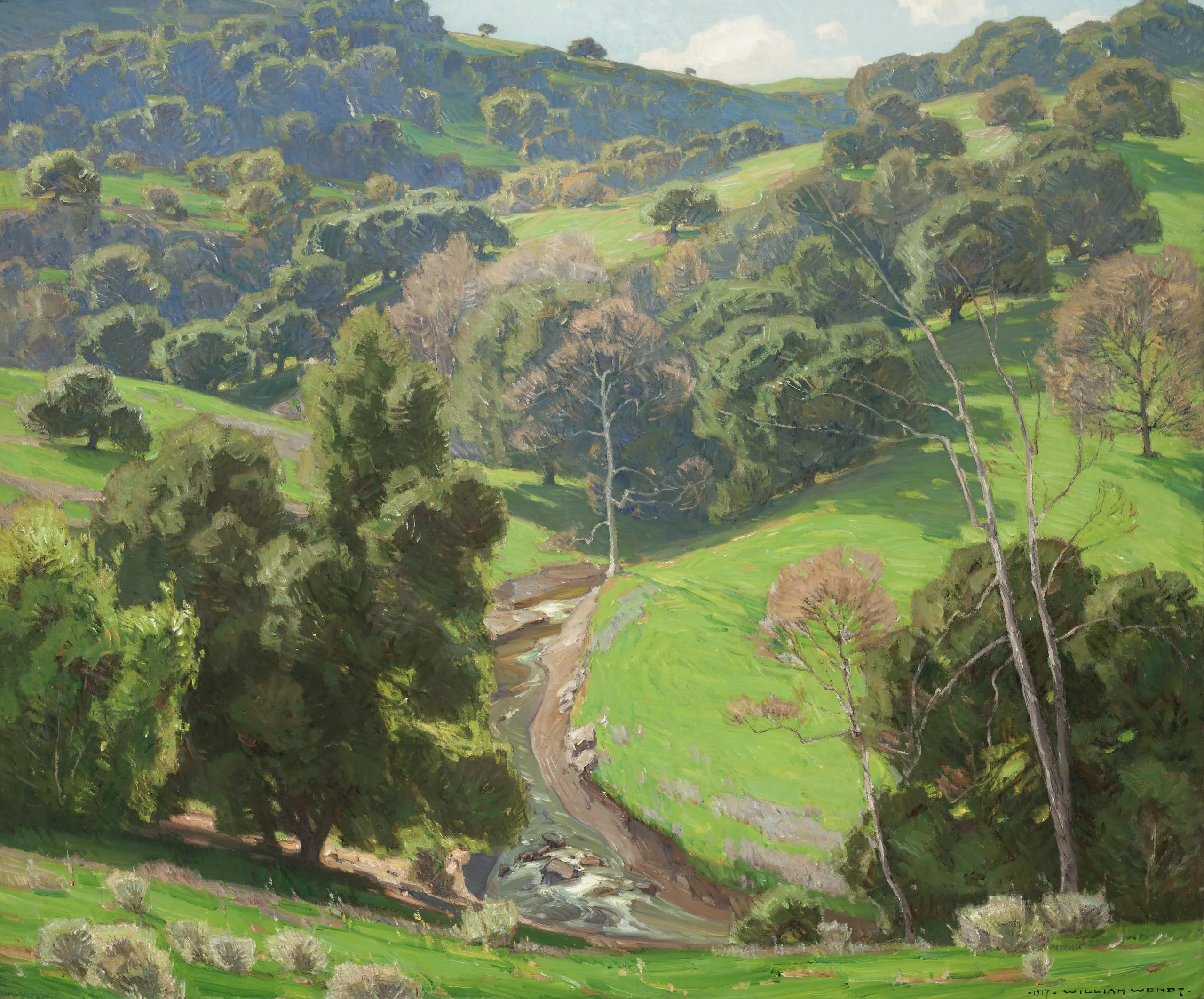
Wendt’s earliest work appears to have been in the poetic tonalist style of the Chicago painters of the period that had evolved toward a form of impressionism, but throughout his career Wendt retained a sensitivity to the spiritual and poetic aspects of nature, as shown in his choice of motifs and titles.
He was particularly attracted to the appearance of the hills in springtime, when the seasonal rains bring a lush greenness to the grass and live oaks, as in this painting. Its unusually strong greens and deep shadows combine to make it one of Wendt’s most lyrical and tender works, notwithstanding its large size and vigorous, choppy brushwork. The high horizon and even, overall pattern of light and shade contribute to the decorative quality often found in Wendt’s variety of impressionism.
The Mantle of Spring was an early acquisition of the museum, the first work of art given to any institution by the Los Angeles District Federation of Women’s Clubs, who presented it in "grateful tribute to the Boys of America who gave their lives and the Mothers who gave their Sons in the World War." It was one example of the numerous cases nationwide of art patronage resulting from the First World War.