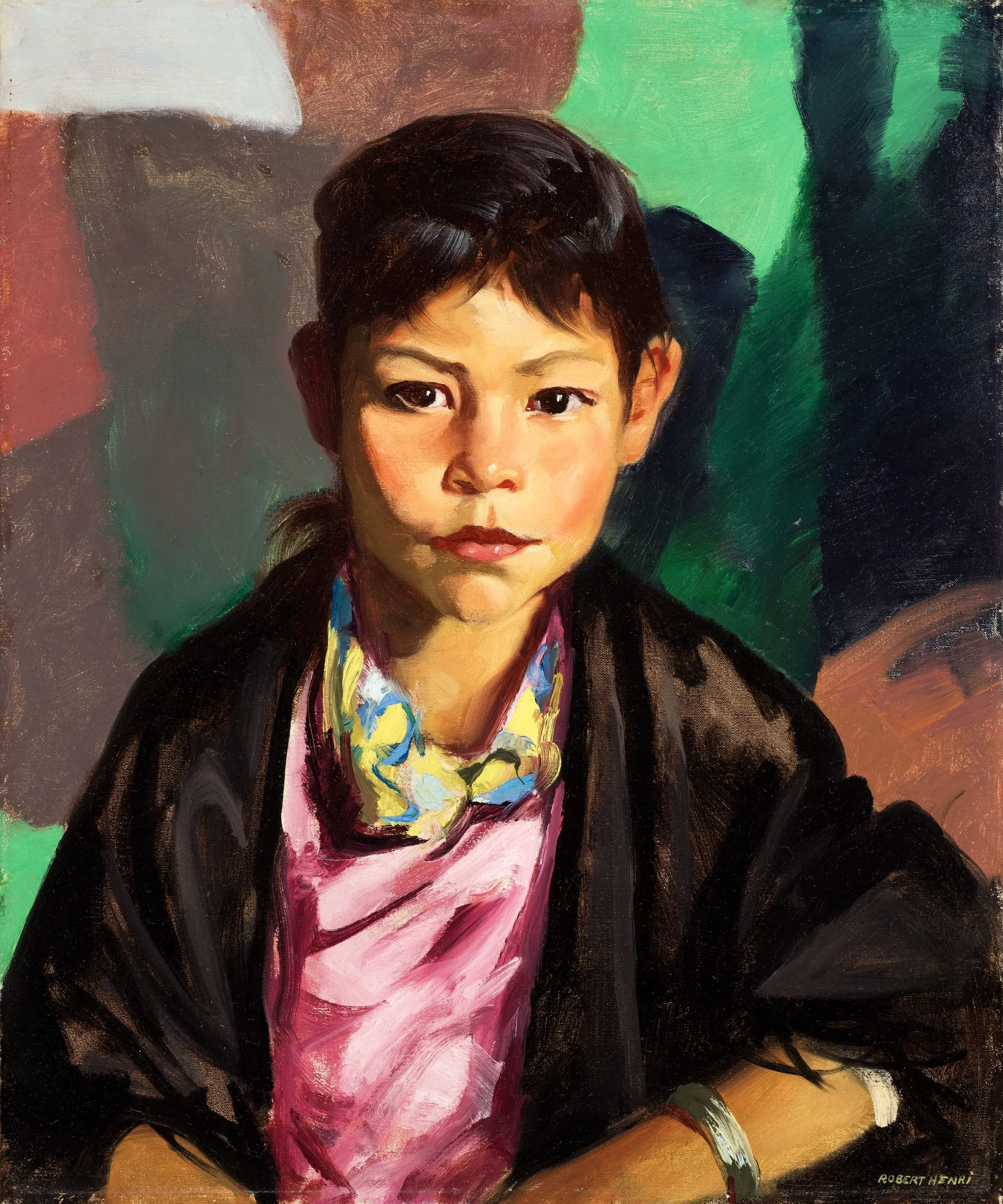
The artist’s record book indicates the title of this painting is Pepita, and it notes elsewhere that it was painted in Santa Fe.
While summering in La Jolla, California, in 1914, Henri planned the art exhibition at San Diego’s Panama-California International Exposition (1915) and became close friends with Dr. Edgar L. Hewett, an ethnologist and director of the School of American Archaeology in Santa Fe, who was in charge of the ethnology and art exhibits. At Dr. Hewett’s invitation Henri spent the summers of 1916, 1917, and 1922 in Santa Fe, where Hewett introduced him to the Native Americans and their cultures. Henri’s ethnological interest in them fits into the larger pattern of his traveling in search of national or ethnic types, such as his Irish, Chinese, and black subjects. In his paintings of Native Americans he paid attention to costumes and daily habits while attempting to convey the spirit of the people, which he saw as noble and mysterious. For this purpose he preferred to paint children rather than adults, saying in The Art Spirit, "I have never respected any man more than I have some children. In the faces of children I have seen a look of wisdom and of kindness expressed with such ease and such certainty that I knew it was the expression of a whole race" (p. 242). The word Pepita simply means "little girl"; Henri’s record book indicates that the model’s name was Juanita.
Several of Henri’s paintings of Native Americans include geometric blankets as backgrounds, perhaps reflecting his growing consciousness of abstract art and surface structure. Pepita’s multicolored background may refer to such textiles. Henri advised in The Art Spirit: "If there are objects in the background, they must not be painted because they are interesting in themselves. Their only right of existence is a complementary of harmonic benefits to the head of the figure" (p. 35).
William Preston Harrison bought Pepita upon the suggestion of GEORGE BELLOWS, an artist the collector much admired.