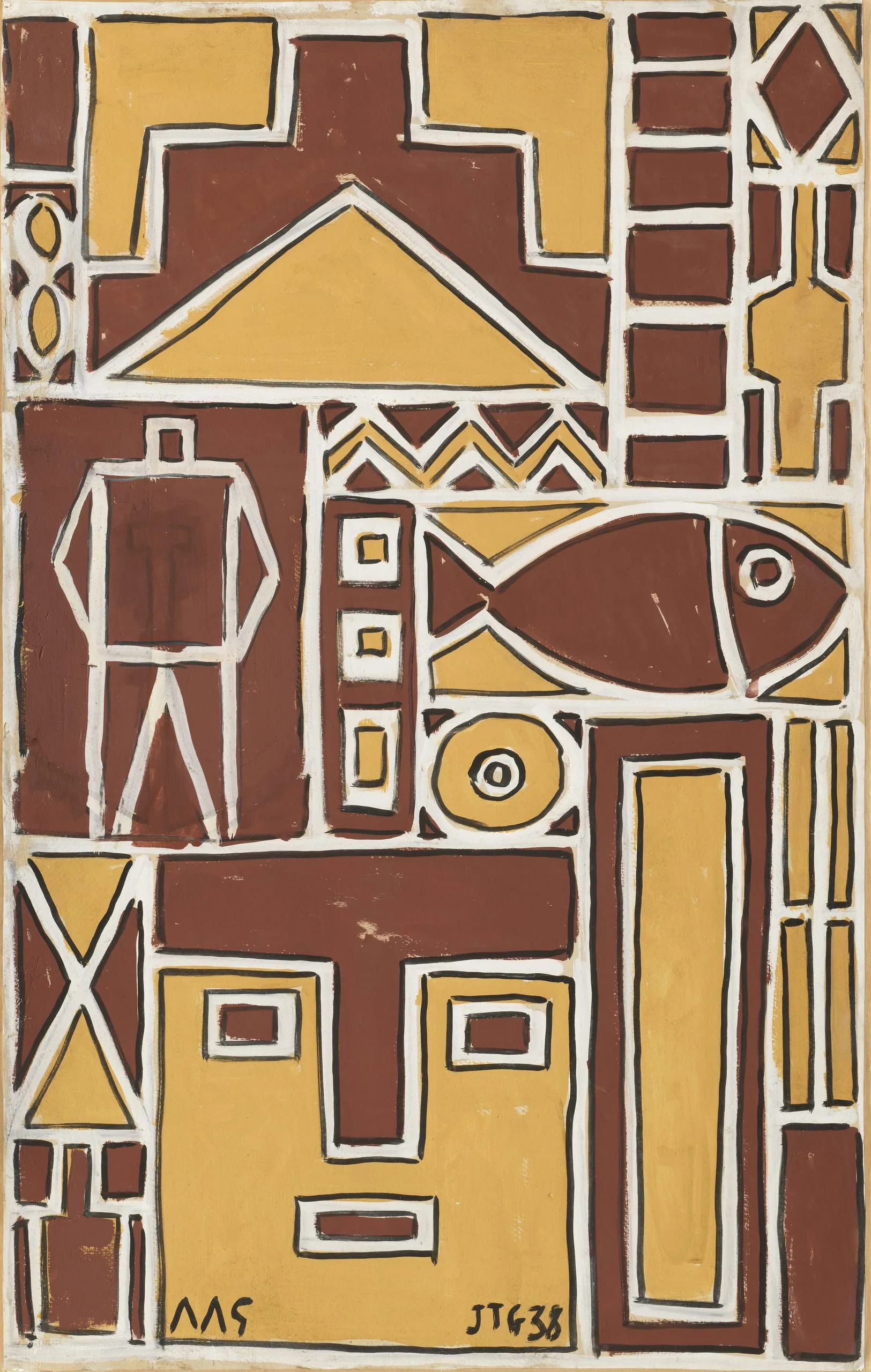
Artist, teacher, and theoretician Joaquín Torres-García invented a unique visual language that he called Universal Constructivism (Constructivismo Universal). Rendered in earth colors typical of Nasca ceramics and ancient Peruvian textiles, Construction with White Line includes symbols recurrent in Torres-García’s work: the universal man and a triangle (denoting reason and creativity), a cosmic fish (the natural world), and an Amerindian mask. The ladder on the upper right symbolizes the idea of progress across time. Throughout his career, Torres-García was fascinated by the ability of ancient cultures to synthesize complex ideas in simple forms. He adapted mathematical traditions such as the golden section or golden ratio to create gridlike structures within which he arranged different symbols to emphasize the idea of universal harmony. His symbols correspond to the three planes of life: intellectual, emotional, and physical.
Born in Uruguay, Torres-García settled in Barcelona in 1891, and much of his career developed in Europe, with a two-year interlude in New York from 1920 to 1922. In 1926, he moved to Paris, where he befriended Piet Mondrian (1872–1944) and Theo van Doesburg (1883–1931), and quickly became associated with an international group of avant-garde abstract artists. In 1929, alongside Jean Arp (1886–1966) and Wassily Kandinsky (1866–1994), he cofounded the group Cercle et Carré (Circle and Square). By 1930, he began integrating symbols into his abstract compositions.
Torres-García was a fundamental catalyst in the introduction of abstract art in South America. One of his most important contributions was to draw upon his region’s cultural legacy. “We need the local to reside in the universal,” he explained. “And with this we [will] arrive at the future art of the Americas.” When he returned to Montevideo in 1934 at the age of sixty, he encouraged young artists to formulate their own form of abstraction and promoted the integration of art and craft in everyday life. To this end, he established the Asociación de Arte Constructivo (AAC; Association of Constructive Art) in 1936, followed by the Taller Torres-García (TTG) in 1943, the historic arts-and-crafts workshop that brought together numerous artists from the Río de la Plata. The marking on the bottom of this painting indicates that it was created within the framework of the AAC.
Ilona Katzew
2024