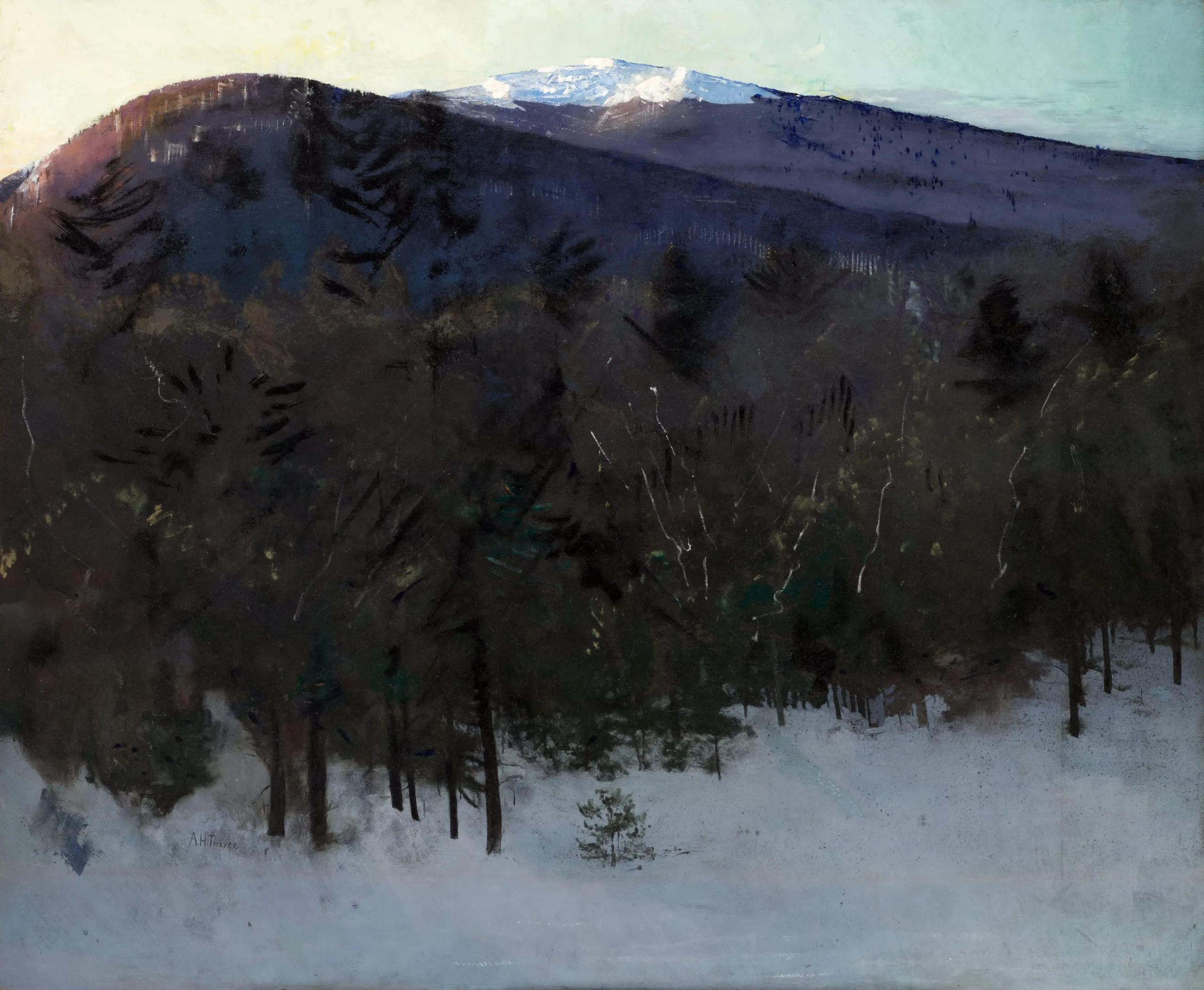
The painting, Mount Monadnock, is one of four Thayer made late in his career of the mountain near the artist’s home in New Hampshire. It represents a crucial link between modernist abstract painting and nineteenth-century landscape painting. Thayer stands at the end of a great tradition of transcendentalist landscape painting, one that begins with Thomas Cole. But he also stands as a contemporary of such figures as Marsden Hartley, Arthur Dove, and Georgia O’Keeffe, and is just as adventurous.
Trained in New York and Paris, Thayer quickly made a reputation as a portrait painter. He was a central player in the development of the Society of Artists, in which Childe Hassam, William Merritt Chase, and other European-trained artists transformed the ideals of American painting at the end of the 1870s. By the end of the century, however, Thayer moved permanently to Dublin , New Hampshire , where he concentrated on two kinds of poetic subjects: portraits of women and landscapes, particularly views of Mount Monadnock . The mountain, the subject of poems by Emerson and Thoreau and an inspiration for writers as diverse as Rudyard Kipling, Mark Twain, and Willa Cather, was already famous, one of the great spiritual sties of the American landscape.
Beginning in 1917, the artist began a monumental series of views of the subject, his last statement about his art and life. The other three are in the Metropolitan Museum of Art, Freer Art Gallery, and Princeton University Museum. With each painting, the trees in the foreground become clearer, the mountain side a richer purple. LACMA’s painting captures the moment when the tops of the pines begin to emerge from the darkness and the air has warmed slightly, so that pockets of snow shake loose to the ground. The surface of the painting is marked by a freedom and control contained within simple, large areas of tone. The variety and range of brushstrokes can be seen in the small dabs that mark the spruce trees near the mountain’s summit, the long thin white strokes of snow released from the branches of the trees, and the odd floating stroke of dark blue in the forest.
Thayer arrived at this conceptual and technical freedom by two routes. The first is immediately evident in the black brushstrokes of the nearest spruce trees: Thayer studied Chinese calligraphy and has translated and naturalized it in his painting. The other is less obvious but just as important for moving Thayer beyond the stylistic limits of his Impressionist colleagues. Thayer was an ardent student of animal camouflage, particularly birds. He was particularly interested in the way in which arbitrary markings in the plumage disrupted the contours of the body so that it faded into the background. Just as he thought of animal skin as a background picture, so he tended to think of his painting surface as something natural. These two wildly different sources are typical of the unusual routes by which American artists arrived at their own version of abstraction, distinct from the work of European avant-garde artists.
Celebrating the beauty of the American landscape, and uniting both an interest in Asian art and in natural science, Thayer’s Mount Monadnock is a splendid addition to LACMA’s diverse collections.