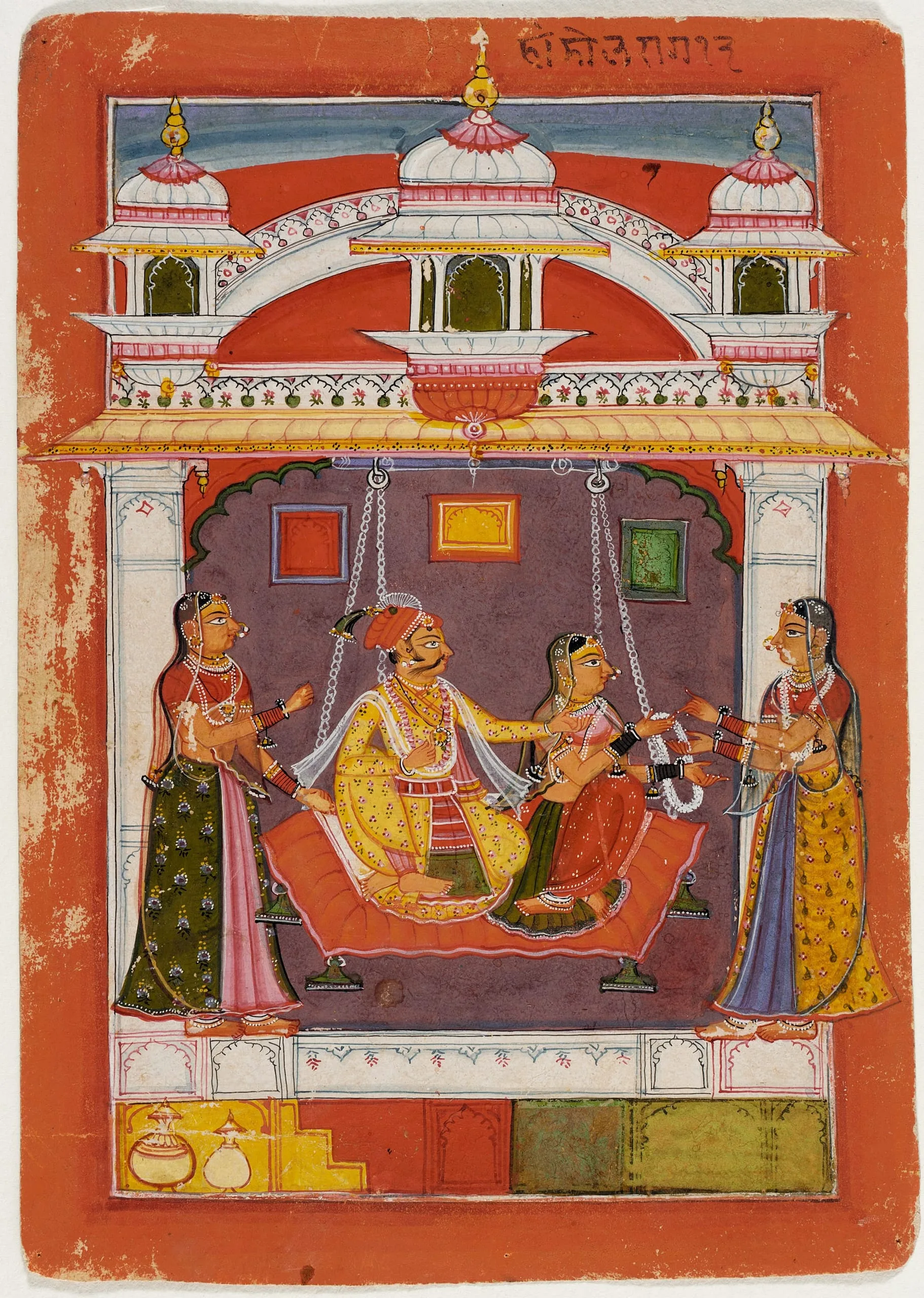
An inscription written in devanagari in the upper red border of this painting identifies it as Hindola Raga. Hindola Raga is unique insofar as it is the only musical mode represented by the same basic visual imagery regardless of the iconographic or geographic system followed. The iconography used for the raga is derived from its name, Hindola (swing), which is the predominant visual feature of the paintings. It is a morning melody associated with the rainy season, especially the Indian month of Chaitra (March-April). Accordingly, burgeoning rain clouds are often portrayed in the literary and pictorial illustrations of Hindola Raga. Besides the set motif of a swing, there are varying numbers of participants in the scene. Typically, a hero or Krishna is shown seated on the swing, usually with a heroine but sometimes alone. Present also are often musicians and attendants, mainly female, one of whom may wave a flywhisk over the protagonist(s).
Here, a mustachioed lord and his consort are seated on a swing suspended from the porch ceiling of an elaborate palace. They are receiving a floral garland from a female attendant. A second female attendant offers pan (betelnut quids) and may be pushing the swing. Dark storm clouds fill the sky.
See also M.71.1.20, and M.83.105.12.