LACMA

ShopMembershipMyLACMATickets
LACMA
Los Angeles County Museum of Art
5905 Wilshire Blvd.
Los Angeles, CA 90036
info@lacma.org
(323) 857-6000
Sign up to receive emails
Subscribe
© Museum Associates 2025

Museum Hours

Monday

11 am–6 pm

Tuesday

11 am–6 pm

Wednesday

Closed

Thursday

11 am–6 pm

Friday

11 am–8 pm

Saturday

10 am–7 pm

Sunday

10 am–7 pm


  • About LACMA
  • Jobs
  • Building LACMA
  • Host An Event
  • Unframed
  • Press
  • FAQs
  • Log in to MyLACMA
  • Privacy Policy
© Museum Associates 2025
Collections

François Balthazar Solvyns
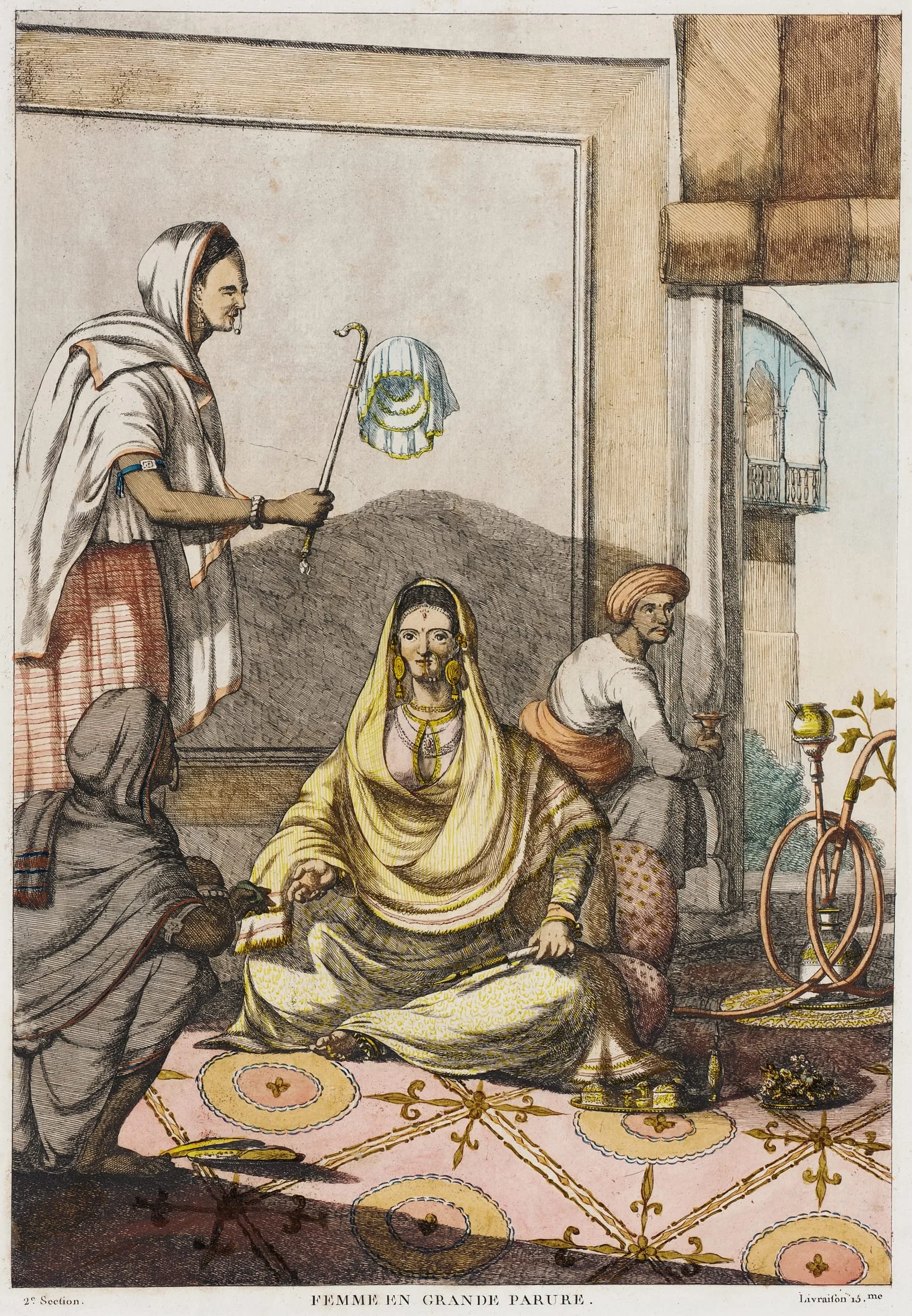
Femme en Grande Parure [Woman in Grand Attire] from Les Hindoûs1808-1812

Not on view
Hand-colored engraving of a richly jeweled woman seated cross-legged on a patterned rug, surrounded by three attendants in an ornate interior, with French text reading 'Femme en Grande Parure'
Artist or Maker
François Balthazar Solvyns
Belgium, 1760-1824
Title
Femme en Grande Parure [Woman in Grand Attire] from Les Hindoûs
Place Made
France, Paris
Date Made
1808-1812
Medium
Colored etching
Dimensions
Image: 13 5/8 x 9 3/8 in. (34.61 x 23.81 cm); Sheet: 21 7/8 x 15 3/4 in. (55.56 x 40.01 cm)
Credit Line
Gift of Aruna and Ranjit Roy
Accession Number
M.2001.210.3
Classification
Prints
Collecting Area
South and Southeast Asian Art
Curatorial Notes

François Balthazar Solvyns (1760-1824) was a Flemish marine painter and printmaker. He lived in Kolkata (Calcutta) in 1791-1803, where he made ethnographic drawings and etchings of the occupations, modes of transportation, festivals, and customs of Bengali life and society. He published some 250 etchings in A Collection of Two Hundred and Fifty Coloured Etchings: Descriptive of the Manners, Customs and Dresses of the Hindoos, printed in Calcutta in 1796. After returning to Europe in 1803, he reworked 288 of his etchings for a bilingual French/English edition, Les Hindoûs, 4 vols., which was published in Paris in 1808-1812.

In this colored etching from Les Hindoûs (Vol 2, Pl. 11), a wealthy Hindu woman dressed in her full finery with copious jewelry sits against an embroidered silk bolster in a room or verandah looking out into the garden. Her attendants fan her, offer her pan (betel-leaf quids), and tend her hookah. In the illustration’s accompanying text, Solvyns describes the woman’s seclusion and life of leisure while living in purdah (social isolation).