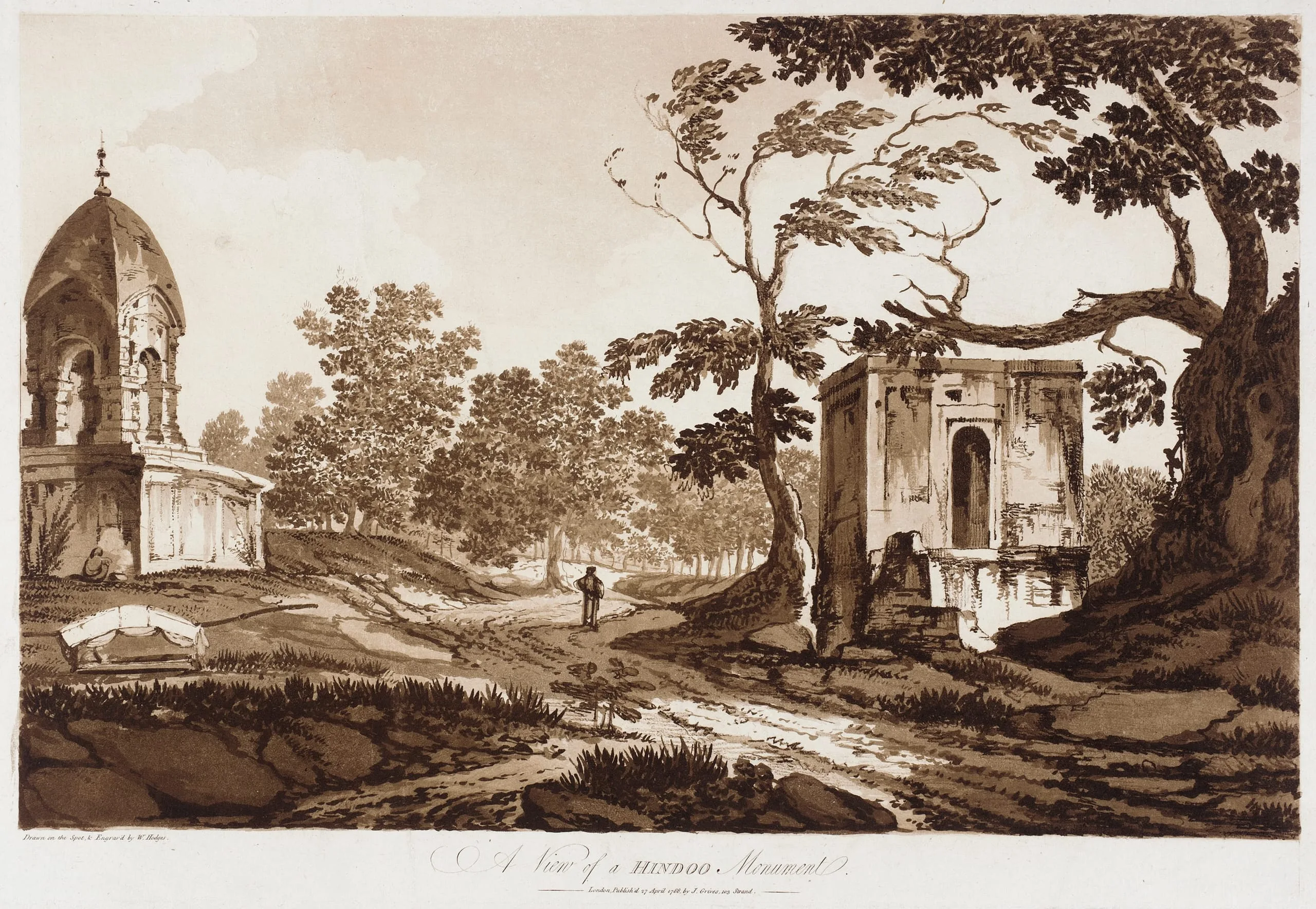
William Hodges (1744-1797) was one of the first British professional landscape and architectural artists to visit India. He traveled across much of northern India in 1779-1783, principally in West Bengal, Bihar, and Uttar Pradesh. He had previously served as the expedition artist under Captain James Cook in the Pacific Ocean in 1772-1775. Hodges was a master of atmospheric effects and specialized in drawing picturesque landscapes, monuments, and ruins. He made sketches and washes on site, which were later reproduced as aquatints and oil paintings after his return to London in 1784. Forty-eight of his engravings were published in 1785-1788 in his series, Select Views in India, drawn on the spot, in the years 1780, 1781, 1782 and 1783, and executed in aqua tinta (known as Select Views in India). The accompanying text was bilingual (English/French), and a German edition was published in 1789. Hodges later published fourteen engravings in his Travels in India during the years 1780, 1781, 1782 and 1783 (known as Travels in India) in 1793.
This sepia aquatint is Volume II, Plate 48 in Select Views in India. It depicts A View of a Hindoo Monument, near Murshidabad, West Bengal. The temple on the viewer’s left is built in a Bengali style of architecture with the sanctum and tower superstructure (rekha deula) made in the traditional form of a dome-shaped roof with drawn-down corners, which is modeled on the straw or reed roofs of rural Bengal.
See also M.2001.210.1.