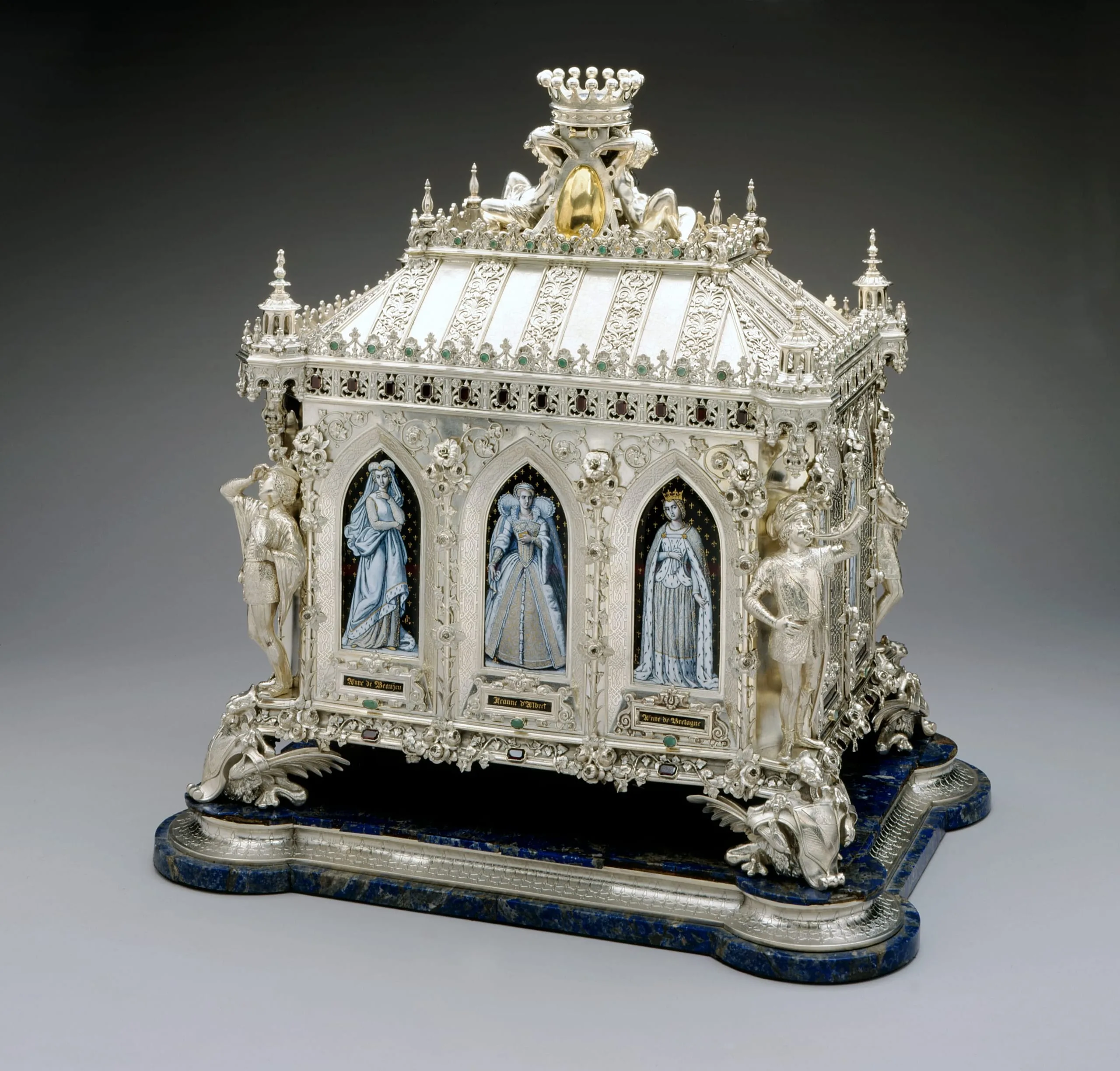
This extravagant silver jewelry casket was made by the same French firm that had created a matching dressing table, mirror, and pair of jewelry caskets a decade earlier as wedding gifts for Louise d’Artois, granddaughter of Charles X of France and future duchess of Parma. That monumental silver ensemble (Musée d’Orsay, Paris), a collaboration among France’s leading architects, sculptors, silversmiths, jewelers, and enamel artists, took six years to produce and attracted worldwide attention in 1851 at the Crystal Palace exhibition in London. It evidently also caught the eye of New York real estate developer Edward Matthews, who commissioned a copy of one of the caskets. By 1876, Matthews had lost his fortune, but the opulence of this commission reflects the wealth and social ambition of New York entrepreneurs in the years following the Civil War.
The casket’s overall design involved a collaboration between Jules Wièse, successor to Paris silversmith Froment-Meurice, and architect Félix Duban, best known today for the restoration of Sainte-Chapelle in Paris. Other artists modeled the standing figures and painted the enamel plaques in the style of sixteenth-century Limoges enamels. Framed by Gothic arches, the panels depict early queens of France, including Joan of Arc. The surrounding cast and chased silver ornament of roses and ivy, symbols of marriage and fidelity, reflect the original casket’s purpose as a royal wedding gift, complete with a crown at the top.