LACMA

ShopMembershipMyLACMATickets
LACMA
Los Angeles County Museum of Art
5905 Wilshire Blvd.
Los Angeles, CA 90036
info@lacma.org
(323) 857-6000
Sign up to receive emails
Subscribe
© Museum Associates 2025

Museum Hours

Monday

11 am–6 pm

Tuesday

11 am–6 pm

Wednesday

Closed

Thursday

11 am–6 pm

Friday

11 am–8 pm

Saturday

10 am–7 pm

Sunday

10 am–7 pm


  • About LACMA
  • Jobs
  • Building LACMA
  • Host An Event
  • Unframed
  • Press
  • FAQs
  • Log in to MyLACMA
  • Privacy Policy
© Museum Associates 2025
Collections

Unknown
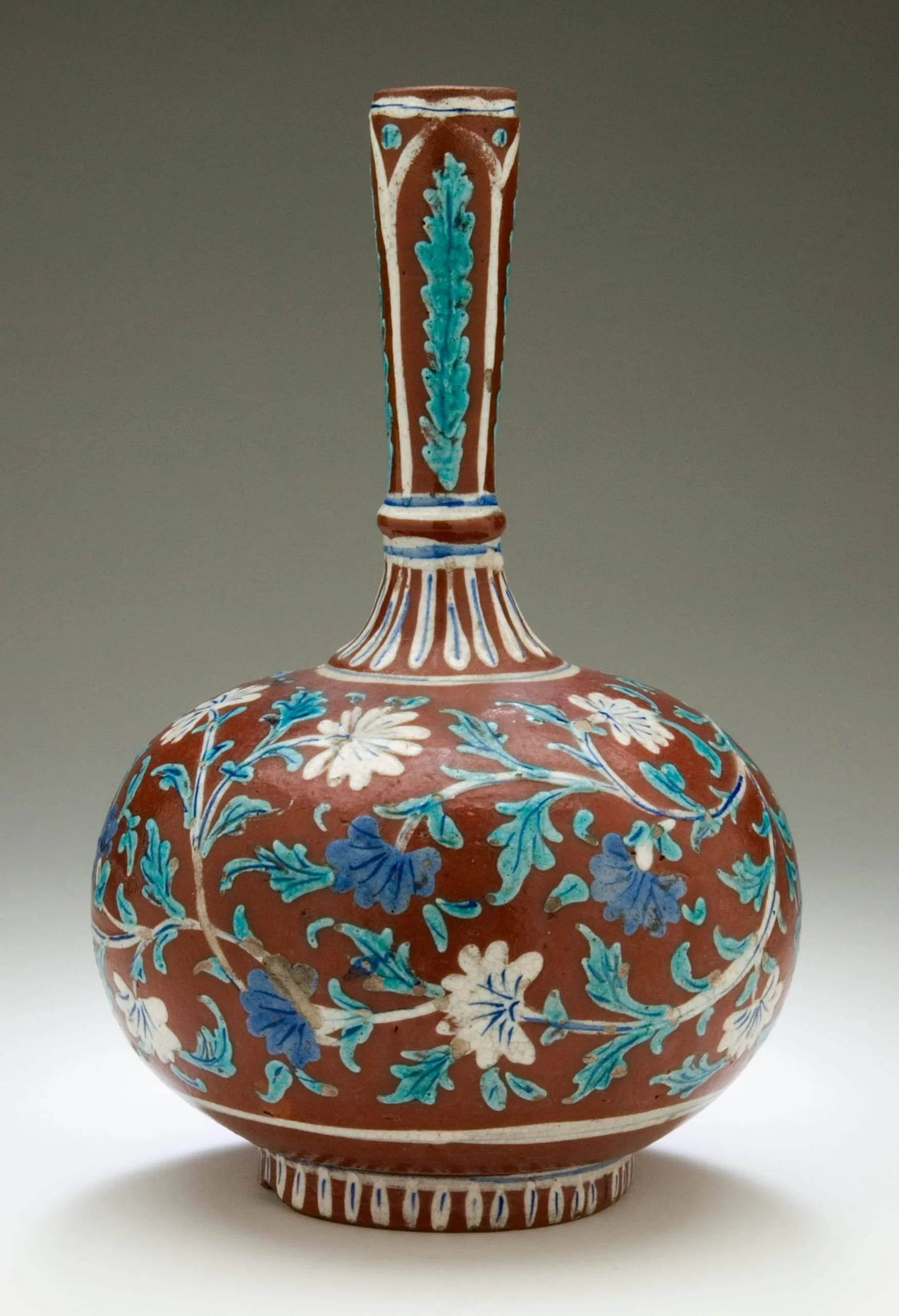
Water Vessel (surahi)circa 1890

Not on view
Ceramic bottle vase with a flattened spherical body and tall cylindrical neck, brick-red ground decorated with turquoise scrolling vines, white daisy blooms, and cobalt blue tulip-shaped flowers
Artist or Maker
Unknown
Title
Water Vessel (surahi)
Place Made
India, Maharashtra, Mumbai (Bombay)
Date Made
circa 1890
Medium
Glazed ceramic
Dimensions
Height: 8 3/8 in. (21.27 cm); Diameter: 5 3/4 in. (14.61 cm)
Credit Line
South and Southeast Asian Acquisition Fund
Accession Number
M.2002.7.2
Classification
Furnishings
Collecting Area
South and Southeast Asian Art
Curatorial Notes

This surahi (water or wine vessel) features the traditional form of a compressed spherical body supported by a circular foot and a tall, slightly flaring neck with a low collar. Glazes in several colors are used: reddish-brown for the background, and white, light blue, medium blue, and dark blue for the vessel’s primary decoration of a flowering scroll encircling the body. Laplets embellish the shoulders and foot. The neck is graced with serrated leaves in pointed arches.

The vessel is attributed to c. 1890 from the Bombay School of Art (established in 1857 as the Sir Jamsetji Jeejibhoy School of Art). Paintings and ceramics were produced by students working under the supervision of indigenous master artists and European administrators to promote Indian arts and crafts. Pottery was produced from the mid-1870s until the early 20th century. Early examples were inspired by Sindh decorative styles, but important additional models were scenes from the renowned murals of the 5th-century Ajanta caves-temples discovered by English East India Company soldiers in 1819 near Aurangabad. Here, however, the prevailing artistic sources for this vessel’s floral decoration may have been the renowned Kutch flowering scroll featured prominently but in a smaller scale on contemporaneous silver works from Kutch, Gujarat.
Selected Bibliography
  • Markel, Stephen. Mughal and Early Modern Metalware from South Asia at LACMA: An Online Scholarly Catalogue. Los Angeles: Los Angeles County Museum of Art, 2020. https://archive.org/details/mughal-metalware (accessed September 7, 2021).