- Artist or Maker
- André Masson
France, 1896-1987, active United States - Title
- The Night
- Date Made
- 1942
- Medium
- Gouache and pastel on paper
- Dimensions
- 28 1/2 × 22 1/2 × 3 in. (72.39 × 57.15 × 7.62 cm)
- Accession Number
- M.2014.35
- Curatorial Notes
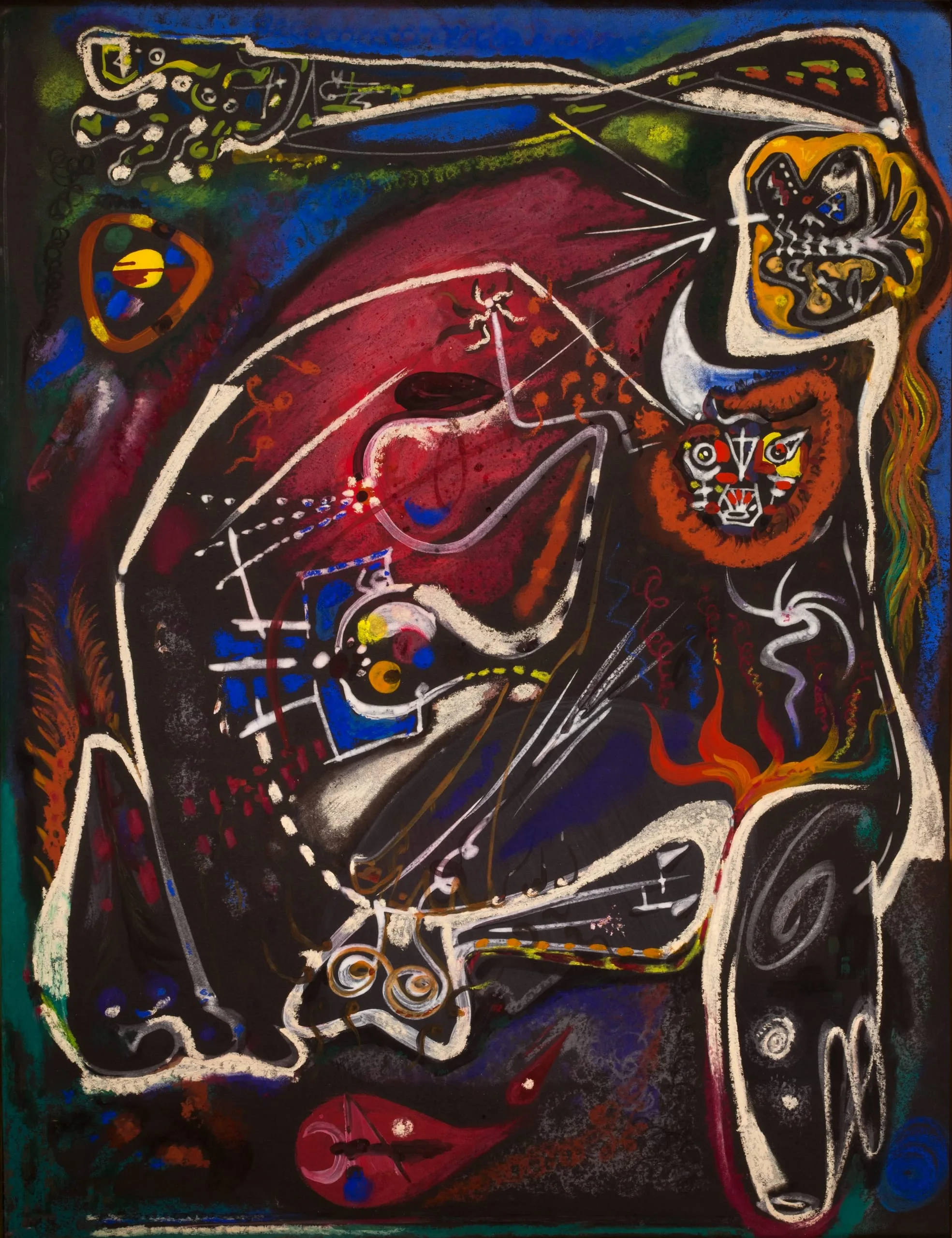
The Night invokes the ancient Greek myth of Pasiphaë and the birth of the Minotaur. When King Minos of Crete refused to sacrifice his most beautiful bull to Poseidon, a curse befell his wife Pasiphaë (depicted here on the upper right with golden hair, as befits the daughter of Helios, the Sun God), and she subsequently fell in love with this very bull. In an attempt to entice and mate with the bull, she commissioned a life-size, hollow wooden cow from Daedelus so as to entice the bull in bovine form. In the intercourse scene depicted in The Night, the bull’s unnaturally elongated head is visible on the lower right, whereas the large drop of blood beneath its testicles in the lower center contains an embryo that simultaneously resembles the male Minotaur and the female praying mantis—both important symbols of sexual cruelty in the Surrealist lexicon.
Following the Nazi invasion of France in 1940, Masson, his Jewish wife, and their children fled to the United States, settling in Connecticut until the end of the war. The Night dates to this period. Masson’s extended preoccupation with the story of Pasiphaë at that time may be interpreted as an indictment of the brutality and virulent irrationality of authoritarian regimes of his day, but it can also translate into a broader, more metaphysical inquiry around human nature and its relationship with art (designing and making things) and artifice (fantasy and deception). As evidenced by this drawing, Masson (among other Surrealists) has been considered an inspiration to the upcoming generation of Abstract Expressionists in the US
- Provenance
The artist (1896-1987). Barbara Poe Levee, Los Angeles; given in 2014 to LACMA.
- Selected Bibliography
- Jones, Leslie. Drawing Surrealism. Los Angeles: Los Angeles County Museum of Art, 2012.
- Selected Exhibition History
- Drawing Surrealism. October 21, 2012 - January 6, 2013
- Copyright
- © Estate of André Masson / Artists Rights Society (ARS), New York