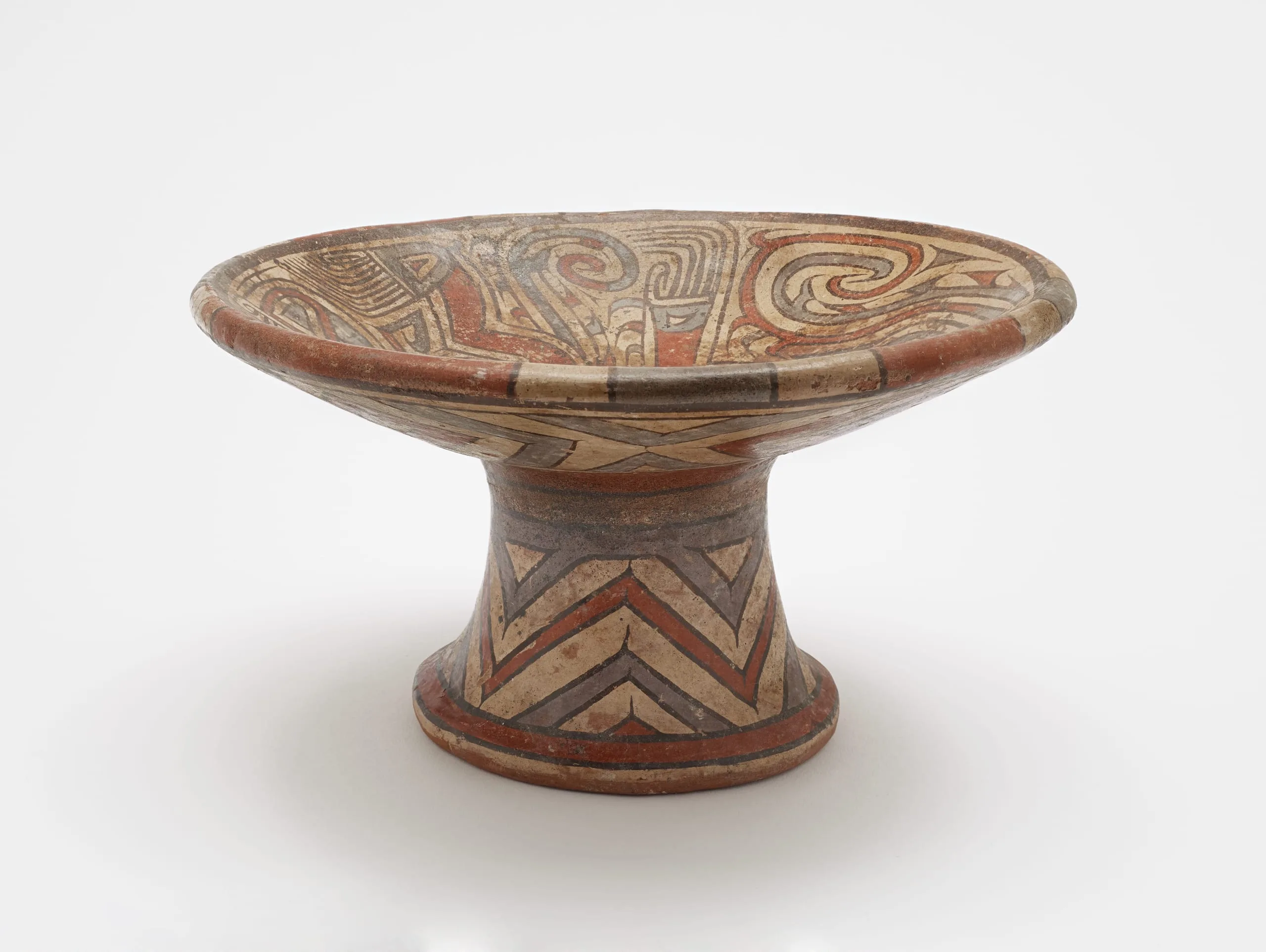
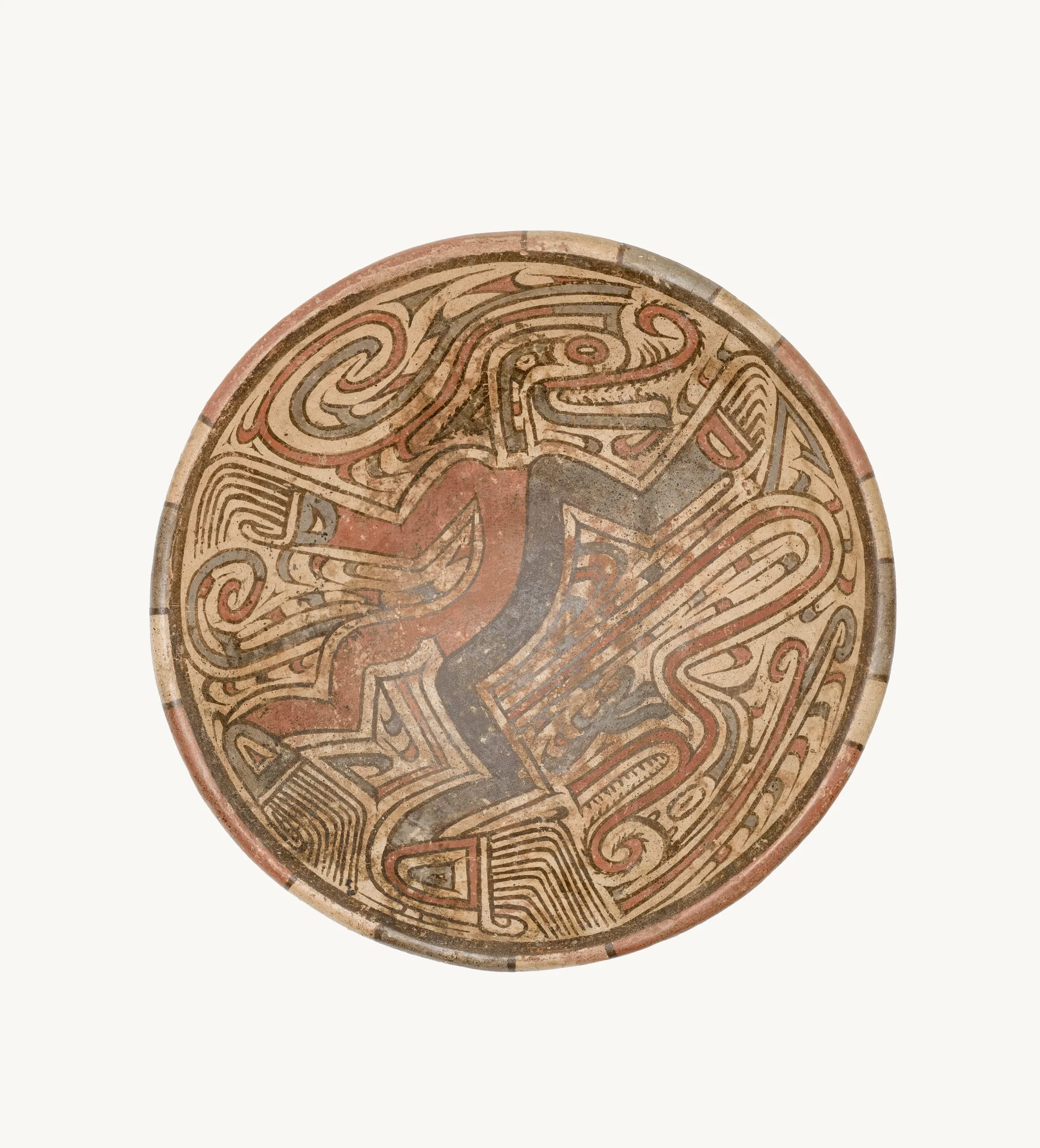
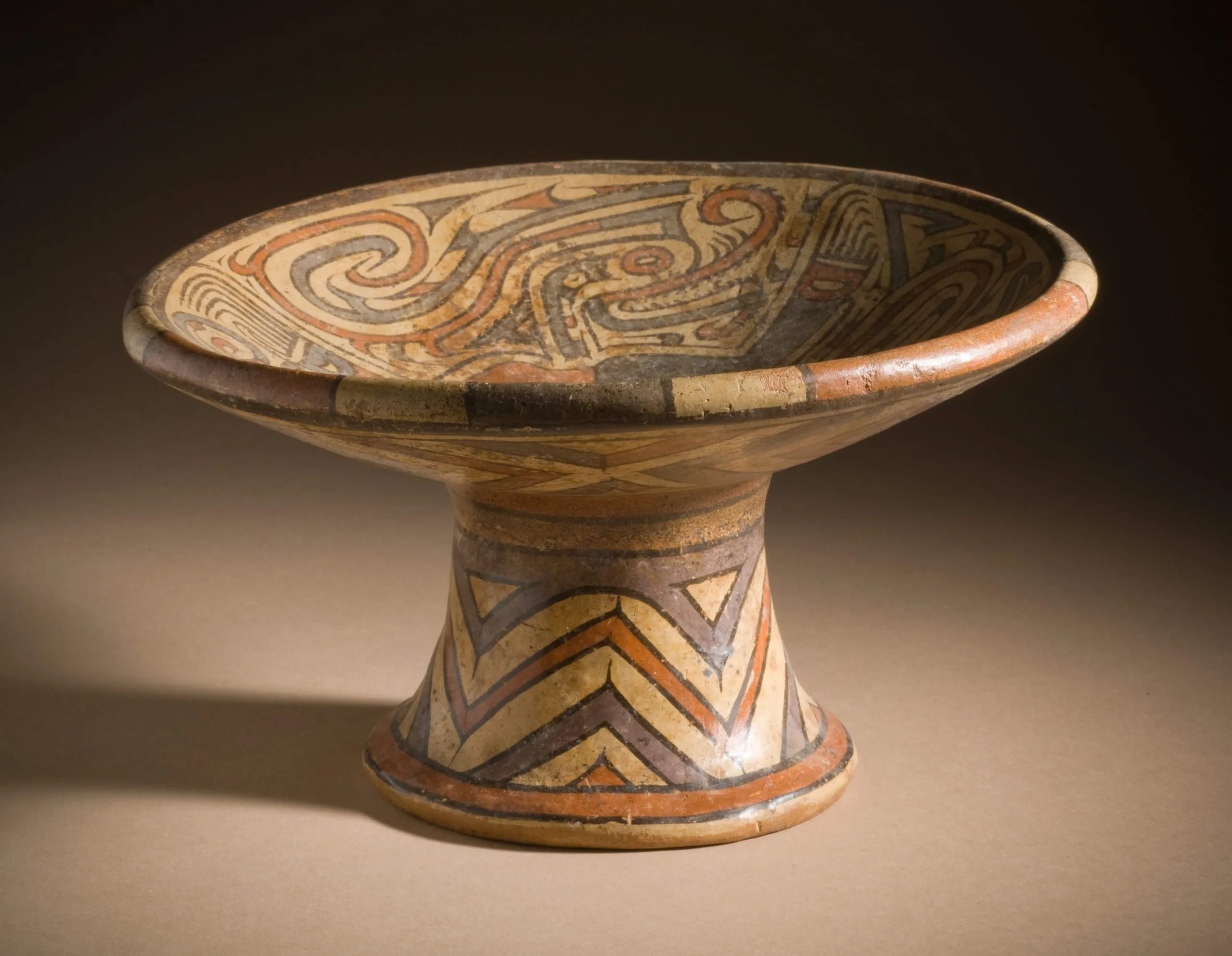
Standing a little over five inches tall, this concave plate resting on a cylindrical pedestal is decorated on the exterior with contrasting zigzag motifs that lead our gaze upward to the figural scene on the interior. The maker rendered the two figures in dynamic movement. With knees bent, arms outstretched, and head turned upward, the central figure emerges forward, while the serpentine creature’s swirling, barbed body fills the rest of the space. Outlined in black, the figures’ forms alternate between areas of red and purple, creating a sense of balance despite their chaotic entanglement.
Tall pedestal plates of this type have been found in large numbers in Panamanian burial sites. This example’s complex figural design, “coral snake” rim, and use of red, purple, black, and cream slip paints place it in the Macaracas ceramic tradition. In many double-headed designs such as this, red and purple differentiate heads or parts of the conjoined animals. Here, the dancing figure’s body is bisected with these two colors: one side is purple with red hands and feet, the other side is red with purple hands and feet.
The iconography has been variously interpreted. Like many reptilian-human depictions of this type, the second figure’s zoomorphic body stems from the hip area of the anthropomorphic figure. Some scholars have related this pattern to a ritual observed among the Ngawbere-speaking Guaymí in which men pierce their foreskins with fish spines as a form of bloodletting for the Lightning God. The zigzag patterns seen on the exterior have also been linked to lightning, as well as to fertility. Others have identified the theme as a “Shaman in Combat,” noting the shaman’s power to mediate natural elements and nurture life. (See also M.2006.170.2.)
Camille Neira
2024
Selected Bibliography
Cooke and Bray 1995; Helms 1995; Labbé 1995; Stone-Miller 2002; Cooke 2011.
Similar Objects in Other Collections
https://collections.peabody.harvard.edu/objects/details/256069?ctx=ba61d788da20f75b18a320835043a40996b38fcb&idx=216
https://collections.peabody.harvard.edu/objects/details/256112?ctx=ba61d788da20f75b18a320835043a40996b38fcb&idx=229