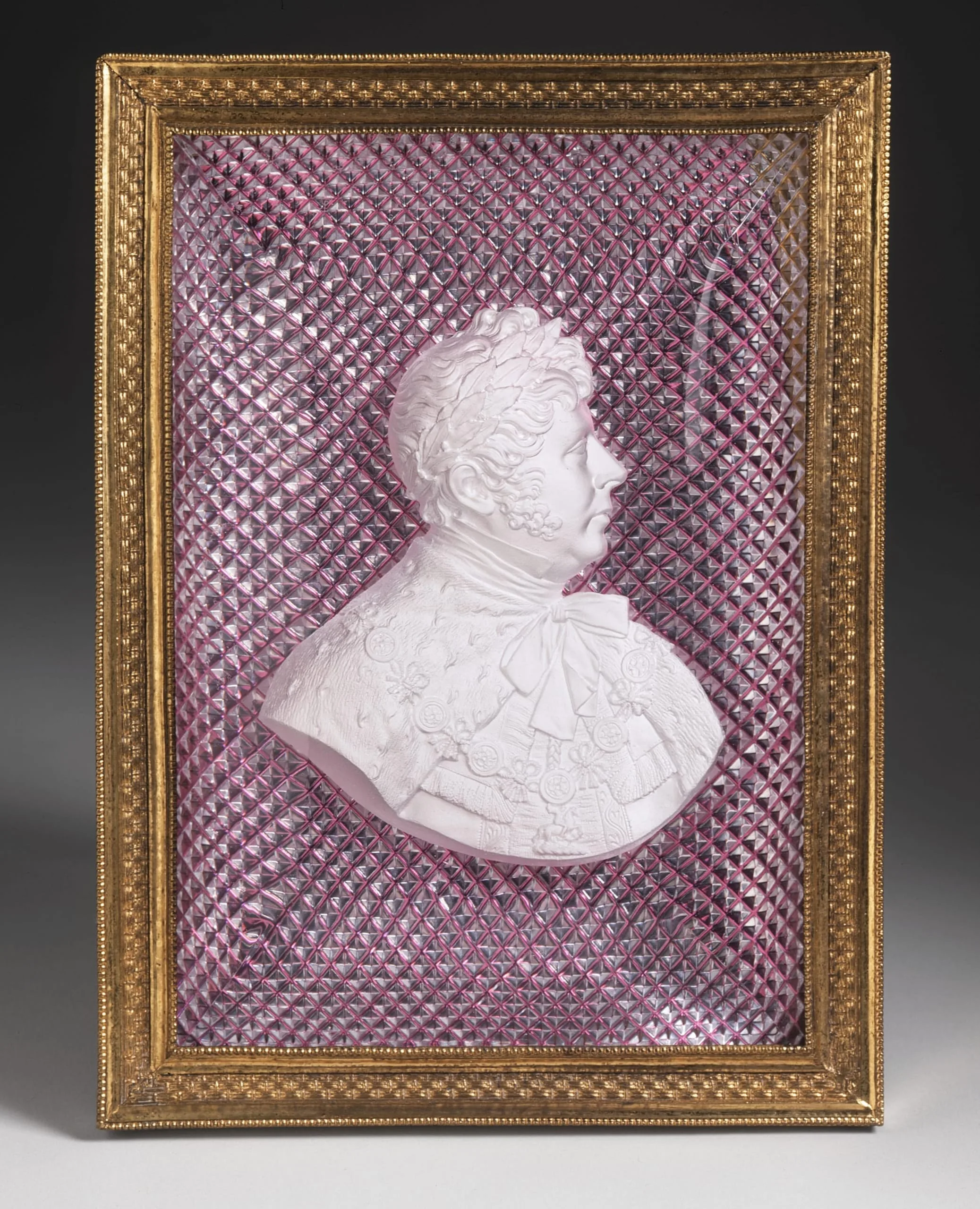
Apsley Pellatt was a second-generation glassmaker. His father, Apsley Pellatt Senior, owned the Falcon Glass House in Blackfriars, which Pellatt took over upon his father’s death in 1826. Pellatt was interested in the chemistry of glassmaking and, in 1819, patented a technique he called crystallo ceramie, also known as sulphides or cameo incrustations. The process produced silvery cameos, often portraits or coats of arms, encased in transparent glass. Pellatt used this technique, which he may have learned from French glassmakers, to decorate pendants, flasks, paperweights, and other household products. In this example, a portrait of King George IV (r. 1820–30) is surrounded by dramatic trellis cut glass and set against a pink background. The sulphide technique, also practiced in France, Bohemia, and the United States, reflected growing interest in the nineteenth century in experimenting with industrial techniques to produce decorative objects.
Cynthia Kok
2025